Round-robin vs skills-based ticket assignment: which routing method is right for your team?
Round-robin routing was built for a world where every ticket needed a human. But the AI front door now resolves the easy ones first. This article explains how routing rules are being transformed through AI and how you can do the same in your company.


A billing question lands. It doesn't enter a queue: it reaches the AI agent first, the way every conversation now does. The AI pulls the invoice through its Stripe connector, checks the charge, and issues the refund in a single step. Thirty seconds, no human, no transfer.
That's the front door now: the AI handles what it can, and only what it genuinely can't resolve moves on to a person.
So picture the bad support ticket that does move on:
- the one the AI escalates because it needs judgement, authority, or a human touch.
- Round-robin assigns it, fairly, to whoever's next in line (and online!).
- That agent handles onboarding, not this. They read it, recognise the mismatch, and pass it on.
- The second agent is mid-conversation with someone else, so it sits for eleven minutes before they pick it up.
- They ask the customer to re-explain. The customer does to a human, again, after the AI already had the full context.
- This agent can see the account but can't authorise what's needed; that requires a specialist. Third transfer.
By the time it closes, the ticket has touched three agents, crossed two queues, and taken the better part of an hour.
The resolution rate on the dashboard reads 100%. The customer's experience reads something else entirely.
This is what happens when a support operation optimises for even distribution and mistakes it for good service.
Round-robin assignment, long the most widely used ticket routing method in customer support, is built around a single goal: fairness to agents.
Everyone gets the next ticket in turn; nobody carries more than their share. It's easy to defend and even easier to set up. But it was built for a world where every ticket needed a human, and the AI front door has already removed the ones that didn't.
What reaches your agents now is, by definition, the hard stuff: the tickets that need the right person, not just the next one.
⚠️ Round-robin is the wrong instinct for exactly that ticket, and that's the case this guide makes. "fair to agents" and "right for the customer" are not the same goal. And the gap between them is where round-robin costs you and your customers.
The real choice isn't between "fair" and "unfair." It's between optimising for even distribution and optimising for the right match. This guide compares the two methods honestly: how each works, where each wins, which one (or which hybrid) your team actually needs, and where they converge in modern intent-based routing.
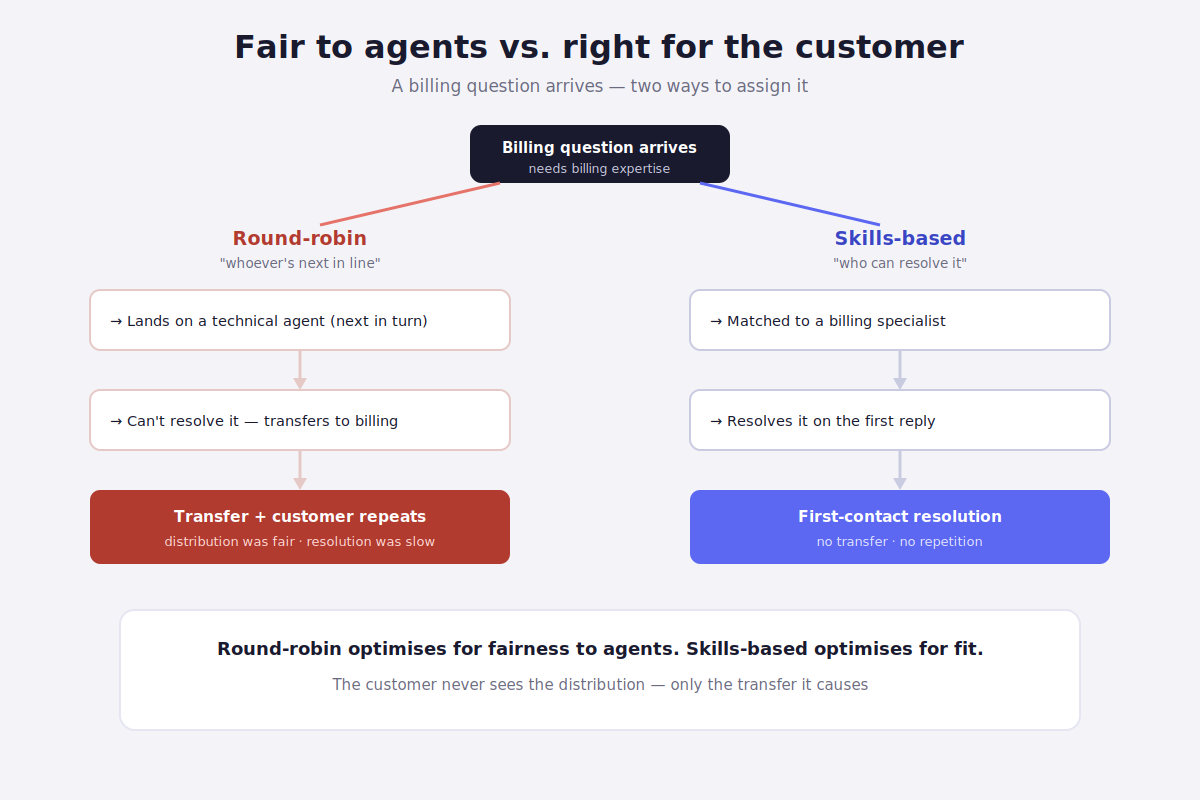
The two methods, defined
Before comparing them, it's worth being precise about what each method actually does, because the difference comes down to what they optimise for.
One thing to hold onto throughout: in the agentic era, neither method ever sees the full inbound stream. Both route the residual — the tickets the AI front door has already escalated because they need human judgement, authority, or empathy. That's what raises the stakes on getting the match right.
Round-robin assignment
Round-robin assignment distributes incoming tickets to agents in a fixed rotation — each new ticket goes to the next agent in line, regardless of the ticket's subject or the agent's expertise. Its goal is even distribution: everyone gets a roughly equal share of the volume. It's blind to content by design — it doesn't read what the ticket is about, only whose turn it is. A common variant, load-balanced round-robin, accounts for how many open conversations each agent already has, so assignment skews toward whoever's least busy — but it's still blind to skill.
Skills-based assignment
Skills-based assignment routes each ticket to an agent equipped to handle it — matching the ticket's subject, language, or complexity to an agent's defined skills. Its goal is the right match: the billing question goes to someone who knows billing, the French conversation to a French speaker. It reads (or is told) what the ticket is about and assigns on that basis, rather than on rotation.
The distinction in one line: round-robin optimises for fairness to agents; skills-based optimises for fit to the customer's need. Everything else in the comparison follows from that.
Round-robin vs skills-based: head to head
Here's how the two methods compare on the dimensions that actually matter to a support team.
The pattern is clear: round-robin wins on simplicity and agent-fairness, skills-based wins on resolution. And resolution is the dimension with the higher downstream cost because misassignment doesn't just slow one ticket — it triggers a transfer, and transfers are among the most damaging things you can do to a customer.
When to use which
Neither method is universally right — the better choice depends on your team's size and the shape of your tickets.
Round-robin is the right call when...
- Your team is small (a handful of agents) and everyone can handle most ticket types competently.
- Your tickets are fairly homogeneous — similar subjects, one language, low specialization.
- Even workload distribution is your main concern, and misrouting is rare because almost anyone can resolve almost anything.
- You're just getting started and need something simple that works today.
At small scale with generalist agents, round-robin's blindness to content barely costs you, because there's no wrong agent to land on. Its simplicity is a genuine advantage here.
Skills-based is the right call when...
- Your tickets span distinct areas — billing, technical, onboarding — that need different expertise.
- You support multiple languages, and matching language is non-negotiable.
- You have specialists whose time is wasted (and whose tickets are mishandled) when work is distributed blindly.
- You're scaling, and the cost of misrouting is climbing as the team and product grow.
Once there's a meaningful difference between agents — in skill, language, or specialization — round-robin's even distribution starts generating transfers, and skills-based routing's higher setup cost pays for itself in first-contact resolution.
Why resolution matters more than the rest
Round-robin wins on simplicity and agent fairness. Skills-based wins on resolution. And resolution is the dimension with the higher downstream cost because misassignment doesn't just slow down one ticket. It generates a transfer.
And in an AI-fronted operation, every transfer is now the transfer of an already-hard ticket — the easy ones never reached a human. The customer being bounced has already been told the AI couldn't help; a botched human handoff on top of that is the second failure they've hit on a single issue.
Transfers aren't an inconvenience. They are one of the most corrosive things you can do to a customer experience. Gartner research found that 96% of customers who have a high-effort service interaction become more disloyal, compared with just 9% of those with a low-effort experience; it names being transferred between agents and having to repeat information as defining markers of a high-effort interaction.
That single number is worth sitting with. Almost every customer who experiences the kind of interaction round-robin routing makes more likely will leave less loyal than they arrived. Round-robin's even distribution is invisible to the customer. The transfer it causes is not.
The payoff of routing it right goes just as deep. The same Gartner research found that low-effort, first-contact resolution reduces repeat calls by up to 40%, escalations by up to 50%, and channel switching by up to 54%. These are operational costs: repeat calls, unnecessary escalations, customers abandoning a channel out of frustration. Round-robin quietly accumulates them every time it sends a ticket to the wrong person in the name of fairness.
This insight isn't new. The original research behind the Customer Effort Score, published in the Harvard Business Review, drew on a study of more than 75,000 customer interactions to reach a counterintuitive conclusion: reducing the effort required to resolve an issue predicts loyalty far more reliably than delighting customers does. Customers don't leave because they weren't impressed. They leave because it was too hard to get help.
What a mismatched ticket actually costs
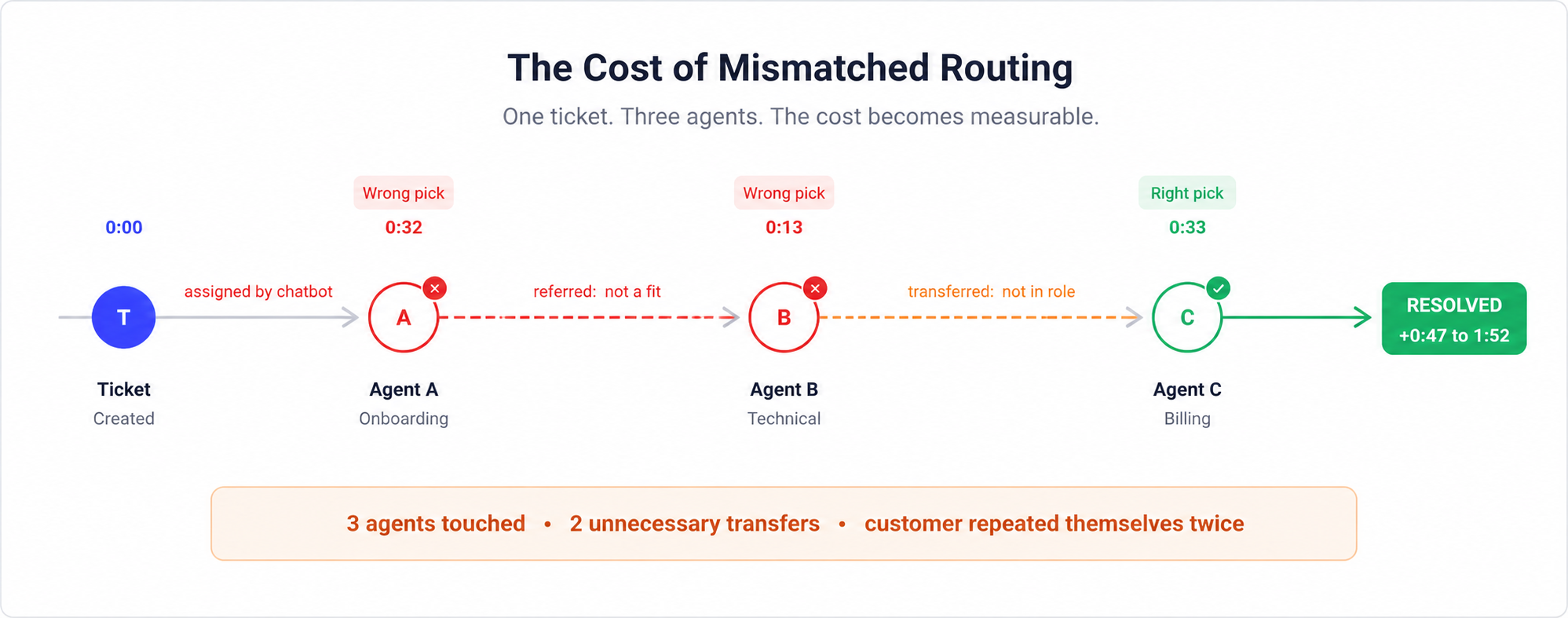
Consider what happened in the scenario at the top of this article in concrete terms.
One billing question. Three agents. Two transfers. A customer who repeated themselves twice and waited forty-plus minutes for a resolution that should have taken five. The dashboard shows a closed ticket. It doesn't show the customer who, by the time they got their answer, had already decided they'd evaluate alternatives at renewal.
Nothing about that sequence was anyone's fault. The rotation was fair. Each agent did their job correctly. But the system was optimised for even distribution, not for getting the right person to the right problem. And the customer absorbed the cost of that choice: time, friction, and the specific kind of frustration that Gartner's research ties directly to disloyalty.
This is the gap between fairness and fit in practice, not in the abstract. It's also the gap that grows every time you add ticket volume, product complexity, or language diversity to a team still running on round-robin.
Where the two converge: intent-based routing
The honest version of this comparison can't end at "skills-based wins on resolution," because skills-based routing has a real cost the table above doesn't hide: someone has to read each ticket and tag it correctly before routing can happen, and someone has to keep the skill taxonomy current as the product and team evolve. At low volume, that's a manageable chore. At high volume, it becomes a bottleneck: the very kind of manual overhead round-robin was built to avoid.
Intent-based routing is the answer to that trade-off — and in an AI-fronted operation, it isn't a separate system you bolt on. It's the same classification the AI already performed when it decided this ticket was beyond it. The AI read the conversation, determined it couldn't resolve it, and knows why: billing authority, a language it couldn't handle confidently, a judgement call. That "why" is the routing signal. Skills-based routing's old cost — a human reading and tagging each ticket — disappears, because the escalation already carries the intent.
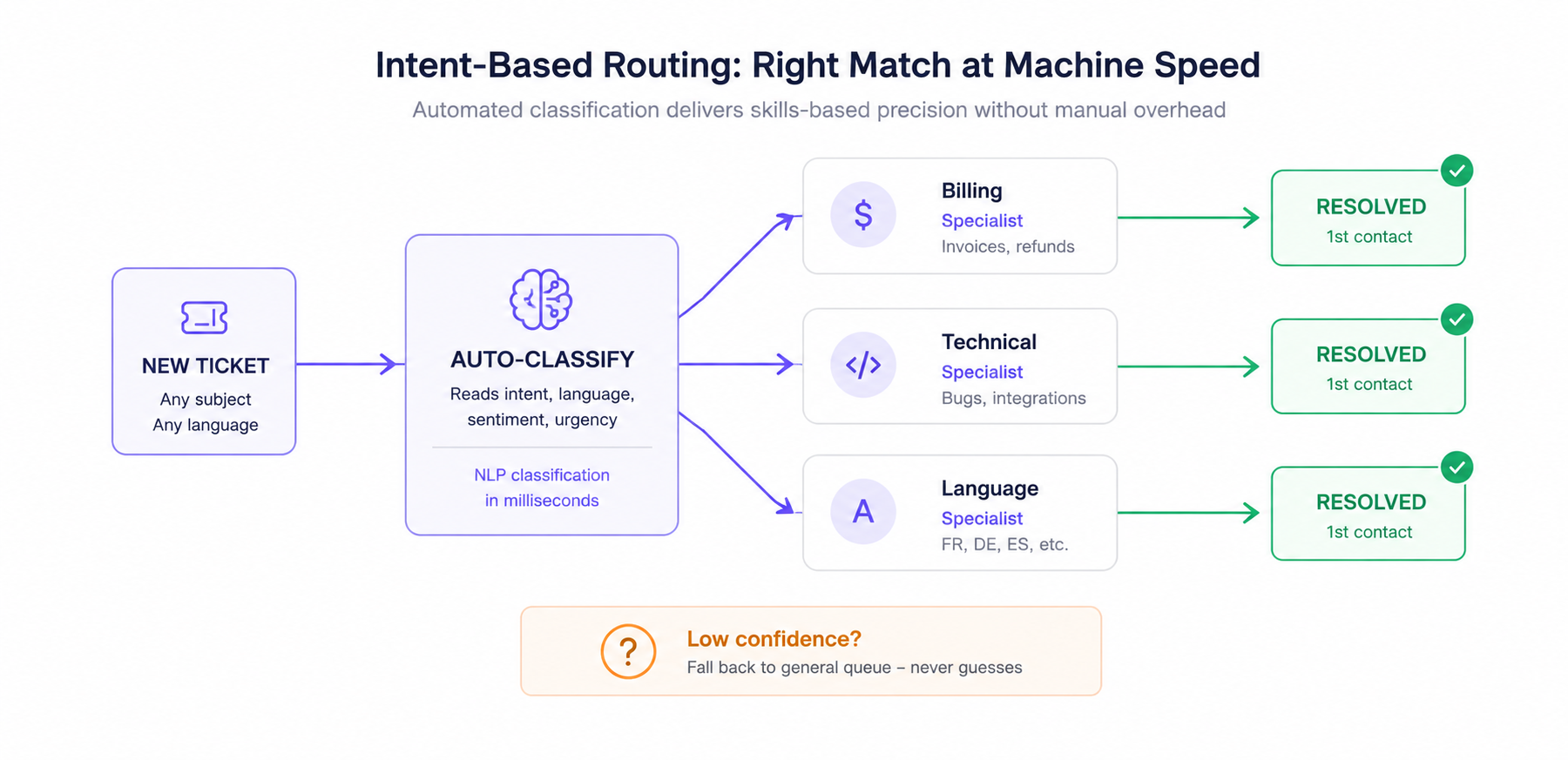
Think of it like this: if round-robin is a deli counter's take-a-number system (fair, but blind to what you need), and skills-based routing is an ER triage nurse directing each patient to the right specialist (matched to need, but reliant on a trained person reading each case), then intent-based routing is an airport kiosk that scans your passport and routes you to the right lane before you've said a word. In the agentic era, the kiosk and the front door are the same system — it scans you on the way in and only routes the cases it can't clear itself.
In practice, intent-based routing typically includes two additional refinements:
Load-balancing within the matched group. Once the system narrows candidates to "agents who can handle billing questions," it can still rotate or balance load among that subset, so fairness is preserved, scoped to the people actually qualified for the ticket.
Confidence-based fallback. When the classifier isn't confident about a ticket's intent, the system routes it to a general queue or round-robin fallback rather than guessing. Round-robin remains in the picture: a safety net, not a default.
How Crisp handles assignment
Crisp supports the full range rather than locking you into one method. You can distribute conversations by round-robin when simple even distribution is what you need, route by skill, team, or language when fit matters, and balance by workload so no agent is overloaded within their pool.
In practice, Hugo AI handles the front door, reading every incoming conversation, resolving what it can, and escalating the rest with the intent already classified. From there, Crisp applies the routing logic you define: skills or language when fit matters, workload balancing so no agent is overloaded, round-robin where simple distribution is enough. The right method (or combination) is applied without a manager triaging by hand.
The result is that you choose the routing logic; Crisp executes it consistently at any volume.
Round-robin isn't wrong, it's right for a small team with generalist agents and homogeneous tickets, where its simplicity is a real asset. But the moment your tickets need different expertise, "fair to agents" stops being "right for the customer," and skills-based routing's higher first-contact resolution starts paying for its setup cost.
The honest answer for most growing teams is the hybrid:
- skill first, workload second
- Moving toward intent-based routing as volume climbs.
Choose the method that matches where your team is now, and make sure your tooling lets you change it as you grow.
Ready to route every conversation to the right agent?
Frequently asked questions
Can a small support team benefit from skills-based routing?
In most cases, no. Or not yet. For small teams where agents handle a similar range of tickets, the overhead of building and maintaining a skill taxonomy outweighs the benefit. Round-robin (ideally load-balanced) is the better default until the team reaches a size and specialisation level where mismatches are a measurable problem.
What happens when no agent with the matching skill is available?
Every implementation needs an explicit fallback: either round-robin among a broader agent pool, or a dedicated general queue with an SLA attached. Without a fallback, the ticket stalls, which is worse than any routing method.
How does intent-based routing relate to skills-based routing?
Skills-based routing requires a human to read and classify each ticket before it can be assigned to the right agent. Intent-based routing automates that classification step, using NLP to read the ticket the moment it arrives and route it accordingly. It delivers the precision of skills-based assignment at the speed of round-robin.
What metrics should I track to evaluate whether my routing method is working?
First-contact resolution rate (FCR), transfer rate by ticket type, and average handle time are the three most diagnostic. If FCR is significantly below the industry benchmark of around 70% and your transfer rate is high, that's a signal your routing is generating mismatches. Note that in an AI-fronted setup, your human-side FCR is measured on a harder residual — benchmark against your own pre-AI baseline rather than the generic ~70%.
Is it possible to run round-robin and skills-based routing at the same time?
Yes, and this is how most scaling teams operate in practice. Skills-based rules handle the ticket categories where expertise matters most: technical issues, billing disputes, non-English conversations. Round-robin catches everything else as a fallback.
Sources
Gartner, Unveiling the New and Improved Customer Effort Score, https://www.gartner.com/smarterwithgartner/unveiling-the-new-and-improved-customer-effort-score
Harvard Business Review, Stop Trying to Delight Your Customers, https://hbr.org/2010/07/stop-trying-to-delight-your-customers
McKinsey & Company, Building Trust: How Customer Care Leaders Pull Ahead with AI, https://www.mckinsey.com/capabilities/operations/our-insights/building-trust-how-customer-care-leaders-pull-ahead-with-ai
McKinsey & Company, Deploying Gen AI for Service Operations, https://www.mckinsey.com/capabilities/operations/our-insights/from-promising-to-productive-real-results-from-gen-ai-in-services
Salesforce Research, State of Service Report, Seventh Edition, https://www.salesforce.com/resources/research-reports/state-of-service/
📚 Related articles
Automated ticket routing: how to get every conversation to the right agent · How to set up automated ticket routing rules that actually work · Team workload management for support: how to balance the queue without burning anyone out

September 2026 - Product Update
Discover the new Knowledge Base editor, benchmark your AI support performance, track how often Hugo escalates conversations, and more. Discover the latest features and improvements released by the Crisp team in September 2026.


Summer 2026 - Product Update
Meet the refreshed Crisp experience, Understand how Artificial Intelligence handles every conversation, Build reusable teams across your workspace, and more. Discover the latest features and improvements released by the Crisp team in Summer 2026.

Best 9 helpdesk software and ticketing systems for 2026
Need help to choose your next helpdesk with a ticketing tool for 2026? We've gathered a guide that gives you everything you need to convince your C-levels.