Single customer view: how to unify scattered data into one support-ready record
Customer data lives in five tools, and none of them sit where the reply happens. Here is how to build a single customer view that your AI agent and your team can both use the second a conversation opens.


A doctor who treats a patient without reading their chart isn't being careless, he is being set up to fail. he'll ask questions the patient has already answered, miss the history that explains the symptom in front of them, and prescribe something that conflicts with what came before: no amount of skill compensates for not having the record.
Today, the first "clinician" a customer meets usually isn't a person, it's an AI agent that deals with the front desk, handles the first point of contact, before a human ever sees the conversation. If the AI answering that first message doesn't have the context, the customer starts the relationship the same way that an under-informed doctor starts a consultation: from zero, with a machine that has no idea what came before.
A unified customer view is the chart tha doctor need, it's what lets the AI agent resolve a case correctly on the first reply instead of guessing, and what lets the human agent who inherits an escalation pick up exactly where the AI left off instead of starting over. Getting that record in front of whoever, or whatever, is replying, at the exact moment of reply, is what separates a response that resolves from one that asks the customer to explain themselves all over again.
Single customer view, a definition
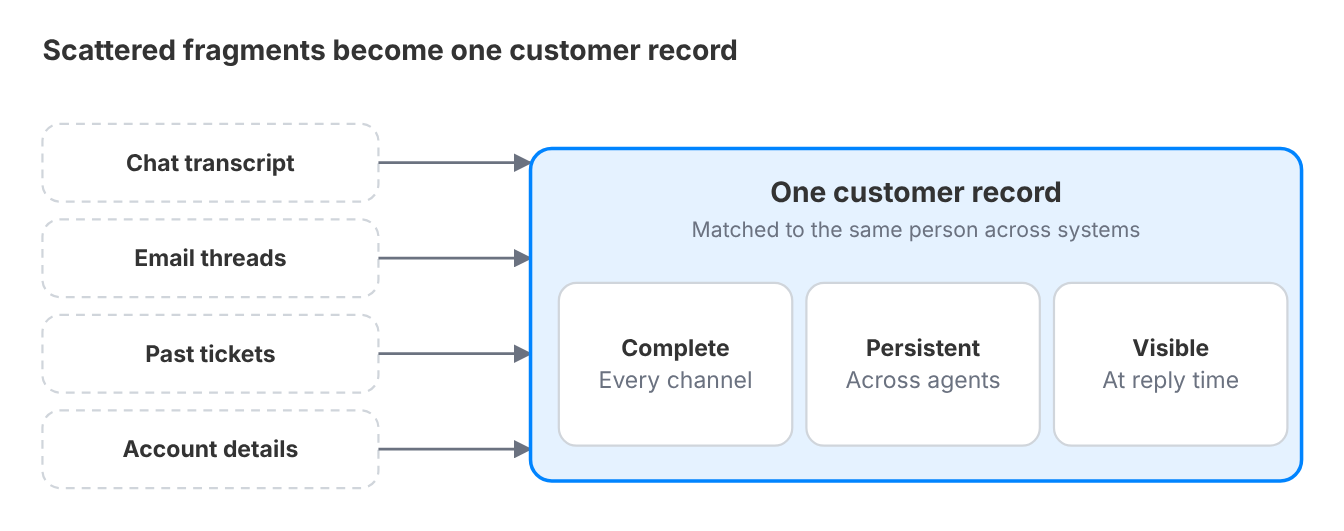
A single customer view (SCV) is one consolidated record of a customer that brings together every interaction, conversation, and relevant attribute, across every channel and over time, into a single place.
Instead of a customer existing as scattered fragments, a chat here, an email thread there, a past ticket in another tool, they exist as one coherent record.
The word doing the work is "single", most support teams already have all the data, it's just fragmented: the chat transcript lives in the chat tool, the emails in the inbox, the past tickets in the helpdesk, the account details in the CRM. Each piece exists but none of it is assembled. Building a single customer view is the act of assembling it into one record, matching the same person across systems so the chat, the emails, the tickets, and the account all resolve to one customer rather than four disconnected traces.
The benefit of a single customer view in support is operational, not analytical: it exists to make every reply context-aware, so no customer has to re-explain what your team already knows.
Creating a single customer view comes down to three properties:
- completeness (every channel and past interaction in one record),
- persistence (it stays attached to the customer across agents and time),
- visibility at the point of reply (the agent sees it without leaving the conversation).
The first two build the record, the third is what turns it into a unified view your agents actually use.
Single customer view vs unified customer view
These two terms get used almost interchangeably, but the distinction is the difference between having the data and actually using it, and it's the difference that decides whether your AI agent resolves cases well or badly.
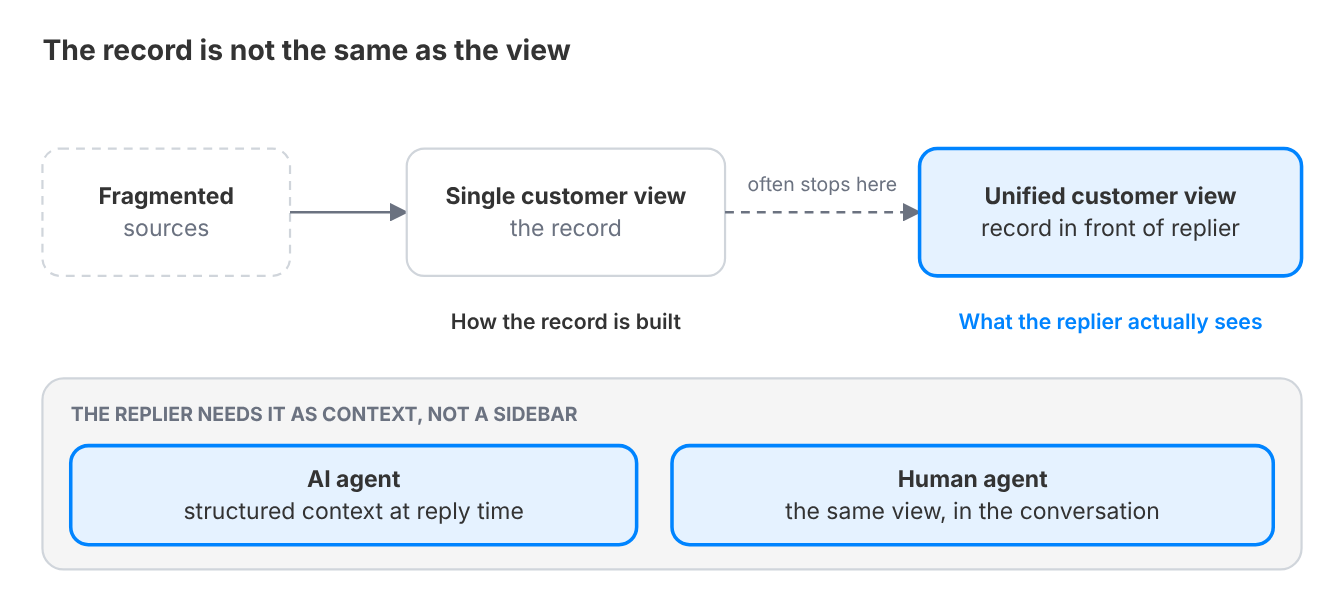
The single customer view is the record: the data-side achievement of consolidating every fragmented source into one consistent profile of the customer. You can build a genuinely excellent single customer view and still have an AI agent that answers blind, because the record exists somewhere the AI was never connected to.
The unified customer view is the application: that record made visible, in real time, to whoever is generating the reply is the piece that actually changes outcomes, and it's also where the AI agent has to be treated as a first-class citizen rather than an afterthought.
Most teams that build a single customer view build it with a human agent's screen in mind: a sidebar, a CRM tab, something a person clicks into. An AI agent doesn't click into a sidebar. It needs the same information delivered as structured, machine-readable context at inference time, or it might as well not exist.
If the AI agent is the one meeting the customer first, and increasingly it is, then the unified view has to be built around what the AI can actually consume, not retrofitted onto it after the human-facing version already shipped.
Put simply: the single customer view is how the record is built; the unified customer view is what's actually in front of whoever, or whatever, is replying. You need the first to get the second, but having the first doesn't guarantee the second, and for an AI agent specifically, "the data exists somewhere" and "the data is available to me right now" are two completely different states.
There's also a third sense of the term worth naming, because it's where most search results land. In marketing and analytics circles, "single customer view" (or "Customer 360") means a data-warehouse achievement built for segmentation, targeting, and reporting: analyzing the customer in aggregate. That's legitimate, but it's a different goal from the support one. The support single customer view exists to make this customer's history available to whoever answers them next. The marketing one exists to model customers in bulk. Same words, different scoreboard.
| Single customer view | Unified customer view | |
|---|---|---|
| What it is | The consolidated data record | That record, visible at the point of reply |
| Primary discipline | Data / architecture | Support operations |
| Measured by | Completeness & accuracy of the record | Whether the agent sees it before replying |
| Lives in | CDP, CRM, data warehouse | The agent's conversation view |
| Fails when | Records don't match across systems | The record exists but isn't on screen |
Why data centralization matters more once AI is the first responder
An AI agent is only as good as what it can see: if customer data lives in four different tools and the AI can query one of them, it will confidently answer from a quarter of the picture, missing the refund promised in a different channel, the plan change from last month, the third recurrence of the same bug.
Centralizing that data isn't a nice-to-have for reporting, it's the difference between an AI agent that resolves correctly and one that's fluent but wrong in ways that are hard to trace back to a cause. It also matters because the volume is only going one direction: Statista's tracking shows a fast-rising share of customer-facing teams now routing direct customer interactions through AI agents, which means whatever context those agents lack gets multiplied across every one of those conversations, not just a few.
Why it matters for support teams
The cost of replying without that context doesn't land on whoever, or whatever, is answering, it lands on the customer, as effort. When the reply comes without the history, the customer has to supply it themselves: re-explaining the issue, re-establishing what was already promised, repeating themselves to a system that, from their perspective, should already know.
Customer effort is one of the most reliable predictors of disloyalty in all of support research, a finding that traces back to the original Harvard Business Review study that introduced the Customer Effort Score.
Gartner found that 96% of customers who have a high-effort service interaction become more disloyal, against just 9% after a low-effort one, and it names having to repeat information and being transferred between agents as defining features of a high-effort experience.
A reply sent without the full view, AI-generated or human-typed, is structurally a high-effort experience waiting to happen, and it's part of why Forrester's most recent Customer Experience Index found the gap between the experience brands intend to deliver and what customers actually get is widening, not closing.
The upside is just as concrete, when the reply is informed by the whole picture, it resolves the issue in one go instead of opening another round of back-and-forth, and first-contact resolution pays back across the board.
Gartner found that low-effort, first-contact resolution reduces repeat calls by up to 40%, escalations by 50%, and channel switching by 54%.
The unified view is upstream of every one of those numbers: nothing, AI or human, can resolve on first contact what it can't see.
How a unified view changes the support experience
The value of a unified customer view for customer support isn't abstract. It shows up as concrete differences in how the reply gets written, starting with the AI agent, since it's the one meeting the customer first, and carrying through to the human agent who steps in when a case escalates.
Here's how it impacts the ticket resolution journey at each stage:
It lets the AI agent resolve, not just respond, on message one
- The principle: AI is now the first point of contact for most conversations, so it's also the first place a fragmented view fails. Gartner predicts agentic AI will autonomously resolve 80% of common customer service issues by 2029. Every one of those resolutions runs on whatever context the agent can see. Give it what a senior agent would have, and it resolves like one.
- Example: A customer asks why they were charged twice this month. A context-blind AI explains the billing cycle and hands off.
Pro tips: Pull 5 recent conversations Hugo handled and check whether each reply used the customer's plan or history. If none did, connect the data source before you scale automation: context-blind automation just sends the blind reply faster.
It extends the same context the moment a case escalates to a human
- The principle: Since the AI is the first point of contact, the human agent is now, by default, the escalation layer. What determines whether that handoff feels seamless or like starting over is whether the same unified view that served the AI also travels with the case to the human: the context can't reset just because a person picked it up.
- Example: Hugo AI attempts a refund, can't fully resolve it, and escalates. The human agent who receives it should see everything the AI saw, plus what the AI already tried, not just the customer's latest message.
Quick win: Pull a sample of recent AI-to-human escalations and check whether the human agent's opening reply references what the AI already tried. If it doesn't, your escalation path is dropping context.
It removes the "can you remind me?" opening
- The principle: When the history is available at the point of reply, whoever is answering, AI first, human on escalation, never has to ask the customer to re-establish what's already known. The reply starts from the current state of the relationship, not from zero.
- Example: A customer writes "still not working." With a unified view, the reply, AI or human, reflects the ticket from last week and the fix that was promised, not "could you describe the issue?"
Quick win: Count how often a reply, AI-generated or human-written, opens by asking for information the customer has given before. Every instance is a unified-view gap.
It lets an escalation honor what was already promised
- The principle: Commitments made earlier, by the AI agent or by a teammate, stay visible, so a human agent picking up an escalation doesn't contradict the AI or drop a promise the customer is still waiting on.
- Example: Hugo AI promised a refund last Tuesday and the case escalated before it closed out. With the history in view, the human agent confirms and completes it rather than treating it as a fresh request.
Quick win: Audit a handful of AI-to-human escalations for contradicted or dropped promises. They're a direct symptom of fragmented context between the two layers.
It surfaces the pattern behind the message
- The principle: A single message is just a data point. The history reveals whether this is a one-off or the fourth time, and that pattern should change the response, and the tone, whether it's the AI answering or a human who's inherited the case.
- Example: "It's broken again" reads very differently when the AI, or the human agent it escalates to, can see it's the third recurrence this month.
Quick win: Flag your top repeat-contact customers and check whether your AI recognizes that recurrence, not just your human agents. If it doesn't, the view isn't unified where it matters most.
Seeing the whole customer data in Crisp
In Crisp, the unified customer view is built into where the reply actually happens, AI first, human on escalation.
The support CRM centralizes each customer's full history and attributes into a persistent profile, so the context follows the person across the AI, across agents, and over time, rather than living in whoever or whatever handled the last message.
The Shared Inbox consolidates every channel, chat, email, social, into one conversation view, so there's no separate tool to open and nothing left for anyone, AI or human, to go digging for.
Hugo AI draws on that same centralized context as the first responder, and because it sits alongside the live conversation rather than behind a search step, the data is there at the exact point of reply, not three clicks and a query away. When a case escalates, the human agent inherits the same view, not a blank one.
Frequently asked questions
When should a company set up a single customer view?
The earlier, the better, but the trigger that usually forces the decision is when fragmentation becomes visible in complaints: customers repeating themselves, promises getting dropped between agents, an AI agent confidently giving wrong answers. If support runs across more than two channels, or an AI agent has started handling first-line replies, the cost of not having one is already showing up in resolution times and repeat contacts, even if no one has named it yet.
Does a single customer support view replace the need for a CRM?
No. A CRM is often one of the sources feeding the single customer view, alongside the helpdesk, the chat tool, and the AI agent's own conversation logs. The single customer view for customer support is the assembled result across all of those sources, not a replacement for any one of them.
How is a unified customer view different for an AI agent versus a human agent?
A human agent can work with a sidebar, a CRM tab, a scrollable history; a person can piece context together manually if the interface makes it available. An AI agent needs the same information delivered as structured, machine-readable context at the moment it generates a reply, not a screen it has to read. Building the AI-facing version generally means treating context delivery as an input to the model, not a UI feature.
What happens if only human agents have a unified view and the AI agent doesn't?
The AI agent answers in isolation, misses history a human colleague would have caught, and either resolves incorrectly or escalates a case that a human still has to fully re-diagnose. Since AI is now handling a large and growing share of first contacts, this is usually where the biggest resolution-quality gap shows up first, not on the human side.
Is centralizing customer data enough on its own?
No. Centralized data that has to be searched or queried mid-conversation isn't meaningfully different from fragmented data, because an AI agent under latency pressure won't always reach the right source or surface the right detail. The data has to be available at the point of reply, already assembled, for both the AI agent and the human agent who might inherit the case next.
How do I know if my current setup is fragmented?
Check whether a reply, AI or human, ever opens by asking the customer for information they've already given, whether escalations reference what the AI already tried, and whether repeat-contact customers get recognized as repeat contacts at reply time. If any of those checks fail regularly, the view isn't unified yet, whatever the data layer looks like underneath.
Sources
- Harvard Business Review, Stop Trying to Delight Your Customers, https://hbr.org/2010/07/stop-trying-to-delight-your-customers
- Gartner, The Effortless Experience, https://www.gartner.com/en/customer-service-support/insights/effortless-experience
- Gartner, Unveiling the New and Improved Customer Effort Score, https://www.gartner.com/smarterwithgartner/unveiling-the-new-and-improved-customer-effort-score
- Gartner, Gartner Predicts Agentic AI Will Autonomously Resolve 80% of Common Customer Service Issues Without Human Intervention by 2029, https://www.gartner.com/en/newsroom/press-releases/2025-03-05-gartner-predicts-agentic-ai-will-autonomously-resolve-80-percent-of-common-customer-service-issues-without-human-intervention-by-20290
- National Bureau of Economic Research, Generative AI at Work, https://www.nber.org/papers/w31161
- McKinsey, Agentic AI and the Future of Customer Experience, https://www.mckinsey.com/capabilities/operations/our-insights/the-future-of-customer-experience-embracing-agentic-ai
- Forbes, AI Gets Real For Customer Service In 2026, https://www.forbes.com/sites/forrester/2025/12/10/ai-gets-real-for-customer-service-in-2026/
- Statista, Share of Marketing Professionals Using AI Agents to Interact Directly With Customers Worldwide, https://www.statista.com/statistics/1621578/marketers-ai-agent-usage-customer-interaction-worldwide/
- MIT Sloan Management Review, The Future of Customer Service Is AI-Human Collaboration, https://sloanreview.mit.edu/article/the-future-of-customer-service-is-ai-human-collaboration/
- Forrester, Forrester's 2025 Global Customer Experience Index Rankings, https://www.forrester.com/press-newsroom/forrester-global-customer-experience-index-2025-rankings/

SLA management in customer support: how to set response targets you actually keep
An AI agent can answer a customer in ten seconds, before a human ever sees the conversation. That changes what an SLA actually protects. This guide covers setting response and resolution targets from real data and catching breaches before they happen, not after.

Collaborative Inbox vs. Shared Mailbox: What's the Difference and Which One Does Your Team Need?
A shared mailbox works until two people answer the same customer. Here is what separates a native shared mailbox from a collaborative inbox, where each one breaks, and how to pick the right one when AI already answers first.

The Real Cost of Managing Customer Emails With CC and Reply-All (With Data)
CC and reply-all feel free. They cost duplicate replies, lost ownership and hours of inbox triage. Here is what that adds up to for a support team, and what replaces it once AI takes the first reply.