How to track customer conversations so nothing falls through the cracks
Conversations don't get dropped on purpose, they get lost in bad status tracking. Here's the 5-step system to give every conversation an owner and a real close.


Almost no support team drops a customer on purpose.
The conversations that fall through the cracks aren't ignored — they're lost: marked "open" and then forgotten, waiting on a reply that never comes, sitting in a status nobody is watching. The customer followed up once, didn't hear back, and quietly decided your team isn't reliable. Nobody made that call. The system just let it happen.
This is the difference between having conversations and tracking them. A team can answer every message that's actively in front of them and still lose the ones that go quiet, the ones waiting on a third party, the follow-up someone meant to send, the issue that was "basically resolved" but never confirmed. Without a way to see which conversations are open, who owns them, and which have gone quiet, those conversations don't get closed. They get forgotten.
This guide is about tracking support conversations so that doesn't happen: giving every conversation a clear status and owner, surfacing the ones that have stalled, and driving each one to a real resolution instead of letting it drift.
It's the foundation everything else in proactive support is built on.
TL;DR
- Centralize channels into one unified inbox: No proper customer conversation tracking can be setup without the centralization enabled.
- Let AI triage first: every conversation meets AI before a queue, and whatever it can't solve gets escalated to a named agent, not "the team"
- Assign a named owner: every open conversation belongs to one person, and handoffs must explicitly transfer that ownership
- Use real status, not open/closed: track actively-in-progress, waiting-on-customer, waiting-on-internal, and resolved-pending-confirmation
- Surface stalled conversations automatically: flag anything with no recent activity before the customer has to chase you
- Close only on confirmation: "basically resolved" isn't resolved until the customer has confirmed it
Why conversations fall through the cracks
Think of your support ticket queue like air traffic control. Every plane in the sky has a call sign, an assigned controller, and a known position. The moment any of those disappear, the risk spikes. Support conversations work the same way. When ownership, status, or visibility breaks down, conversations crash quietly. Four failure points drive nearly every dropped conversation:
1. No clear owner. A conversation assigned to "the team" belongs to no one. When a handoff happens without explicit ownership transfer, every agent assumes someone else has it. Shared responsibility becomes zero responsibility.
2. Status that doesn't reflect reality. Binary open/closed tells you nothing useful. It can't distinguish between a conversation being actively resolved, one waiting on a customer reply, one waiting on an internal team, and one that's simply been forgotten. 56% of customers say they have to repeat themselves during support interactions because channels are disconnected — and that usually starts with a team that lost track of where the conversation stood.
3. No visibility into what's gone quiet. 96% of customers with a high-effort service interaction become more disloyal — and having to chase a team for an update is one of the highest-effort experiences a customer can have. The conversations most at risk are the ones with no recent activity, and if your system doesn't surface them, you find out only when the customer follows up. Gartner's research shows customers who experience a low-effort resolution are 61% more likely to stay with the company; a high-effort experience drops that probability to just 37%.
4. Lack of automation. The first three gaps all share a dependency: they rely on a human noticing. Ownership, status, and stall visibility all break down at the exact moment a human's attention is somewhere else, and in a live queue, it's always somewhere else eventually. Without automation covering the queue continuously, coverage is only as good as whoever happens to be watching at that moment, and every conversation is one distraction away from becoming invisible
5. Lack of centralization. The most major, and first one companies often face is cluttered inbound messages not being seen / answered or worst, answered days after. The lack of a unified inbox in companies prevents them from being able to proper track support tickets and build statistics upon them.
Fix these four gaps and most dropped conversations stop happening.
The common thread is visibility. A conversation falls through the cracks when the system can't show that it's open, who owns it, and that it's gone quiet. Fix that visibility and the cracks close.
How to track conversations to resolution
Tracking conversations is about building a system that reflects the actual state of every open conversation at all times so nothing can drift unnoticed. Think of it like a hospital triage board: every patient has a status, an assigned doctor, and a time since last update. Nobody leaves a patient as "open" and moves on.
Here's how to build that system.
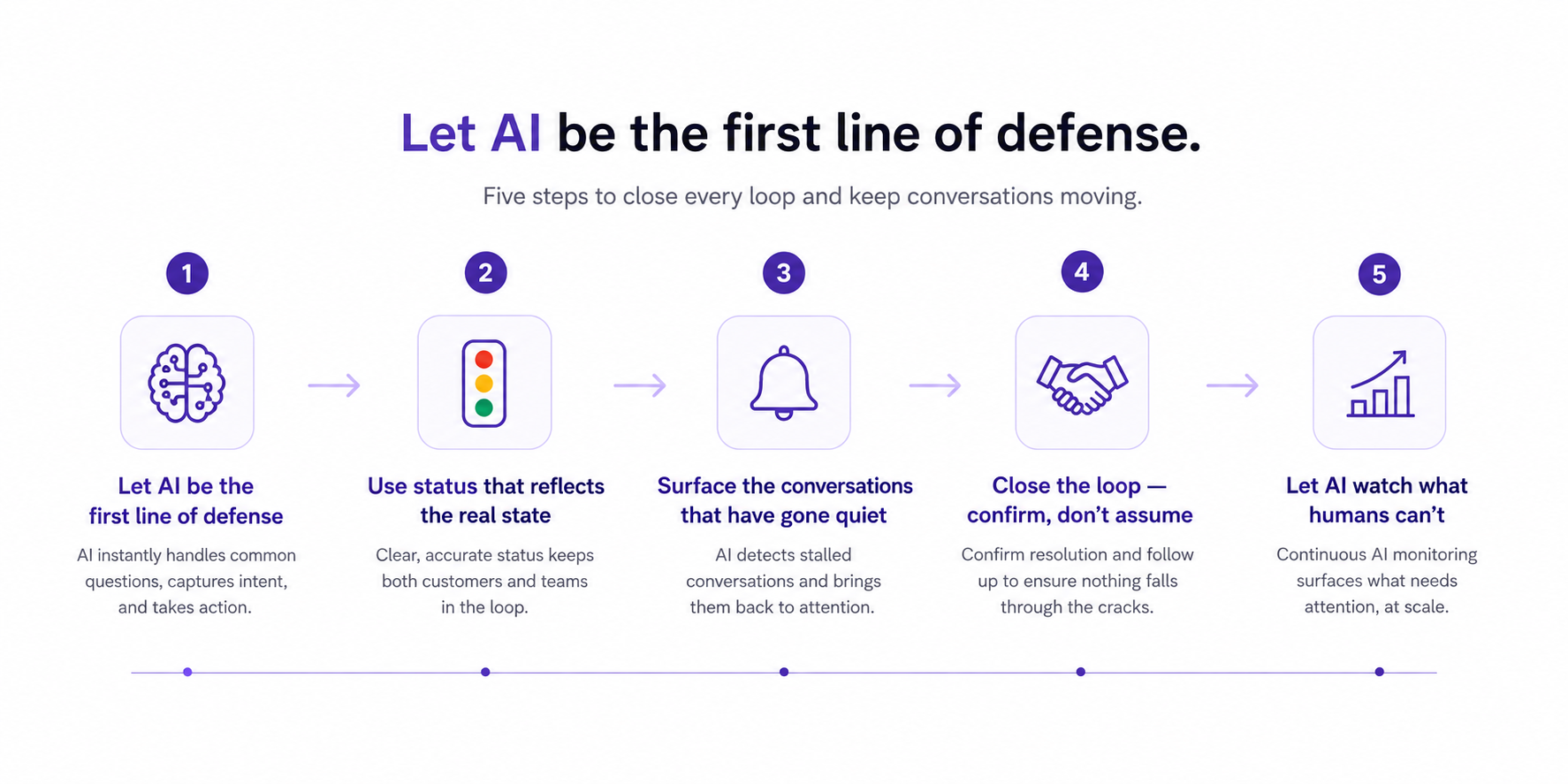
Step 0: Build that unified inbox
Ahead of tracking customer conversation, you need that unified shared inbox that centralizes conversations, knowledge and data around teams and departments. Without that mandatory steps, you'll never be able to properly build that customer conversation tracking strategy.
By adding a shared inbox software to your company, not only you allow yourself to build data upon channels and support efficiency, but also unlock new features and possibilities for your business.
Step 1: Let AI be the first line of defense
Every conversation should meet AI before it meets a queue. When a conversation lands, AI should attempt resolution first, and only escalate what it can't solve, and it should escalate with ownership, not to "the team," but to a specific named agent.
This single change fixes the ownership gap at its source. A conversation that's been triaged and handed to a named person the moment it needs one never passes through the ambiguous, unowned state where most conversations get lost. AI isn't just resolving the easy cases here, it's doing the assignment work that used to depend on a human remembering to do it.
AI also closes gaps a human working the queue can't. AI can watch every open conversation continuously, resolve the routine ones outright, and flag anything that's gone quiet long before a customer has to follow up. Human attention is finite and has to be somewhere. AI's doesn't.
Step 2: Give every conversation a clear owner
Every open conversation needs a named agent who is personally responsible for driving it to resolution. Not a team. A person. Ownership is the single biggest defense against dropped conversations because it eliminates the assumption that someone else has it covered.
The most dangerous moment for ownership is a handoff. Reassignment has to be explicit, not an implicit understanding that the next agent will pick it up. If the transfer doesn't name a new owner, ownership disappears.
Step 3: Use status that reflects the real state
Move beyond open/closed. Meaningful status means you can tell at a glance whether a conversation is actively being worked on, waiting on a customer reply, waiting on an internal team, or sitting in a gray zone where nothing is happening.
That distinction is what separates conversations that are progressing from the ones that have stalled. Without it, the forgotten ones are invisible among the active ones. A handful of well-maintained statuses beats a complex scheme nobody uses.
Step 4: Surface the conversations that have gone quiet
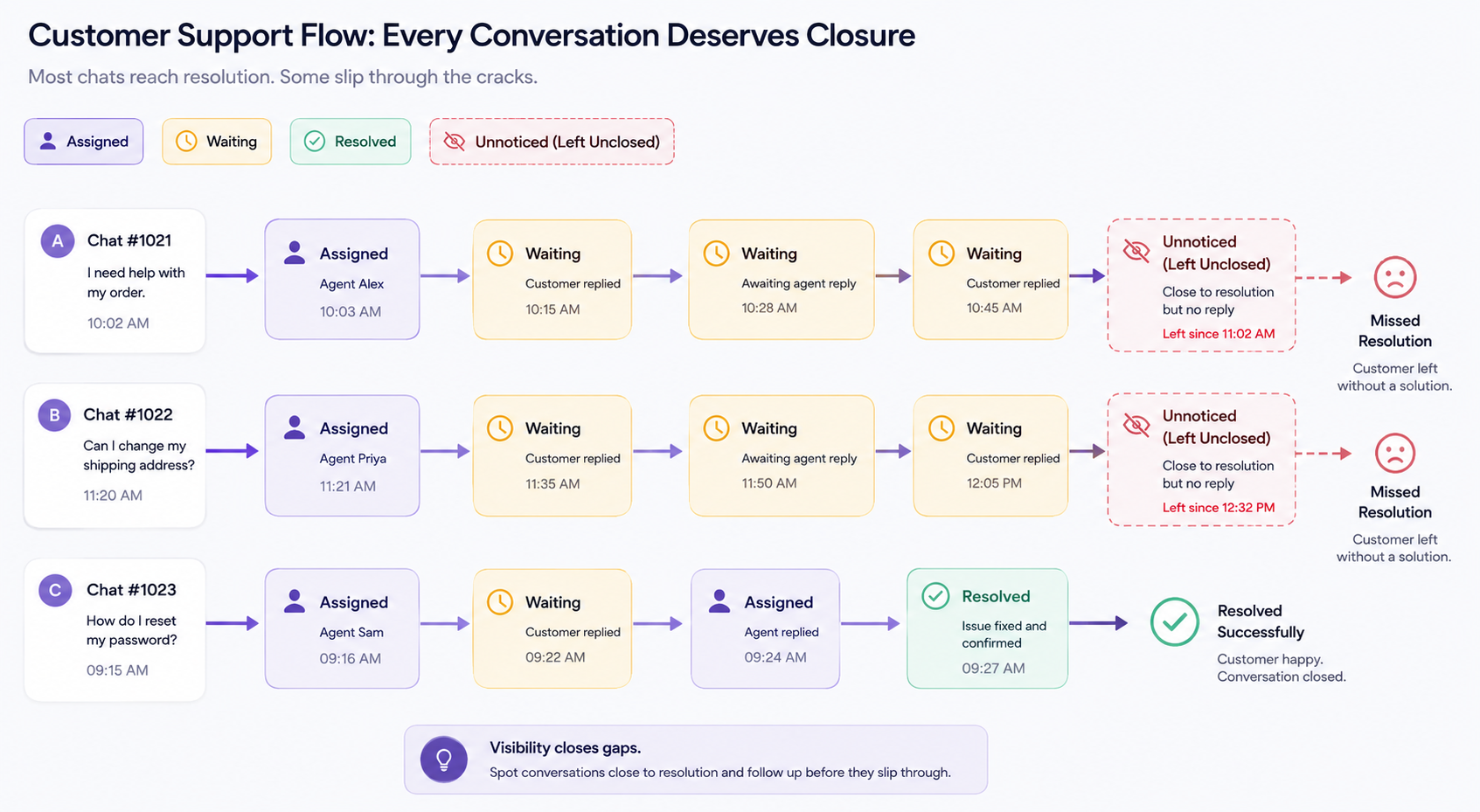
Owners and statuses are passive, they record state. Surfacing stalled conversations is the active part: a mechanism that flags anything open with no recent activity before the customer has to follow up.
The expectation isn't sympathy for a busy queue; it's a continuous clock. A stall you catch internally is a problem you can solve. A stall the customer catches is a loyalty event.
Step 5: Close the loop — confirm, don't assume
"Basically resolved" is not resolved. A conversation should only be closed when the customer's issue has been confirmed solved — not when an agent has done their part and moved on. Premature closes are dropped conversations with tidy labels on them.
Closing to clear the queue is one of the most common sources of repeat contacts. Only 58% of callers report their issues being resolved with the first agent — meaning nearly half of customers are leaving a first interaction still unresolved, often without a clear follow-up in place.
The signal that nothing is being dropped
You'll know the system is working when your metrics stop being reactive. The specific numbers that tell you conversations are being tracked to real resolution:
First Contact Resolution is the old benchmark , but that's a call-center metric built for phone calls, not async AI-driven conversations, and it rewards exactly the premature closes this guide warns against. The number that actually matters now is Confirmed Resolution Rate: the share of closed conversations that stay closed, with no reopen or repeat contact. Teams that have implemented structured conversation tracking have seen that number climb alongside FCR rising from 62% to 80% and same-day resolution from 76% to 90%.
Repeat contact rate falling is the clearest signal that conversations are being confirmed resolved rather than assumed resolved. When customers don't need to come back, the close was real.
Queue age staying low specifically, few or no conversations open beyond your defined SLA window, it means your stall-surfacing mechanism is working. If conversations age out, the signal is broken somewhere.
CSAT climbing on follow-up interactions means that even conversations that need multiple touchpoints are being handled with consistent ownership. 86% of service leaders who use AI report a positive impact on CSAT, and the compound effect of structured tracking and AI coverage shows up there first.
This is proof that the system you built is actually closing the gaps.
Tracking Conversations in Crisp
Crisp is built to make this system work without adding overhead. The Shared Inbox gives every conversation a named owner. Conversation states let your team record actual status rather than a binary flag. Analytics and filtered views surface the ones going quiet. And Hugo AI works in the background, resolving the straightforward cases and keeping your human attention where it belongs — on the conversations at real risk of being dropped.
The result is a queue where nothing drifts, every conversation has someone accountable for it, and resolution means the issue is actually confirmed closed — not just moved out of the way.
Ready to make sure nothing gets dropped?
Frequently asked questions
What's the most common reason customer support conversations get dropped?
Ambiguous ownership. When a conversation belongs to "the team" rather than a named agent, everyone assumes someone else is handling it.
How many statuses does a support team actually need?
Four to five is enough: actively in progress, waiting on customer, waiting on internal, and resolved pending confirmation. More than that and agents stop maintaining them.
What's the difference between a conversation being resolved and being confirmed resolved?
Resolved means an agent believes the issue is handled. Confirmed resolved means the customer has acknowledged it. Only the second one closes the loop.
How does AI help prevent dropped conversations?
AI monitors open conversations continuously at a scale no human can match, resolving routine issues outright and flagging anything that's gone quiet before the customer has to follow up.
What metric best tells me conversations aren't falling through the cracks?
First Contact Resolution rate. If it's rising, ownership and closure are working. If it's flat or falling, conversations are being closed without being confirmed resolved.
How quickly should a stalled conversation be flagged?
Depends on your SLA, but any conversation open with no activity beyond your standard response window should surface automatically. The system catches it; agents shouldn't have to remember.
Sources
Gartner, Effortless Experience Research, https://www.gartner.com/en/customer-service-support/insights/effortless-experience
Gartner, Two Actions Customer Service Leaders Must Prioritize, https://www.gartner.com/en/newsroom/press-releases/2020-08-19-gartner-reveals-two-actions-customer-service-leaders
HubSpot, State of Customer Service Report 2024, https://blog.hubspot.com/service/customer-service-stats
Zendesk, CX Trends Report 2025, https://www.zendesk.com/blog/customer-experience-trends
Salesforce, State of the AI Connected Customer (7th Edition), https://www.salesforce.com/resources/research-reports/state-of-the-connected-customer
Forrester, Customer-Obsessed Organizations Research, https://www.forrester.com/report/customer-obsessed-growth
Ringly.io / CEB, Customer Effort Score Statistics 2026, https://www.ringly.io/blog/customer-effort-score-statistics-2026
📚 Related articles
Proactive customer service: how to get ahead of issues instead of chasing them · SLA management in customer support: how to set response targets you actually keep · Ticket escalation done right: how to move issues up the chain without losing context

September 2026 - Product Update
Discover the new Knowledge Base editor, benchmark your AI support performance, track how often Hugo escalates conversations, and more. Discover the latest features and improvements released by the Crisp team in September 2026.


Summer 2026 - Product Update
Meet the refreshed Crisp experience, Understand how Artificial Intelligence handles every conversation, Build reusable teams across your workspace, and more. Discover the latest features and improvements released by the Crisp team in Summer 2026.

Best 9 helpdesk software and ticketing systems for 2026
Need help to choose your next helpdesk with a ticketing tool for 2026? We've gathered a guide that gives you everything you need to convince your C-levels.