Proactive customer service: how to get ahead of issues instead of chasing them
Your ticket queue only shows the customers who complain — the ones who quietly walk away never show up. Here's why reactive support leaks customers silently, and how to build proactive service in layers, from follow-up discipline to AI that catches what humans can't watch.


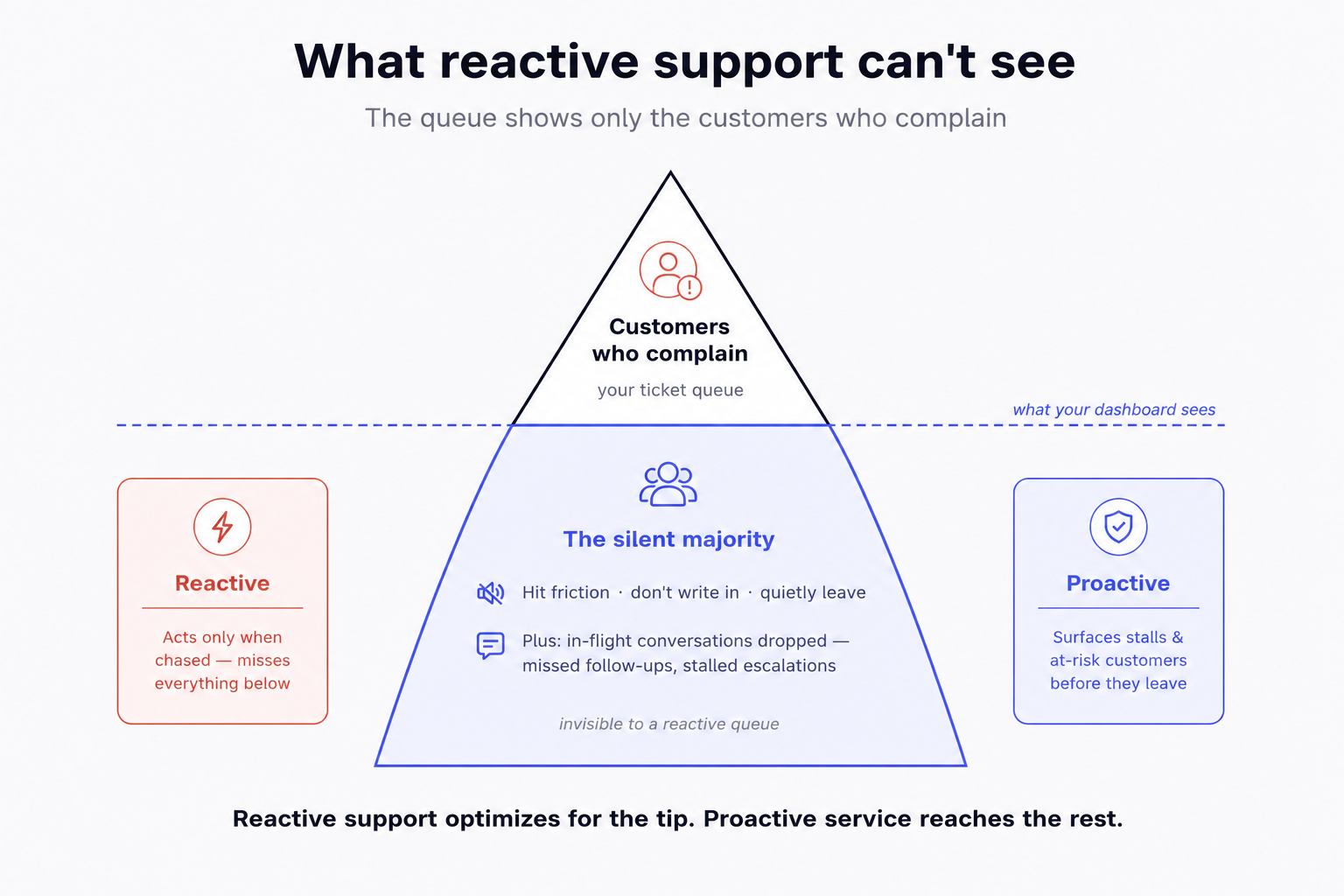
Here's the uncomfortable part about running support reactively: the ticket queue shows you only the customers who bothered to complain. The ones quietly giving up: hitting an implementation wall, not finding an answer, deciding it's not worth the effort to write in. It never shows up in your metrics at all. Your dashboard looks calm while customers leave through a door you can't see.
This is the structural blind spot of reactive support. It waits for the customer to raise their hand, which most unhappy customers never do. And even the issues that do come in get dropped more often than anyone admits: a follow-up that never happens, an open conversation no one owns, an escalation that stalls because the next person never picked it up. Reactive support is a system that only acts when chased, and customers who shouldn't have to chase, don't. They churn.
Proactive customer service flips this. Instead of waiting for problems to arrive, you reach customers before they have to chase you, surface issues before they're reported, and make sure no open conversation is ever left hanging. This guide covers what proactive customer service really is, why reactive support leaks customers silently, and how to build a proactive operating model — not just occasional outreach, but a system that catches what would otherwise slip.
By the end, you'll be able to:
- See why reactive support misses most at-risk customers — and what that costs
- Tell genuine proactive service apart from shallow "notification" versions
- Recognize the signals your team is stuck firefighting instead of getting ahead
- Build proactive service in layers — from follow-up discipline to AI-surfaced risk
- Track the metrics that show you're ahead of issues, not just reacting to them
What is proactive customer service?
Proactive customer service is support that acts before the customer has to ask. Instead of waiting for a ticket, a call, or a complaint, the team, or the system working alongside it, identifies a problem forming, a delay, a stall, a confusing step, and resolves it or reaches out first.
The customer experiences fewer moments where they have to chase an answer, because the answer already found them.
The contrast that defines it is who moves first. In reactive service, the customer initiates: something breaks, they write in, you respond. In proactive service, you initiate: you see the problem forming, the stalled conversation, the at-risk account, and you act before the customer has to. Reactive support plays defense; proactive support plays offense.
Increasingly, that offense is a combination of people who set the rules and priorities, and AI that watches continuously for the signals a human team could never monitor by hand.
The term gets watered down to mean "send some notifications," which misses most of what makes it work. The distinctions matter because the shallow version backfires.
| What it's NOT | What it IS |
|---|---|
| Blasting customers with outbound messages they didn't ask for | Anticipating genuine needs and acting on the ones that matter |
| A one-off "your order shipped" notification | A systematic model for catching issues and stalled conversations before they churn |
| Replacing reactive support | Adding a forward layer so fewer issues ever become reactive tickets |
| Following up only when a customer chases you | Following up before they have to — and never dropping the ones in flight |
Proactive service is also not the same as marketing outreach. Marketing pushes messages to drive action; proactive service anticipates a service need — a delay, a stall, a problem forming — and gets ahead of it. Done badly, the two blur, and that's exactly where proactive outreach backfires: Gartner found that two-thirds of customers contact the company anyway after receiving proactive outreach, often because the message raised a question it didn't answer. Proactive done right resolves; proactive done badly just creates a new inbound ticket.
Why reactive customer support leaks customers silently
The blind spot
Reactive support has a measurement problem built into it: it can only act on what it can see, and it can only see the customers who complain. The trouble is that most unhappy customers don't. They hit friction, decide it's not worth the effort, and quietly leave — gone before anyone in support knew there was a problem. A reactive team optimizing its ticket queue is optimizing for the minority that speaks up while the silent majority walks out unmeasured.
The compounding cost
Two costs compound here. The first is the silent churn above — customers lost without ever generating a ticket to learn from. The second is the issues that do arrive and still get dropped: the follow-up that never happened, the conversation marked "open" that no one owns, the escalation that stalled because the handoff never completed. Every one of those is a customer who did raise their hand and still got let down — the most damaging kind, because they gave you the chance and you missed it.
The economics make the case plainly. Retaining customers is dramatically cheaper than replacing them: Harvard Business Review's analysis of Bain research found that a 5% increase in customer retention can increase profits by 25% to 95%. Proactive service attacks both leaks at once — it surfaces the silent friction before it becomes churn, and it imposes the discipline that stops in-flight conversations from being dropped. It's not a feel-good initiative; it's a retention strategy with measurable returns.
And proactive is not the same as self-service deflection. Gartner found that only 14% of customer service issues are fully resolved in self-service — so a strategy that just pushes customers to a help center isn't proactive, it's avoidance. Real proactive service anticipates and resolves; it doesn't redirect.
You've hit this point if...
- You learn a customer was unhappy only when they cancel — not before.
- Conversations sit marked "open" for days because no one clearly owns driving them to resolution.
- Follow-ups depend on an agent remembering, rather than on the system surfacing them.
- Escalations stall partway because the handoff to the next person never fully completes.
- Your team is permanently firefighting the inbound queue, with no capacity to get ahead of anything.
If these are familiar, your team isn't failing — it's stuck in a purely reactive model, acting only when chased, and losing the customers who don't chase.
What good proactive service looks like
The solved state
When proactive service is working, the team is no longer purely at the mercy of the inbound queue. Stalled conversations surface automatically before they go cold, so nothing sits ignored for days. Follow-ups happen because the system reminds and assigns them, not because someone remembered. At-risk customers — the ones whose behaviour signals trouble before they've said a word — get flagged for outreach while there's still time to keep them. And every open conversation has a clear owner and a clear path to resolution, so the question "did anyone get back to them?" simply doesn't arise. The team spends less time firefighting because fewer fires start.
The most advanced version of this is AI-assisted. AI can watch every open conversation for signs of a stall, surface the ones at risk of being dropped, detect sentiment shifts that hint a customer is slipping away, and trigger or draft the follow-up — at a scale no human manager could monitor by hand. Proactivity that depended entirely on human vigilance was always capped by attention; AI lifts that cap.
Proxy metrics vs. real signals
Proactive service is easy to fake on a dashboard. Counting outbound messages sent tells you the team is busy, not that it's getting ahead of issues.
| Proxy metric | Real signal |
|---|---|
| Outbound messages sent | Issues resolved before the customer reported them |
| Tickets closed | Reopen rate — how often "resolved" conversations come back |
| Average first response time | Stalled-conversation rate — how many sit open with no next action |
| Self-service deflections | Silent-churn / at-risk accounts caught before they left |
| Activity volume | Follow-up completion rate — commitments actually kept |
The real signals — issues caught pre-report, stalled-conversation rate, follow-up completion, at-risk accounts saved — are the ones that only move when the team is genuinely ahead of problems rather than reacting to them.
A realistic benchmark
Proactive service is a shift in posture, not a switch you flip. No team eliminates reactive work entirely — nor should it. The target is a steadily growing share of issues caught before the customer reports them, a falling stalled-conversation rate, and follow-up completion approaching 100%. A maturing team moves from "we respond fast" to "we rarely let it get to the point where a response is the first thing the customer notices."
How to build proactive customer service: a layered approach
Each layer below builds on the one before it, so the order matters as much as the individual steps.
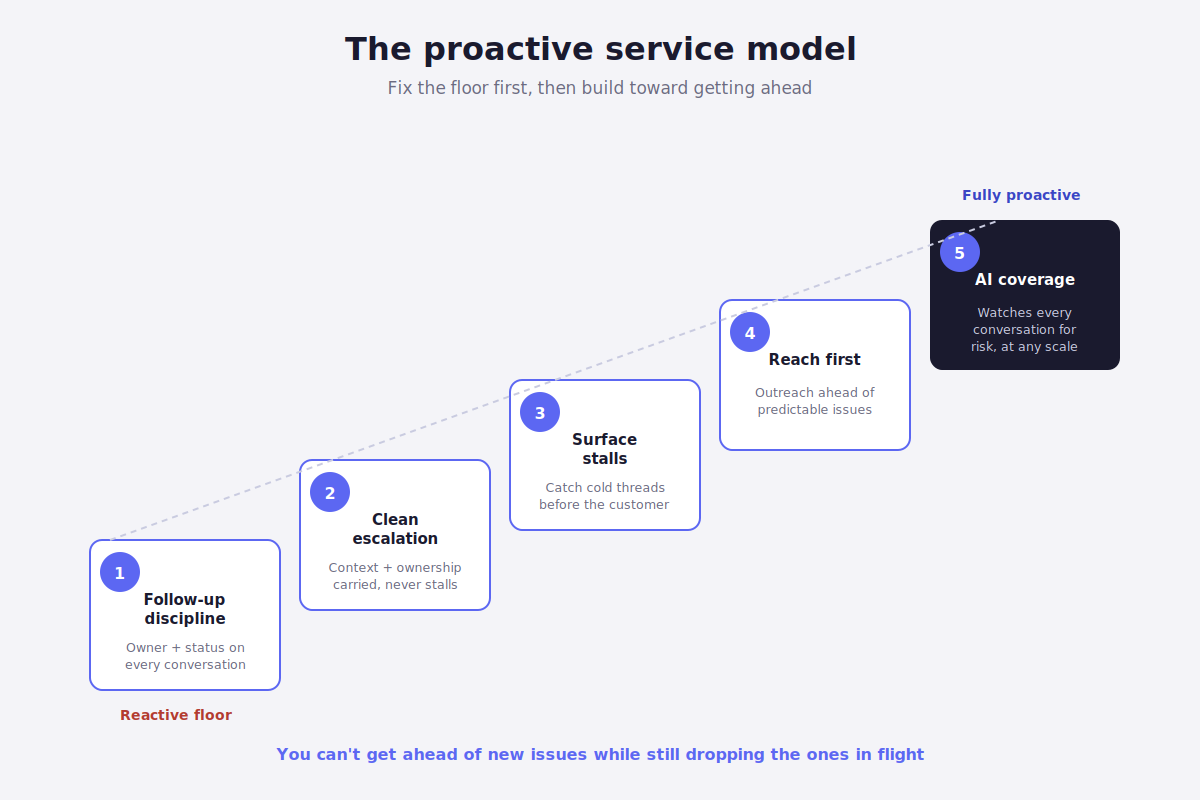
Step 1: Fix follow-up discipline first
- What to do: Make sure every conversation that needs a later action has a clear owner, a defined next step, and a mechanism that surfaces it — so follow-ups don't depend on memory.
- Why this step matters for this job: You can't get ahead of new issues while you're still dropping the ones already in flight. Follow-up discipline is the floor proactive service is built on; without it, "proactive" outreach just adds to a pile you're already failing to clear.
- Watch out for: Treating "open" as a default state rather than a commitment. An open conversation with no owner and no next action is a dropped follow-up waiting to happen.
Step 2: Make escalations carry context and ownership
- What to do: Define escalation paths so that when a conversation moves to another person or team, it carries full context and a clear owner — and never stalls in the handoff.
- Why this step matters for this job: A stalled escalation is one of the most common ways an in-flight issue gets silently dropped. The customer already raised their hand; losing them in a handoff is the avoidable failure.
- Watch out for: Escalations that transfer the ticket but not the ownership. If no one clearly owns the escalated conversation, it stalls.
Step 3: Surface stalled conversations before they go cold
- What to do: Put a mechanism in place that flags conversations sitting open with no recent activity, so they're surfaced and acted on before the customer has to chase.
- Why this step matters for this job: This is the first genuinely proactive layer — catching the in-flight conversations that are about to become a "you never got back to me" complaint, before they do.
- Watch out for: Surfacing stalls but not assigning them. Visibility without ownership just moves the dropped follow-up one step downstream.
Step 4: Reach customers before they reach you
- What to do: Use what you know about customer behaviour and lifecycle to reach out ahead of predictable issues — onboarding stumbles, usage drop-offs, known delays — before they become complaints.
- Why this step matters for this job: This is proactive service in its fullest sense: getting to the issue before the customer experiences it as a problem. Done well, it prevents tickets rather than just handling them faster.
- Watch out for: Outreach that raises questions it doesn't answer — the exact trap that makes two-thirds of proactively-contacted customers contact you anyway. Make proactive messages self-contained and confidence-building, not cliffhangers.
Step 5: Layer in AI to catch what humans can't watch
- What to do: Use AI to monitor every open conversation for stalls, sentiment shifts, and at-risk signals at a scale no human can — and to surface or draft the follow-ups that result.
- Why this step matters for this job: Human-driven proactivity is capped by attention; a manager can't watch every conversation. AI removes that ceiling, watching everything continuously and flagging what needs a human's judgment.
- Watch out for: Treating AI flags as resolutions. AI surfaces and drafts; a human still owns the judgment on at-risk accounts and the relationship that saves them.
Common mistakes that keep teams reactive
Three patterns show up again and again in teams that think they've gone proactive but haven't.
- Mistaking notifications for proactive service. The shallow version of "going proactive" is bolting on a few outbound messages, shipping confirmations, status updates, and calling it done. But proactive service isn't about sending more messages, human or AI-generated; it's about catching issues and stalled conversations before they cost you a customer. Worse, outreach that raises a question it doesn't answer drives customers right back into your inbound queue, eroding the benefit. The test isn't whether you sent the message; it's whether you got ahead of the problem.
- Going proactive while still dropping the basics. Teams get excited about predictive outreach and at-risk flagging, sometimes powered by a shiny new AI tool, while follow-ups are still falling through the cracks and conversations sit open with no owner. Proactivity layered on top of poor follow-up discipline collapses, you can't get ahead of new issues while losing the ones already in hand. Fix the floor before building the upper storeys.
- Confusing self-service deflection with being proactive. Pushing customers to a help center, or to a chatbot that can only answer from existing content, and counting the deflection looks like getting ahead of demand, but it's avoidance, not anticipation, and with only a small fraction of issues fully resolved in self-service, most of those customers are heading back to you anyway, now more frustrated. Real proactive service resolves and anticipates; it doesn't redirect and hope.
Getting ahead of the queue instead of chasing it
Proactive service is the productivity lever that works by preventing work rather than speeding it up. Every issue caught before it becomes a ticket, every stalled conversation surfaced before it turns into an angry follow-up, every at-risk customer saved before they churn, all of it removes downstream load from the team.
None of that works without the right system underneath it, and this is where the layers we discussed earlier become concrete rather than aspirational. Crisp's Shared Inbox tracks every conversation as Pending, Unresolved, or Resolved, and lets you sort by Longest Waiting, so a stalled conversation is something your team can see and act on, not something you find out about when the customer complains.
Crisp's CRM holds customer data, behavioral events, and conversation history in one profile, and Automated Campaigns and Message Triggers use that same data to reach a customer proactively, onboarding nudges, usage-drop check-ins, win-back messages, based on what they actually did, not a guess.
And where a conversation does need AI at the front line, Hugo can resolve the routine cases directly and, connected to your CRM or internal tools through MCP, escalate the rest to a human with the conversation and context fully attached, rather than a bare ticket number.
Put together, that is what turns "proactive service" from a slide in a deck into something your stack actually does: conversations that don't go stale, outreach that's triggered by real signals instead of a hunch, and handoffs, AI to human or human to human, that never make a customer start over.
Ready to get ahead of issues instead of chasing them?
Frequently asked questions
Is proactive customer service the same as customer success?
They overlap but aren't identical. Customer success owns the relationship and growth of an account long-term. Proactive service is the operating discipline, catching stalls, gaps, and at-risk signals, that customer success and support teams both rely on to do that job well.
How much does proactive customer service cost to implement?
It depends more on process discipline than on tooling spend. Fixing follow-up ownership and escalation paths costs little beyond time. Adding AI monitoring for stalls and sentiment is typically the more expensive layer, but it scales coverage a small team couldn't otherwise sustain.
Can small support teams do proactive service without AI?
Yes, at a smaller scale. Follow-up discipline, clear ownership, and stall tracking can all be done manually with the right process. AI becomes valuable once conversation volume outgrows what a person can watch continuously.
What's the difference between proactive service and customer retention marketing?
Proactive service resolves a forming problem before the customer notices it. Retention marketing sends offers or messages to encourage a customer to stay or re-engage.
How do you measure ROI on proactive customer service?
Track churn avoided among flagged at-risk accounts, reduction in "why haven't I heard back" complaints, and follow-up completion rate over time. Compare these against the cost of the tools and process changes involved, rather than counting messages sent.
Sources
Gartner, Gartner Survey Finds Two-Thirds of Customers Contact Customer Service After Receiving Proactive Outreach From a Brand, https://www.gartner.com/en/newsroom/press-releases/gartner-survey-finds-two-thirds-of-customers-contact-customer-se
Gartner, Gartner Survey Finds Only 14% of Customer Service Issues Are Fully Resolved in Self-Service, https://www.gartner.com/en/newsroom/press-releases/2024-08-19-gartner-survey-finds-only-14-percent-of-customer-service-issues-are-fully-resolved-in-self-service
Gartner, Self-Service Customer Service topic overview, https://www.gartner.com/en/customer-service-support/topics/self-service-customer-service
McKinsey and Company, The Economic Potential of Generative AI: The Next Productivity Frontier, https://www.mckinsey.com/capabilities/tech-and-ai/our-insights/the-economic-potential-of-generative-ai-the-next-productivity-frontier
McKinsey and Company, The Next Frontier of Customer Engagement: AI-Enabled Customer Service, https://www.mckinsey.com/capabilities/operations/our-insights/the-next-frontier-of-customer-engagement-ai-enabled-customer-service
McKinsey and Company, The Contact Center Crossroads: Finding the Right Mix of Humans and AI, https://www.mckinsey.com/capabilities/operations/our-insights/the-contact-center-crossroads-finding-the-right-mix-of-humans-and-ai
Statista, Consumer Opinions on Use of Conversational AI for Customer Service in 2024, https://www.statista.com/statistics/1538260/consumer-opinions-on-conversational-ai/
Statista, AI Usage: Positive Impacts on Customer Service Metrics Worldwide 2023, https://www.statista.com/statistics/1426201/ai-usage-positive-impacts-customer-service/
Statista, Chatbot Queries in E-Commerce 2024, https://www.statista.com/statistics/1609263/use-of-chatbots-for-customer-support-worldwide/
📚 Related articles
SLA management in customer support: how to set response targets you actually keep · Ticket escalation done right: how to move issues up the chain without losing context · How to track customer conversations so nothing falls through the cracks

September 2026 - Product Update
Discover the new Knowledge Base editor, benchmark your AI support performance, track how often Hugo escalates conversations, and more. Discover the latest features and improvements released by the Crisp team in September 2026.


Summer 2026 - Product Update
Meet the refreshed Crisp experience, Understand how Artificial Intelligence handles every conversation, Build reusable teams across your workspace, and more. Discover the latest features and improvements released by the Crisp team in Summer 2026.

Best 9 helpdesk software and ticketing systems for 2026
Need help to choose your next helpdesk with a ticketing tool for 2026? We've gathered a guide that gives you everything you need to convince your C-levels.