Ticket escalation done right: how to move issues up the chain without losing context
When AI handles first contact, every handoff to a human should feel like a continuation, not a reset. Here's how to build escalation that carries full context and clear ownership at every step, instead of making customers repeat themselves.


The customer explained everything once. Their account number, their timeline, what they had already tried, why the standard fix did not work. It took four minutes. The AI handling the conversation tracked all of it. Then it reached the edge of what it was built to handle and transferred the conversation to a human agent.
The agent opened with: "Can you tell me a little bit about your issue?"
That is escalation failing in real time. Not because the AI gave up, but because what it knew did not travel with the conversation.
In an AI-first support model, every customer inquiry lands first with AI. The AI checks the issue, attempts resolution, and either closes it or hands it to a human agent. That human agent picks up where the AI left off, or tries to. If they cannot close it either, they escalate further up the chain.
At each of those transitions, the same failure can occur: the context built in the previous stage does not make it to the next one.
This guide is about building escalation that works across the full chain:
- Build a single data layer so AI and agents always work from the same picture.
- Separate the customer-facing brief from the internal diagnostic notes agents need.
- Set clear criteria for when AI, or a human agent, should actually escalate.
- Track the signals (CSAT, containment rate, time-to-first-response) that show it's working.
TLDR: How to improve ticket escalation?
- Centralize customer data — one unified layer every tool reads from and writes to, so AI and agents always see the full picture.
- Let AI build the context record from first contact — every message and resolution attempt tracked in real time, so nothing needs reconstructing later.
- Assign a clear, named owner — never a vague queue or "tier 2," so someone is always accountable for the next step.
- Add internal context the customer never sees — a customer-facing brief plus a private diagnostic layer (root cause, ruled-out fixes, account flags) for the receiving agent.
- Define what actually warrants escalation — clear criteria for AI and for human agents, so handoffs are deliberate, not reflexive.
- Let AI handle the routine cases — so the escalations that do reach humans are rare and genuinely need them.
Why ticket escalations go wrong
Most escalation failures come down to two problems, and neither is about whether to escalate: they're about how the handoff happens.
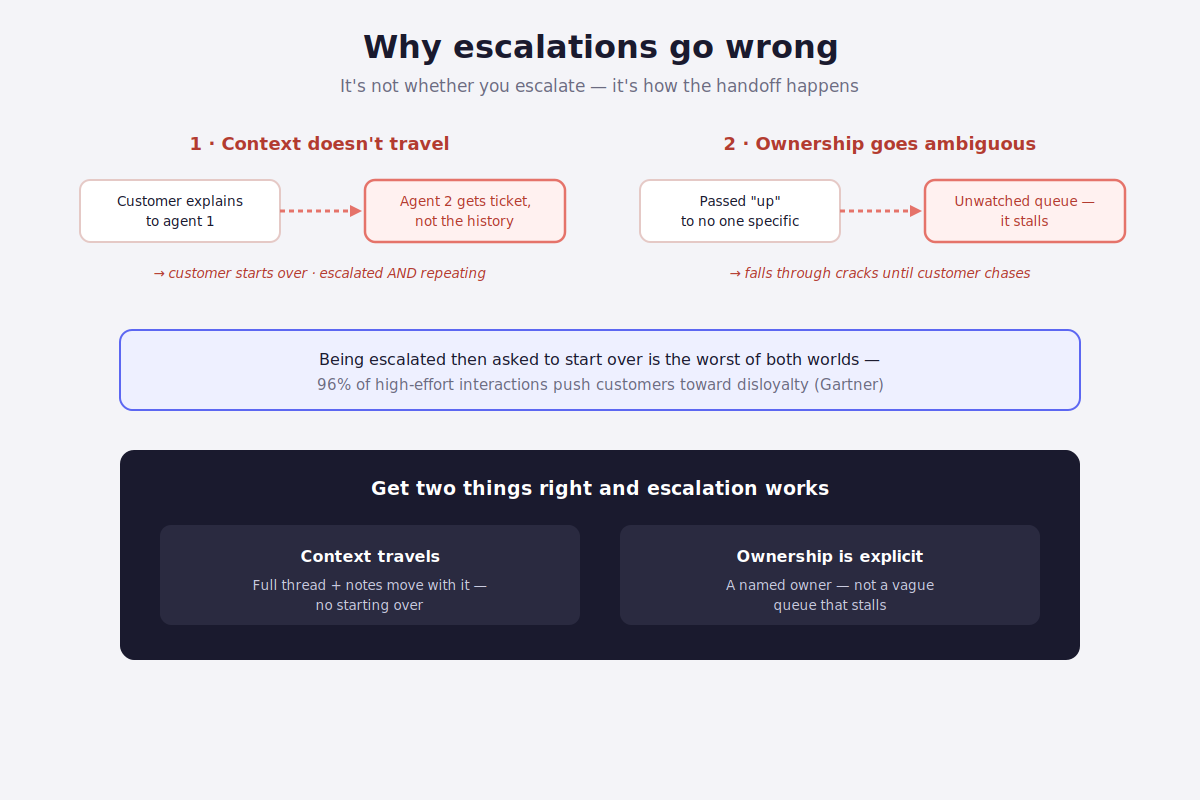
1. Context does not transfer
A customer inquiry can pass through several hands before it closes. The AI picks it up first, checks the issue, and tries a few resolution paths. If it cannot close it, it escalates to a human agent. That agent works the problem for a while, and if they cannot resolve it either, they escalate again. At every one of those transitions, there is an opportunity for context to get left behind.
Sometimes the AI escalates quickly, before it has built much context at all, and the receiving human agent starts nearly from zero. Sometimes the AI has tried several things, diagnosed the likely root cause, and built a complete picture, but escalates without passing any of it on. Sometimes the human agent spends twenty minutes on the issue, narrows it down, and then escalates to a senior colleague without writing a word of it down. In each case, the next person in the chain either asks the customer to repeat themselves or starts resolving from scratch.
The fix is the same either way: make context transfer automatic at every transition, not dependent on whether the outgoing party remembered to document what they knew.
2. Ownership goes ambiguous in the handoff
The other failure is the escalation that lands nowhere. AI flags the conversation as needing human attention and passes it on, but to a queue no one is actively watching, or to a team where everyone assumes someone else has picked it up. Or a human agent escalates to a senior colleague who assumes the original agent is still tracking it. The conversation stalls. The customer waits. Nobody notices until the customer follows up.
An escalation without a named owner is not an escalation. It is a conversation quietly falling through the cracks. Whether AI is handing off to a human, or a human is handing off to another human, the principle is the same: every escalation must land with a specific person who is now accountable for driving it to resolution.
Get both right, context transfers and ownership is explicit, and escalation does what it is meant to. Get either wrong, and escalating actively makes the experience worse than if the previous agent had stayed on the conversation longer.
How to escalate tickets without losing context
Ticket escalation done right is less about urgency and more about information architecture. Think of it like a surgical handoff in an operating room: the outgoing surgeon doesn't just leave and let the next one figure it out. They brief the incoming team:
- what was done,
- what wasn't,
- what to watch for.
The patient never has to explain their own chart. That's the standard. Here's how to build the right escalation workflow into your customer support operation:
Step 1: Centralize customer data and escalate context
⚠️ Everything else in this guide depends on this step.
AI can only carry the context it has access to, and a human agent can only hand off what they can see. When customer data is fragmented across separate tools, every agent in the chain is working with a partial picture. The context record at the point of escalation reflects only what lived in the current tool, not everything that is known about this customer.
The practical requirement is a single data layer that every tool in the support stack reads from and writes to: a live, unified record that AI can query in real time during the conversation and that human agents see in full when they take over.
When that exists, the context record at the point of escalation is complete: Not just what happened in this conversation, but everything known about this customer across every touchpoint and every previous interaction.
56% of customers say they have to repeat or re-explain information to different representatives.
Almost all of that traces back to this: the information existed somewhere, but was not accessible when it was needed.
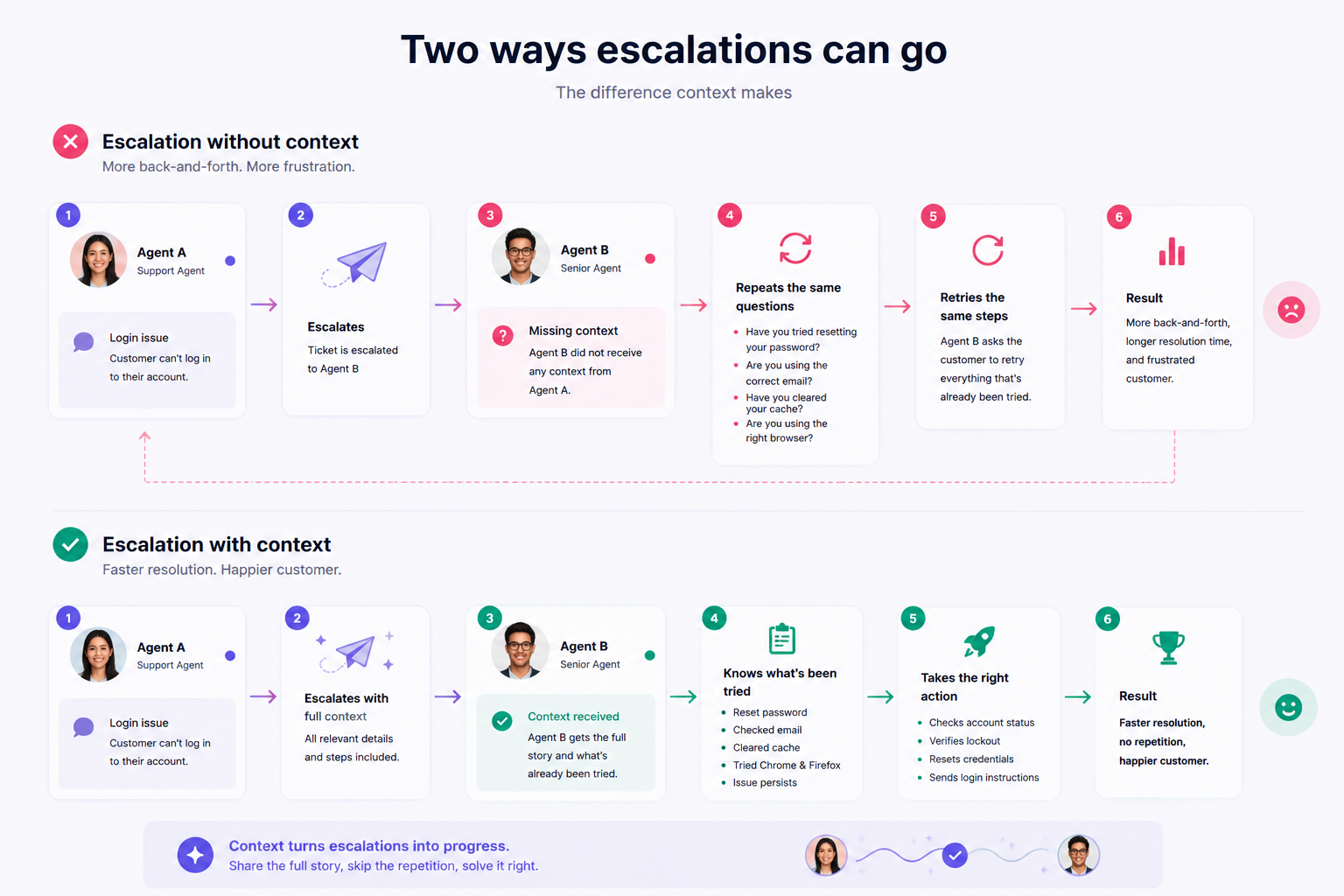
The entire thread, every customer message, every agent reply, every attempt at resolution, needs to travel with the escalation automatically:
- Not a forwarded summary.
- Not an agent's interpretation.
The actual conversation.
Step 2: Let AI build the context record from first contact
In an AI-first era, the AI handling first contact is not just attempting resolution. It is building the handoff document in real time. Every message, every clarification, every resolution attempt, every sentiment shift: the AI tracks it as the conversation unfolds. By the time escalation becomes necessary, the context record is already complete. There is nothing to reconstruct or scroll to be done.
This changes what escalation requires from the receiving human agent. Instead of assembling context from fragments, they read a complete brief generated by the AI, drawn from the unified data layer, and start solving immediately. The first thing they say to the customer is informed, not introductory.
Step 3: Assign a clear new owner, never a vague queue
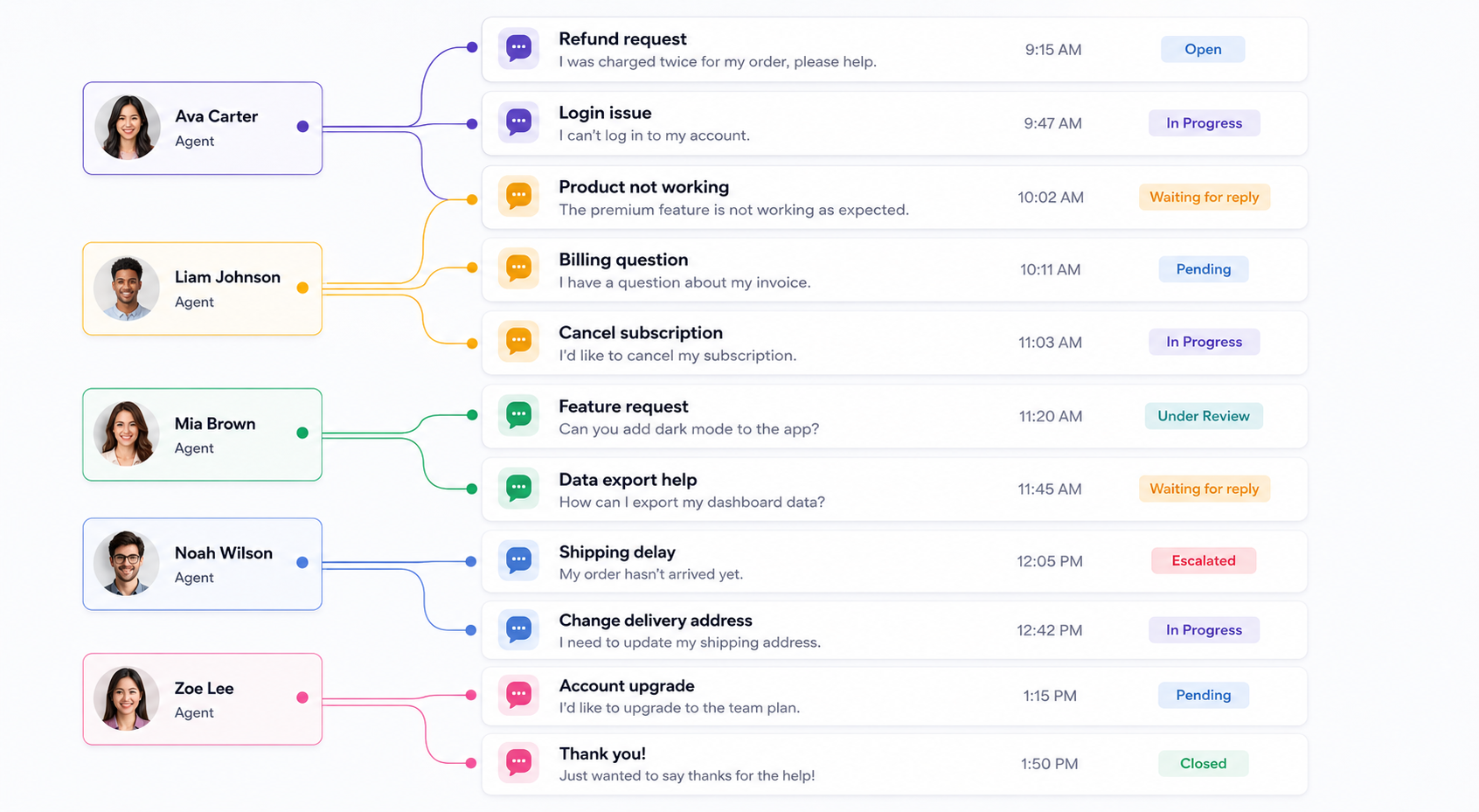
Every escalation must land with a specific person who is now accountable for driving it to resolution. Not a team. Not "tier 2." A named agent who owns the next step.
Customer satisfaction drops by an average of 22 percentage points when a ticket is escalated compared to same-tier resolution — from 89% CSAT for non-escalated contacts down to 67% for escalated ones.
That gap is already a hole you're climbing out of: ambiguous ownership makes it deeper. A named owner means someone is watching the conversation; an unwatched queue means the conversation waits until the customer chases.
Step 4: Add internal context the customer never sees
Two distinct types of context need to travel with an escalation, and they should not be collapsed into one.
The first is the handover brief: a clear summary of the customer's issue, what has been attempted, and what they need next. This is the context that orients the receiving agent on the substance of the conversation. It is drawn from the thread and can be generated automatically.
The second is the internal diagnostic layer: what the AI flagged as the likely root cause, what resolution paths it ruled out, why it decided to escalate, and any account-level flags that are operationally relevant but should not surface to the customer. Things like billing sensitivity, previous churn history, or a suspected backend bug rather than a user error. This layer should travel with the escalation privately. It informs the receiving agent's approach without exposing the handoff's internal mechanics to the customer.
When these two layers are kept distinct and both transferred automatically, the receiving agent has everything they need: the customer-facing picture and the operational context behind it. The customer experiences a seamless continuation. The agent walks in fully briefed.
Step 5: Define what actually warrants escalation
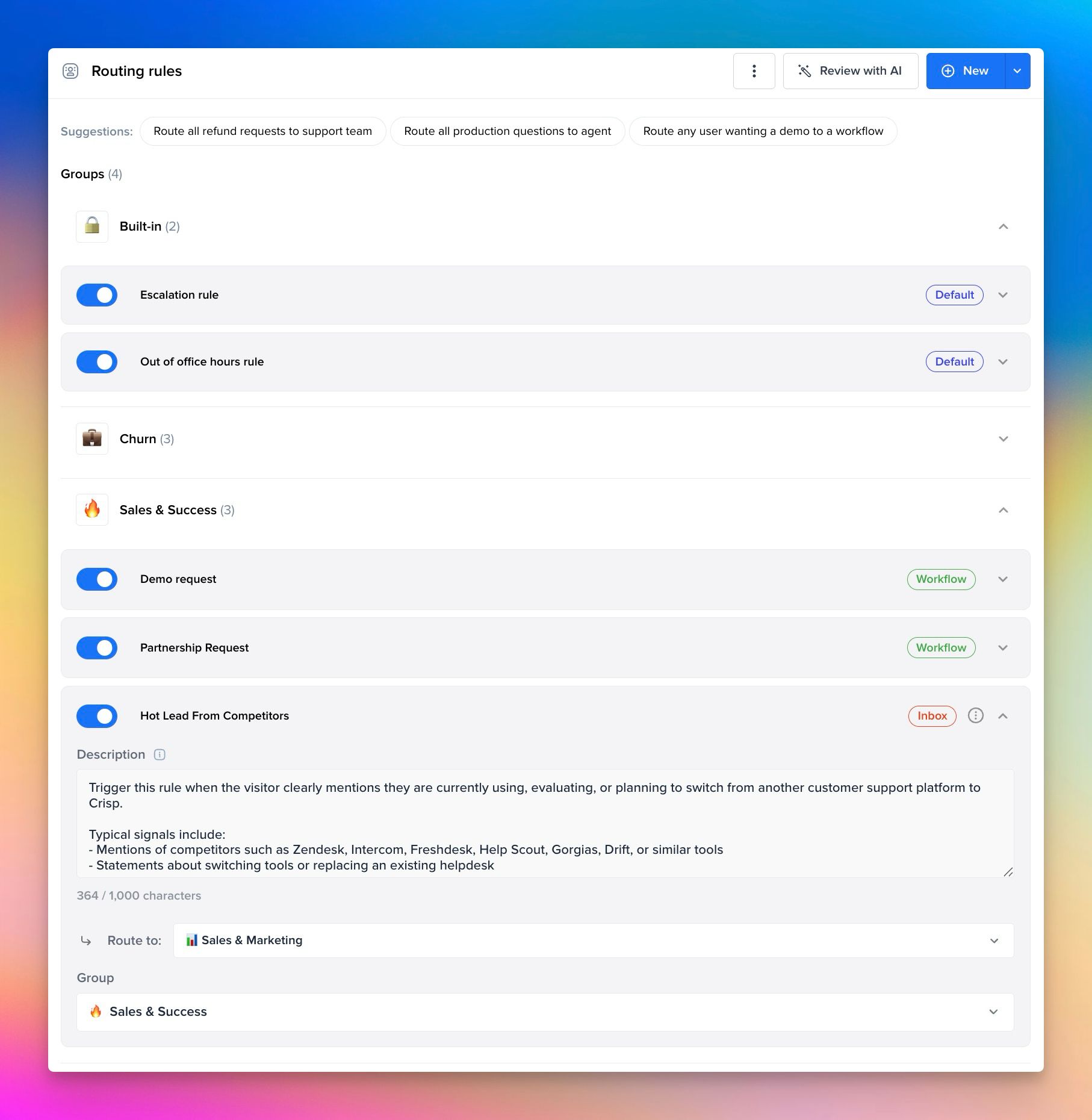
Not every hard conversation needs to move up the chain. This applies equally to AI and to human agents. Clear escalation criteria, defining what falls within each party's authority and what genuinely requires the next level, is what separates deliberate escalation from reflexive escalation.
For AI, the criteria should define the boundary of autonomous authority: what issue types, complexity levels, and customer signals warrant a handoff to a human. Without those boundaries, AI escalates by pattern-matching to vague signals and offloads work it could close itself, or stays on conversations it should have handed off earlier.
For human agents, the criteria should define the boundary between tier-one resolution and specialist or supervisory involvement: what requires a different skill set, a higher level of authority, or sign-off that the current agent cannot provide. Without those boundaries, agents escalate by feel, senior agents get buried in cases they should not be handling, and the cases that genuinely need expert attention get slower service because the queue is clogged.
Step 6: Let AI handle the routine so escalations are rare and real
When AI carries the straightforward cases — password resets, status checks, policy questions, common troubleshooting paths — the escalations that reach human agents are the ones that genuinely need them. That's not just efficiency. It's what makes escalation meaningful again.
Escalation works best when it's rare and meaningful, not constant — and the direction is clear: Gartner predicts agentic AI will autonomously resolve 80% of common customer service issues by 2029, leaving the genuinely hard cases for human escalation.
The signals that ticket escalations are working
You can feel when escalation is broken:
- customers repeat themselves,
- senior agents are overloaded,
- CSAT drops on any ticket that needed a second touch.
The metrics that confirm the system is actually working:
- Autonomous resolution rate trending up. This is the upstream signal. If AI is resolving more conversations end to end without escalation, the overall escalation volume should fall naturally. An escalation rate that is climbing despite a rising autonomous resolution rate points to criteria or routing problems. The wrong conversations are being handed off.
- AI escalation rate staying low. The share of AI-handled conversations that escalate to a human is the direct measure of AI containment. High numbers mean the signal is usually one of two things: AI lacks the data access it needs to resolve confidently, or escalation criteria are too loosely defined.
- Context completeness at handoff. What percentage of escalated conversations arrive with a complete handover brief and internal diagnostic note attached? This is the data centralization metric in practice. Incomplete handovers, where the receiving agent has to ask the customer for context already given, point directly back to fragmented data or broken transfer workflows.
- Escalation CSAT closing the gap. The 22-point drop between non-escalated and escalated contacts is the baseline. A well-run escalation process with full context transfer and named ownership should narrow that gap measurably. When escalated contacts start showing CSAT in the 80s rather than the 60s, the handoff quality has improved.
- Repeat contact rate on escalated tickets falling. If customers are coming back after an escalation, the resolution wasn't real. A confirmed close on an escalated ticket should look the same as on any other: the issue is actually solved, not just moved to someone with more seniority.
- Human escalation rate staying at or below 10–15%. Top-performing operations hold escalation volume below that range. If yours is climbing above it, the signal is usually one of two things: tier-one agents don't have the authority or tools to close what they're seeing, or routing is sending the wrong conversations to the wrong people from the start.
- Time-to-first-response after escalation staying short. A named owner creates accountability. That accountability shows up as faster first response from the receiving agent. If escalated tickets are sitting untouched for hours after handoff, ownership isn't actually landing — it's just being re-labeled.
Ticket escalation in Crisp
Crisp is designed to solve the exact customer support challenges covered in this guide:
- Unified customer data layer — Every conversation, account record, and interaction history lives in one place, so AI has a complete picture from first contact, and every escalation carries full context automatically.
- Automatic conversation history transfer — The entire conversation thread follows the ticket when it's reassigned, ensuring no context is lost.
- Private internal notes — Agents can brief the next person with relevant details without exposing internal discussions to the customer.
- Clear ownership — Named assignment makes it obvious who is responsible for driving the issue to resolution.
- AI-powered deflection — Hugo AI resolves routine inquiries before they reach the queue, reducing noise and preventing unnecessary escalations.
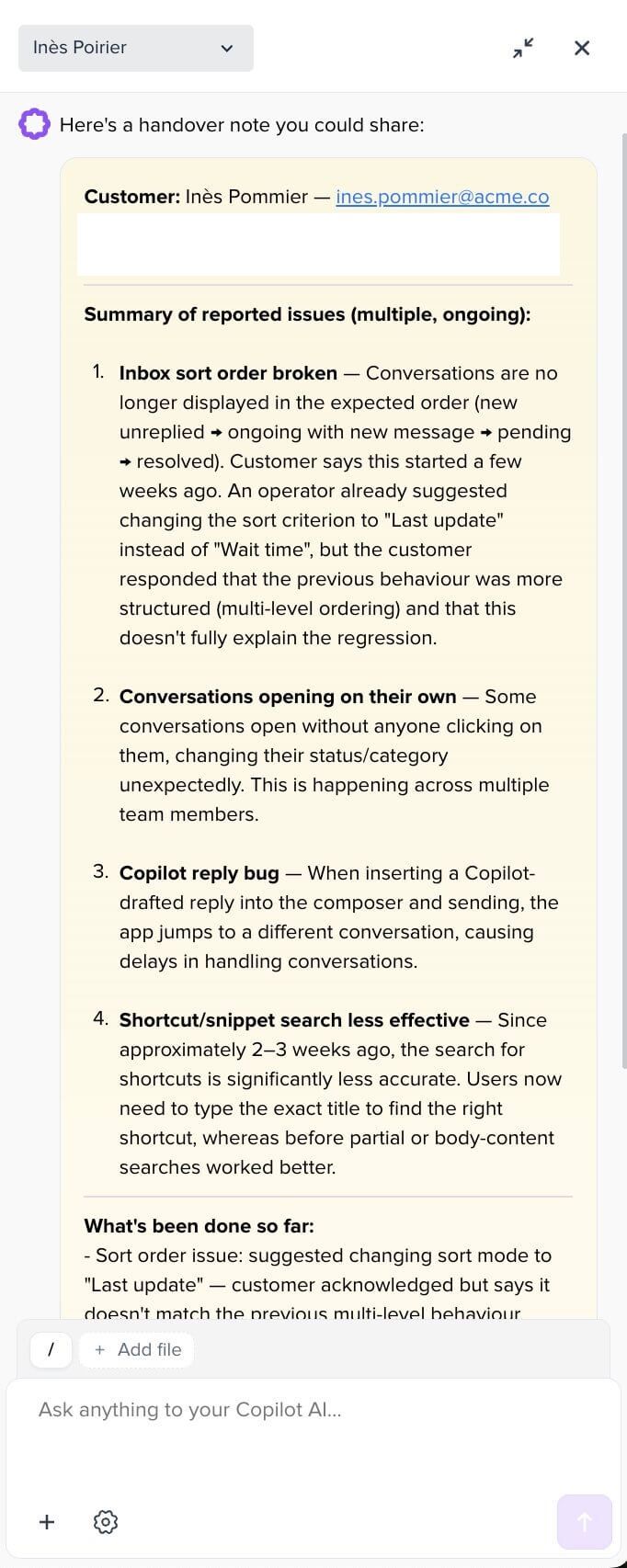
- AI-powered Assistant — Hugo AI is also helping support teams get perfect handover notes, summary or draft to make them more efficient at handling conversations that requires the most intense care.
Behind the scenes, the right people get the right information at the right time. From the customer's perspective, they simply receive faster, more effective help—without feeling shuffled between agents or departments.
Ready to make sure every escalation actually lands?
Frequently asked questions
What's the right escalation rate for a support team?
Between 10–15% is the cross-industry average; top-performing teams stay below that. Above 20–25% usually points to under-equipped tier-one agents or poor initial routing.
What's the difference between escalating to a team versus escalating to a person?
Ownership. A team can acknowledge a conversation indefinitely. A named person is accountable for the next action. Always escalate to a specific agent.
Should AI ever handle an escalated conversation?
AI should handle the cases that prevent escalation — routine issues resolved before they need a senior agent. Once a ticket is genuinely escalated, a human should own the resolution, with AI providing context and support.
How do internal notes improve escalation quality?
They let the escalating agent pass diagnostic context privately — what's been tried, what's suspected, why they're escalating — without the customer seeing the internal mechanics of the handoff.
What data does AI need to carry context effectively through an escalation?
A unified view of the customer: full conversation history across every channel, account and profile data, past ticket records, purchase or usage history, and any internal notes from previous interactions.
Should AI generate the handover brief, or should the human agent write it?
AI should generate it automatically as part of the escalation action. The human agent reviews and adds their judgment where needed. When a human agent is the one escalating, AI assists with drafting rather than leaving the agent to write from scratch under load.
Sources
Gartner, Agentic AI Will Autonomously Resolve 80% of Customer Service Issues by 2029, https://www.gartner.com/en/newsroom/press-releases/2025-03-05-gartner-predicts-agentic-ai-will-autonomously-resolve-80-percent-of-common-customer-service-issues-without-human-intervention-by-20290
Gartner, Effortless Experience Research, https://www.gartner.com/en/customer-service-support/insights/effortless-experience
Forrester, Contact Center Transformation Research 2025, https://www.forrester.com/report/contact-center-transformation
SQM Group, Escalation Rate Benchmarks 2024, https://www.sqmgroup.com/resources/library/blog/call-center-escalation-rate
AmplifAI, Customer Service Statistics 2026, https://www.amplifai.com/blog/customer-service-statistics
📚 Related articles
Proactive customer service: how to get ahead of issues instead of chasing them · SLA management in customer support: how to set response targets you actually keep · How to track customer conversations so nothing falls through the cracks

September 2026 - Product Update
Discover the new Knowledge Base editor, benchmark your AI support performance, track how often Hugo escalates conversations, and more. Discover the latest features and improvements released by the Crisp team in September 2026.


Summer 2026 - Product Update
Meet the refreshed Crisp experience, Understand how Artificial Intelligence handles every conversation, Build reusable teams across your workspace, and more. Discover the latest features and improvements released by the Crisp team in Summer 2026.

Best 9 helpdesk software and ticketing systems for 2026
Need help to choose your next helpdesk with a ticketing tool for 2026? We've gathered a guide that gives you everything you need to convince your C-levels.