Customer service automation: how to move from deflection to autonomous resolution
A chatbot deflects a ticket. The customer's problem is still unsolved. This guide covers why deflection-era automation is ending, what separates real resolution from a delay in disguise, and how to build automation in layers that actually closes the loop.


A support team automates. A chatbot goes in. A few canned responses, a handful of routing rules. Ticket volume to human agents drops, for a while.
Then the complaints start. Customers stuck in bot loops. "That didn't answer my question." A conversation deflected three times before a human finally picks it up, more frustrated than the customer ever was. The automation didn't resolve anything. It just delayed the human touch and called it progress.
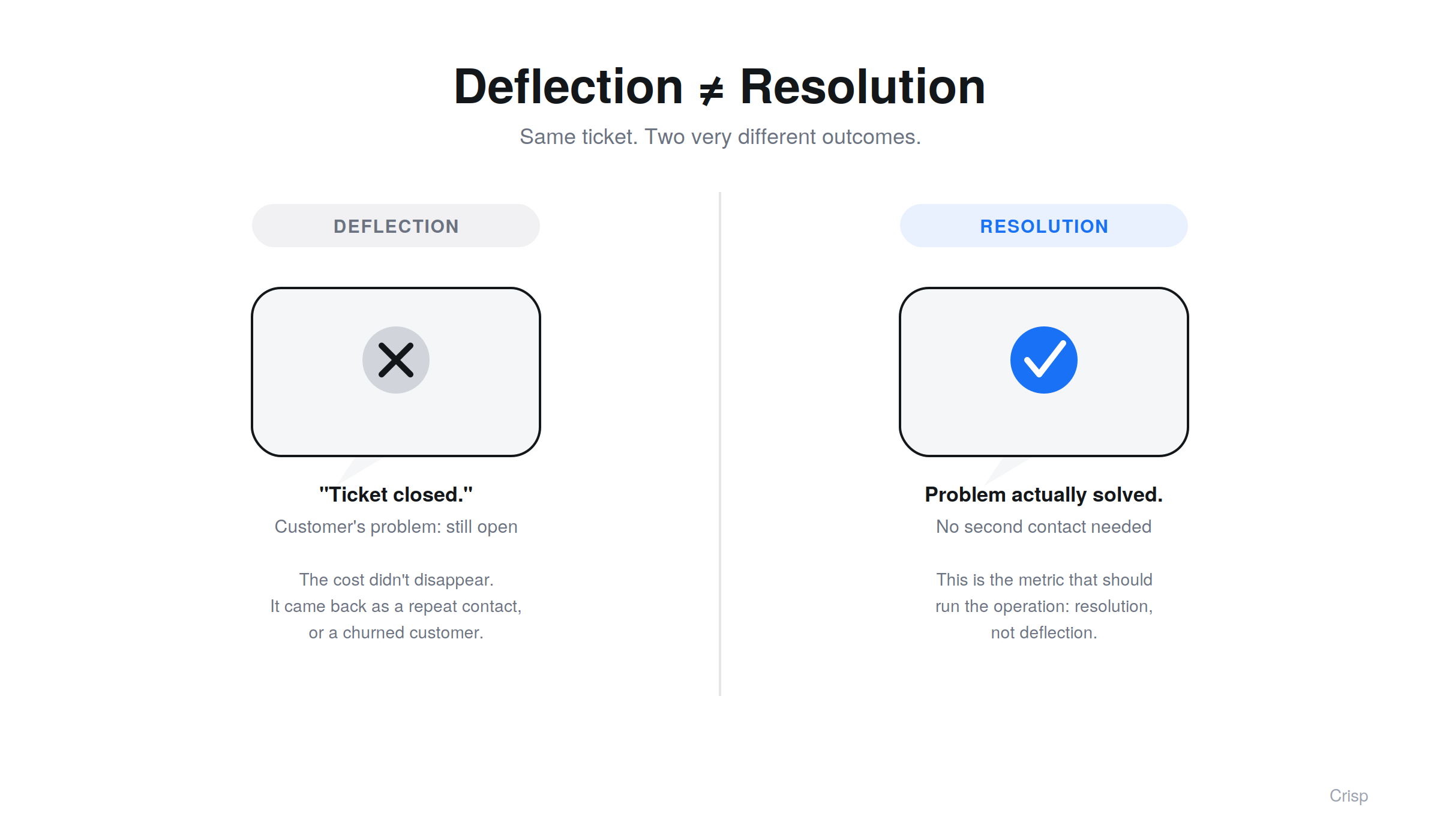
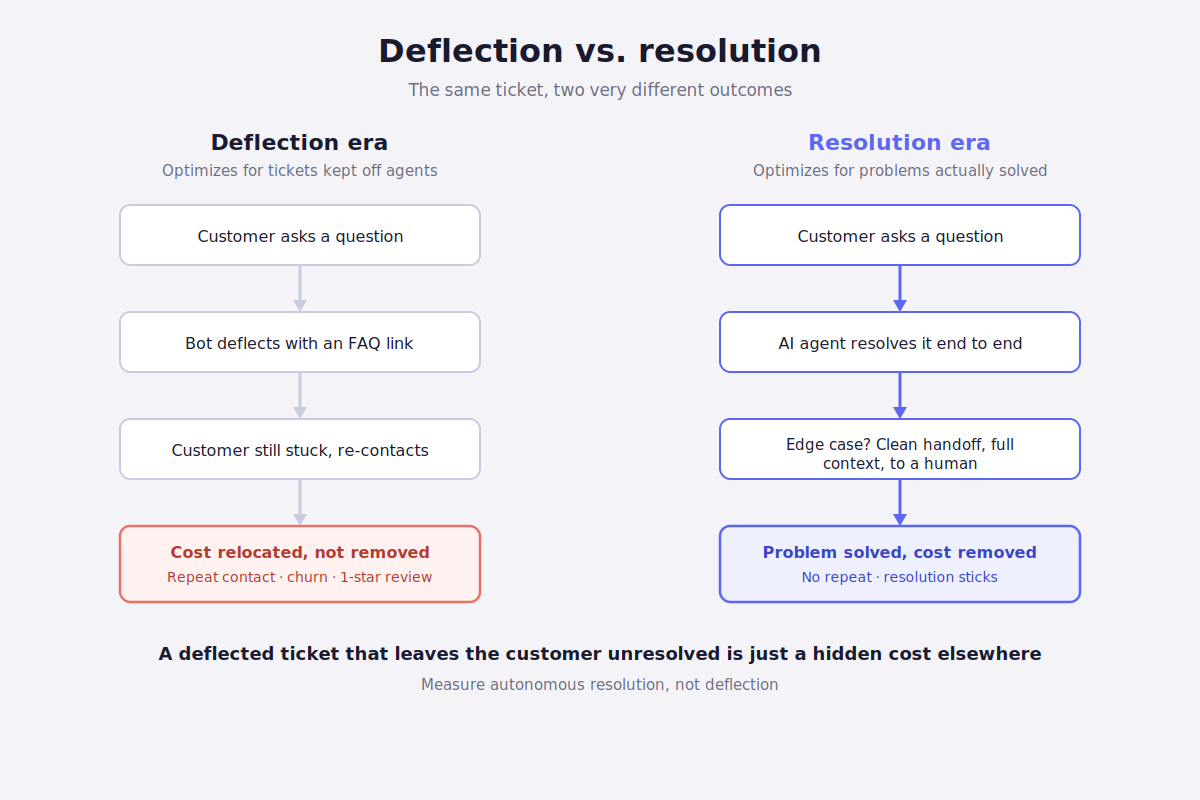
This is the trap most customer service automation falls into. It optimizes for deflection, getting tickets away from agents, instead of resolution, actually solving the customer's problem. A deflected ticket that leaves the customer unresolved doesn't disappear. It comes back angrier, or it churns quietly. The cost moved. It didn't go away.
There's a real shift underway, and it changes what "automation" even means. This guide covers what customer service automation is in 2026, why the deflection era is ending, and how to build automation that resolves issues end to end, keeping humans for the work that genuinely needs them.
By the end, you'll be able to:
- Tell the difference between deflection and true resolution — and why measuring the wrong one hides cost
- Recognize the signals your current automation is stalling rather than scaling
- Apply a clear model for what to automate and what to keep human
- Build automation in layers, from self-service to autonomous AI agents
- Track the agentic-era metrics that actually reflect whether automation is working
What is customer service automation?
Customer service automation is the use of technology, self-service content, workflow rules, and increasingly AI agents, to complete customer requests without requiring a human to handle each one individually.
That last clause is where the definition is quietly changing. For a decade, "automation" in support meant deflection: FAQ pages, chatbots, and macros designed to keep tickets away from human agents.
The modern definition raises the bar from deflection to resolution — automation is judged not by how many tickets it keeps off an agent's plate, but by how many customer problems it actually solves without one.
What it is, and what it is not
The term gets used loosely, which lets weak automation pass for the real thing. The distinctions matter because they determine what you measure and what you buy.
| What it's NOT | What it IS |
|---|---|
| Deflection — pushing tickets away from agents, resolved or not | Resolution — closing the customer's request, with or without a human |
| A chatbot that answers FAQs and escalates everything else | A layered system where AI resolves what it can and hands off cleanly when it can't |
| Replacing your support team | Removing the repetitive work so the team handles what needs judgment |
| A one-time setup ("turn on the bot") | An operating model that improves as it learns from resolved conversations |
Automation is not the same as simply using a chatbot. A chatbot is one tool; automation is the broader system of rules, workflows, and AI agents that together reduce manual work. And it is not headcount replacement. The highest-performing teams use it to redirect human effort, not eliminate it.
What's driving the shift
The capability changed. Earlier AI could generate text or summarize a conversation; it couldn't act. Agentic AI can — it takes steps to complete a task, not just describe one. Gartner predicts that by 2029, agentic AI will autonomously resolve 80% of common customer service issues without human intervention, cutting operational costs by 30%. That is a different claim from "deflect 80% of tickets" — it's resolution, not avoidance. Salesforce similarly forecasts that AI will handle half of all service cases by 2027, up from 30% in 2025. The category is moving from assisting agents to resolving on their behalf, and automation strategy has to move with it.
Why deflection-era automation stalls
The pattern
Deflection-era automation hits a ceiling fast. The chatbot handles the ten most common questions, deflection metrics look good for a quarter, and then the curve flattens. Everything past those ten questions still lands on a human — and now those humans are handling a queue that's been stripped of the easy wins, so their average handle time rises. The team automated the simple work and kept all the hard work, which feels like progress on a dashboard and like burnout on the floor.
The cost of measuring the wrong thing
The core failure is metric choice. When deflection is the headline number, a ticket that the bot "handled" counts as a win even if the customer left unresolved and simply gave up — or churned. The cost didn't vanish; it relocated to churn, to a second contact, to a one-star review. Industry analysis is increasingly explicit that treating deflection as the primary metric masks poor outcomes: a deflected-but-unresolved ticket is just a hidden cost somewhere else in the business.
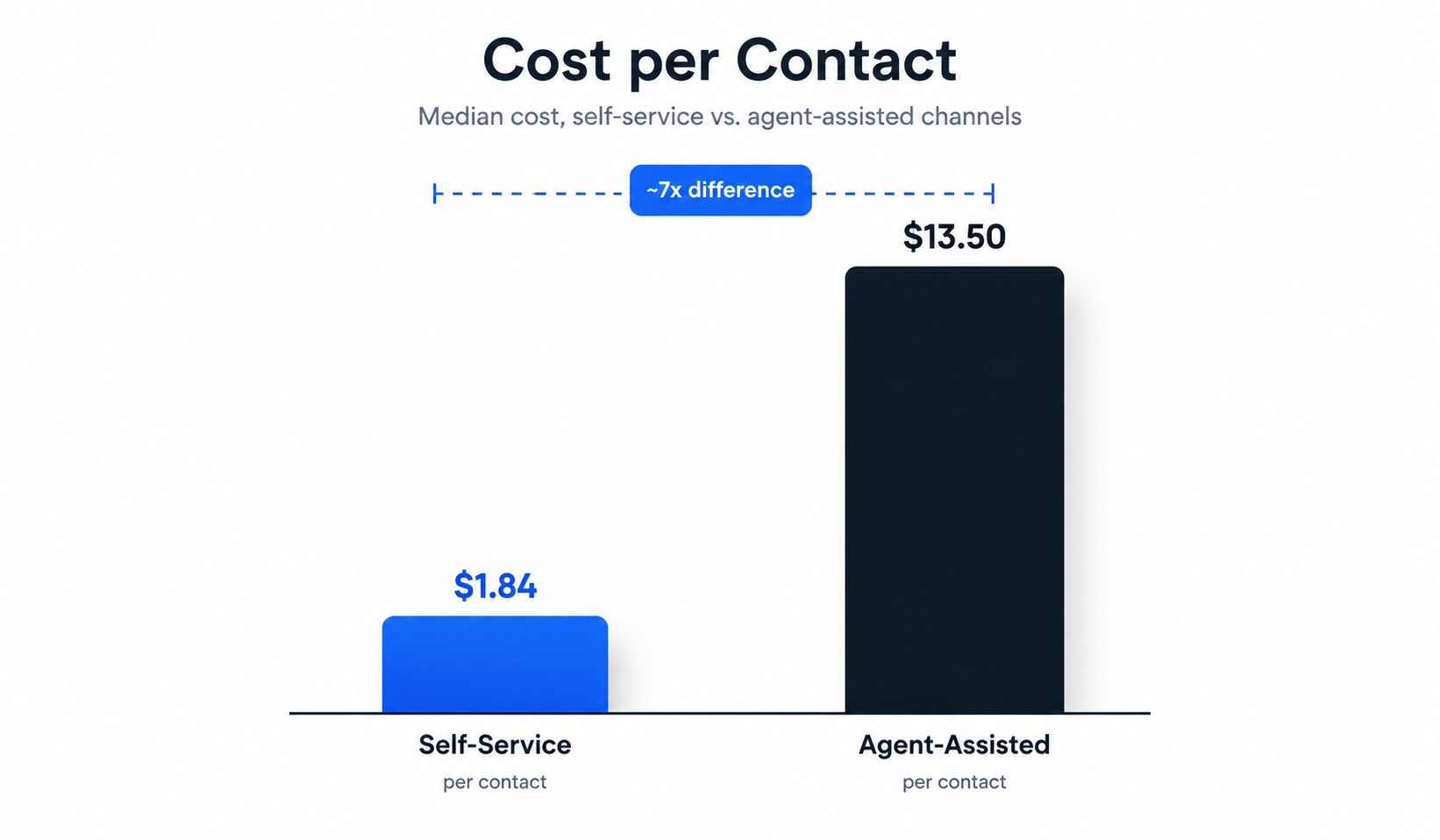
The economics underneath are real, which is what makes getting the metric right so valuable. Gartner benchmarks the median cost at roughly $1.84 per self-service contact versus $13.50 for an agent-assisted one — close to a sevenfold difference. That gap is the prize. But it only materializes if the automated contact actually resolved the issue. A cheap contact that didn't solve the problem generates an expensive second contact, erasing the saving.
You've hit this point if...
- Your deflection rate looks healthy, but repeat-contact rate and escalations are climbing in parallel.
- Agents say the queue feels "harder" than it used to — because automation skimmed off the easy tickets and left the rest.
- Customers regularly type "talk to a human" or "agent" to escape the bot within the first message.
- You can report how many tickets the bot handled, but not how many it actually resolved.
- Adding more canned responses or FAQ entries no longer moves any meaningful number.
If these are familiar, the problem isn't that you automated too much — it's that you automated for deflection instead of resolution.
What good customer service automation looks like
The solved state
When automation is working in the modern sense, the bulk of routine, well-structured requests — order status, password resets, refund eligibility, plan changes — is resolved end to end without a human ever touching them. The customer gets an answer in seconds, at any hour, and the resolution sticks: no second contact, no "that didn't help." Human agents spend their time on the conversations that genuinely need judgment, empathy, or a policy exception — and they arrive at those with full context already gathered by the automation layer, not starting cold.
Crucially, the system knows its own limits. When a request is sentiment-heavy or ambiguous — a complaint, a billing dispute, an edge case — the automation doesn't bluff its way through. It acknowledges, gathers what's relevant, and hands off to a human with everything pre-populated. The speed comes from AI; the judgment stays human.
Proxy metrics vs. real signals
The metric you lead with determines the behaviour you get. Deflection-era dashboards reward the wrong thing.
| Proxy metric (deflection era) | Real signal (resolution era) |
|---|---|
| Deflection rate — tickets kept off agents | Autonomous resolution rate — % closed without a human, and without a repeat contact |
| Tickets "handled" by the bot | Tickets actually resolved by the bot |
| Raw ticket volume reduced | Cost per resolution (not cost per ticket) |
| Bot containment | Human escalation rate, with clean context transfer |
| Response time only | CSAT on AI-handled conversations vs. human-handled |
The "real signal" column is the agentic-era vocabulary: autonomous resolution rate, cost per resolution, escalation rate, and CSAT on AI-handled conversations. These are the numbers that tell you whether automation is creating value or just relocating cost.
A realistic benchmark
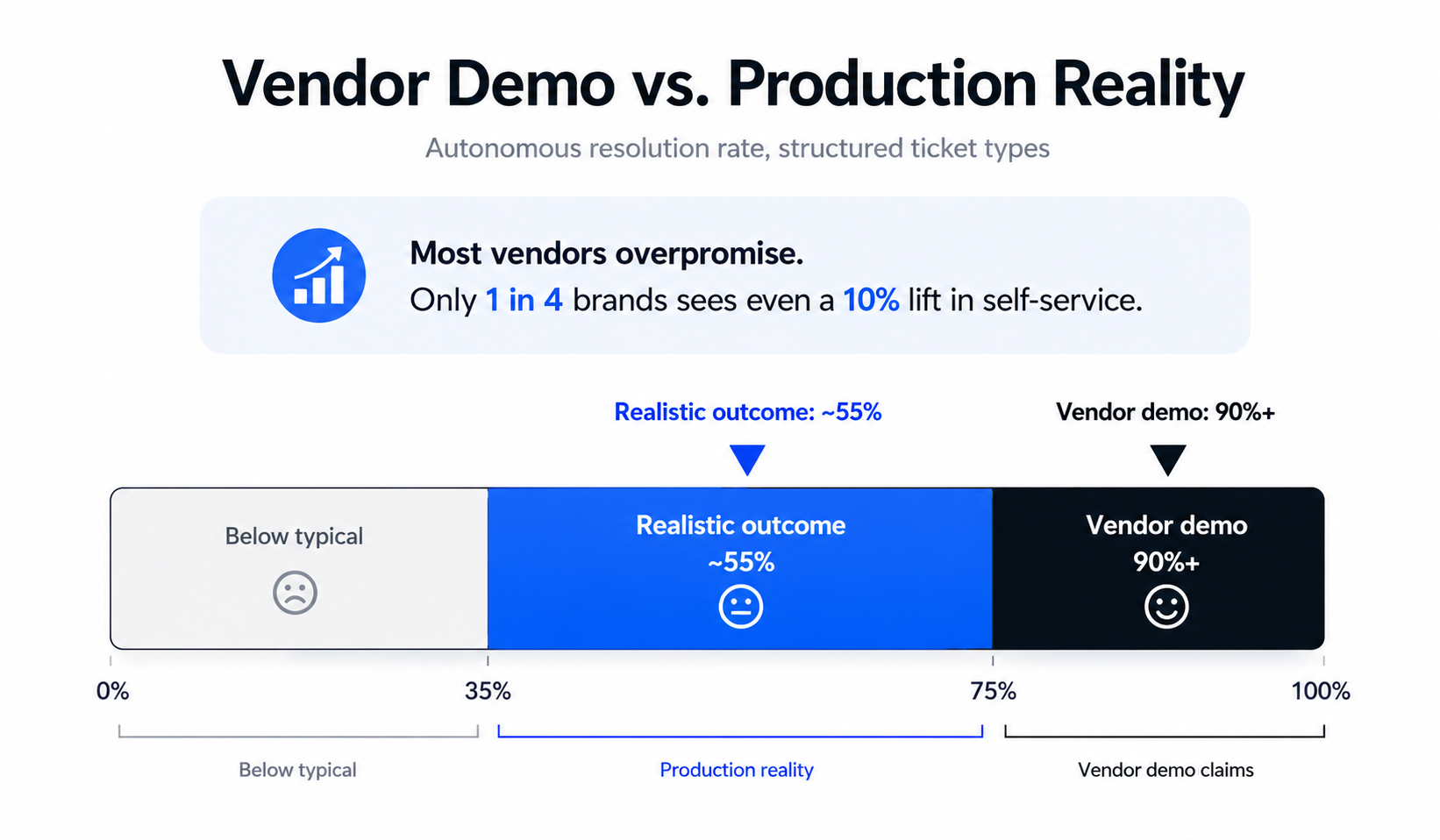
Be wary of vendor demos showing 90%+ automation. Production reality across implementations lands lower and varies sharply by ticket type: structured, repetitive intents can be largely resolved autonomously, while sentiment-heavy intents still belong with humans. The right target isn't "automate everything" — it's "autonomously resolve the structured majority, route the rest cleanly." A mid-sized team should expect meaningful but partial autonomous resolution, climbing as the system learns, not an overnight 80%.
How to automate customer service: a layered approach
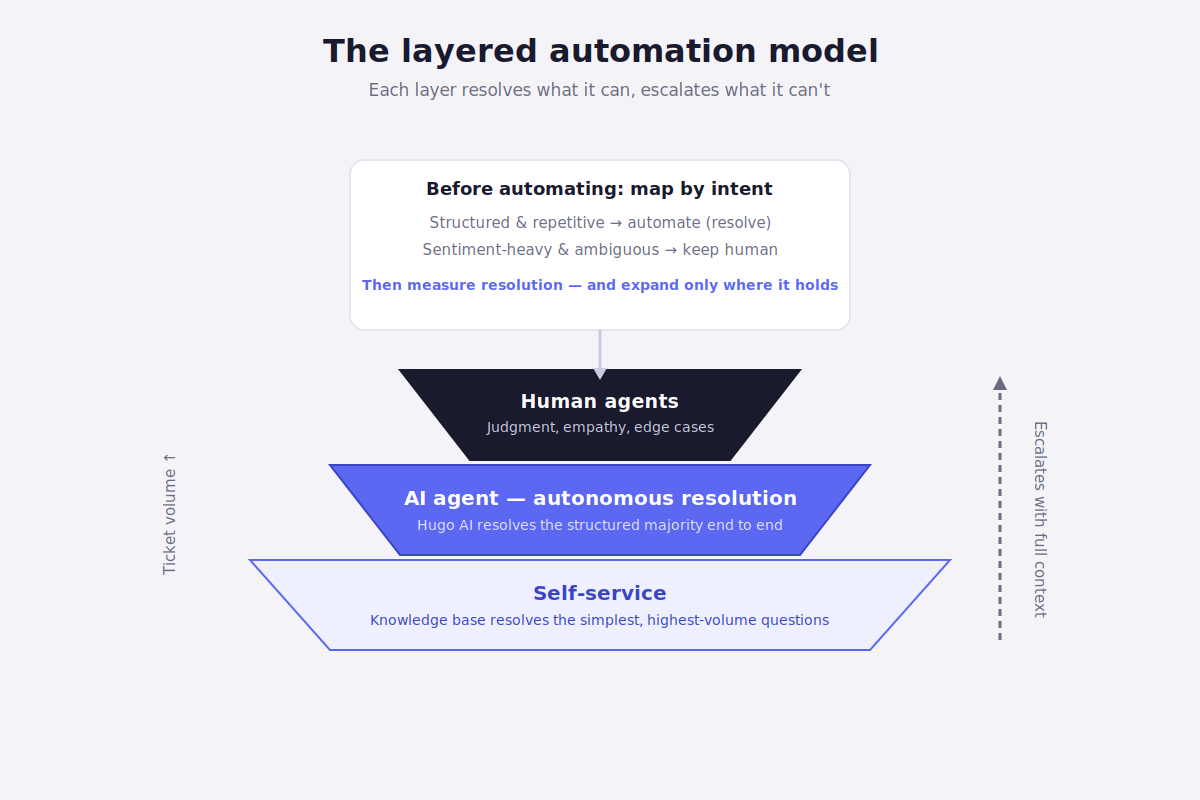
Step 1: Map what's repetitive before you automate anything
- What to do: Audit a few weeks of tickets and sort them by how structured and repetitive they are, order status and password resets at one end, nuanced complaints at the other.
- Why this step matters for this job: Automation applied blindly automates the wrong things. The structured, high-volume, low-judgment tickets are where autonomous resolution pays off; the sentiment-heavy ones are where it backfires. You can't automate well without this map.
- Watch out for: Automating by channel instead of by intent. The unit of automation is the type of request, not "all chat" or "all email."
Step 2: Start with self-service for the structured majority
- What to do: Stand up a knowledge base and self-service answers for the highest-volume, most structured questions — the ones customers would rather solve themselves anyway.
- Why this step matters for this job: Self-service resolves the simplest requests at the lowest cost per resolution, and it feeds the AI layer above it. A well-structured knowledge base is the foundation autonomous resolution draws on.
- Watch out for: Self-service that deflects without resolving. If customers can't find the answer and end up contacting support anyway, you've added a step, not removed one.
Step 3: Deploy an AI agent for autonomous resolution
- What to do: Layer an AI agent on top of your knowledge base and conversation history to resolve structured requests end to end — not just answer, but complete the task.
- Why this step matters for this job: This is the shift from deflection to resolution. An AI agent that can act — look up an order, process a status request, close the loop — removes the repetitive work entirely rather than delaying it.
- Watch out for: Deploying the AI agent without measuring resolution. If you can't see autonomous resolution rate and repeat-contact rate, you can't tell whether it's resolving or just deflecting.
Step 4: Build clean escalation with full context
- What to do: Define exactly when automation hands off to a human, and ensure the handoff carries the entire conversation and customer context with it.
- Why this step matters for this job: The difference between real automation and a frustrating deflector is the handoff. When AI escalates with full context, the customer never repeats themselves and the agent starts solving immediately. When it doesn't, automation just adds a wasted round trip.
- Watch out for: Escalation that drops context. A handoff that makes the customer start over is worse than no automation — it spends their patience twice.
Step 5: Measure resolution, then expand
- What to do: Track autonomous resolution rate, repeat-contact rate, escalation rate, cost per resolution, and CSAT on AI-handled conversations — then expand automation into the next tier of intents only where the numbers hold.
- Why this step matters for this job: Automation is an operating model that improves as it learns, not a one-time switch. Measuring resolution (not deflection) tells you where to expand safely and where automation is masking cost.
- Watch out for: Expanding on deflection numbers. If you grow automation based on tickets "handled" rather than resolved, you scale the hidden cost along with it.
Common mistakes that keep automation stuck
Measuring deflection instead of resolution. This is the root mistake that produces most of the others. When the headline metric is "tickets kept off agents," automation that frustrates and abandons customers still looks successful. The fix is to lead with autonomous resolution rate and repeat-contact rate, numbers that only move when the customer's problem is actually solved.
Automating sentiment-heavy work to chase a higher rate. Teams pushing for an impressive automation percentage start letting AI handle complaints, billing disputes, and emotionally charged issues, exactly the work where a technically correct, tonally wrong response does real damage. Structured intents are where autonomous resolution belongs; nuanced ones need a human, with AI handling the speed and gathering the context.
Treating automation as a one-time setup. "Turn on the bot" thinking caps automation at the first ten FAQs. The systems that compound are the ones treated as an operating model, measured, learned from, and expanded tier by tier as resolution holds. Automation that's never revisited quietly stops scaling while the dashboard still shows a green number from launch day.
Automate for resolution, not deflection
None of this requires ripping out what you already have. It requires pointing automation at the right target: not fewer tickets touching agents, but more customers walking away with an actual answer.
Crisp brings that layer together in one place instead of stitching it across separate tools. The knowledge base gives Hugo AI a single source of truth to resolve structured requests end to end, not just answer them. When a conversation needs a human, the handoff carries the full conversation and customer profile straight into the same shared inbox, so the customer never repeats themselves and the agent never starts cold. The analytics behind it track how much Hugo AI resolved on its own versus escalated, so you expand automation on outcomes, not guesswork.
Start resolving instead of deflecting.
Go deeper
Go deeper on each layer of customer service automation:
→ Task Automation in Customer Support: Complete 2026 Guide — the full breakdown of which repetitive tasks to automate first.
→ 7 AI Chatbot Workflows to Automate Customer Support Tasks — concrete workflow examples you can adapt to your own queue.
→ Customer Service Automations Every Support Team Should Deploy — a practical starter set of automations.
→ How AI Improves Customer Service Workflows — where AI fits across the support workflow end to end.
Frequently asked questions
What does "deflection" mean in customer support, and why does it get criticized?
Deflection means keeping a ticket away from a human agent, regardless of whether the customer's problem actually got solved. It gets criticized because a deflected ticket that leaves someone unresolved doesn't vanish. It shows up later as a repeat contact, a churned customer, or a bad review, which is why more teams are shifting to resolution as the metric that matters.
How much cheaper is self-service than a human agent?
Gartner benchmarks the median cost at roughly $1.84 per self-service contact versus $13.50 for an agent-assisted one, close to a sevenfold difference. That saving only holds if the self-service contact actually resolves the issue.
What percentage of customer service will eventually be handled by AI?
Forecasts vary by source and time horizon. Gartner projects agentic AI could autonomously resolve 80% of common service issues by 2029.
Can AI fully replace human customer support agents?
Current data doesn't support that. PwC's 2025 Customer Experience Survey found 86% of consumers still consider human interaction essential to their brand experience, and independent forecasts caution that scaling autonomous resolution is a gradual process, not an overnight switch. The practical model emerging across the industry is AI handling the structured majority with humans retained for judgment-heavy exceptions.
What is agentic AI, and how is it different from earlier customer service AI?
Earlier AI tools could generate text or summarize a conversation but couldn't act on it. Agentic AI can take steps to complete a task, looking up an order, processing a request, closing a loop, rather than just describing what someone else should do next.
Sources
Gartner, "Gartner Predicts Agentic AI Will Autonomously Resolve 80% of Common Customer Service Issues Without Human Intervention by 2029," https://www.gartner.com/en/newsroom/press-releases/2025-03-05-gartner-predicts-agentic-ai-will-autonomously-resolve-80-percent-of-common-customer-service-issues-without-human-intervention-by-20290
Gartner, "Benchmarks to Assess Your Customer Service Costs," https://www.gartner.com/en/documents/5164231
Salesforce, "AI Expected to Resolve Half of Service Cases by 2027, Data Shows," https://www.salesforce.com/news/stories/state-of-service-report-announcement-2025/
McKinsey & Company, "Beyond the Bot: Building Empathetic Customer Experiences with Agentic AI," https://www.mckinsey.com/capabilities/operations/our-insights/beyond-the-bot-building-empathetic-customer-experiences-with-agentic-ai
National Bureau of Economic Research, "Generative AI at Work," https://www.nber.org/papers/w31161
Harvard Business School Working Knowledge, "When AI Chatbots Help People Act More Human," https://www.library.hbs.edu/working-knowledge/when-ai-chatbots-help-people-be-more-human
Forbes, "AI Gets Real For Customer Service In 2026," https://www.forbes.com/sites/forrester/2025/12/10/ai-gets-real-for-customer-service-in-2026/
PwC, "2025 Customer Experience Survey," https://www.pwc.com/us/en/services/consulting/commercial-excellence/library/2025-customer-experience-survey.html
Statista, "What Is the Most Important Aspect of a Good Customer Service Experience?," https://www.statista.com/statistics/810614/important-aspects-of-a-good-customer-service-experience/
📚 Related articles

September 2026 - Product Update
Discover the new Knowledge Base editor, benchmark your AI support performance, track how often Hugo escalates conversations, and more. Discover the latest features and improvements released by the Crisp team in September 2026.


Summer 2026 - Product Update
Meet the refreshed Crisp experience, Understand how Artificial Intelligence handles every conversation, Build reusable teams across your workspace, and more. Discover the latest features and improvements released by the Crisp team in Summer 2026.

Best 9 helpdesk software and ticketing systems for 2026
Need help to choose your next helpdesk with a ticketing tool for 2026? We've gathered a guide that gives you everything you need to convince your C-levels.