The Real Cost of Managing Customer Emails With CC and Reply-All (With Data)
CC and reply-all feel free. They cost duplicate replies, lost ownership and hours of inbox triage. Here is what that adds up to for a support team, and what replaces it once AI takes the first reply.


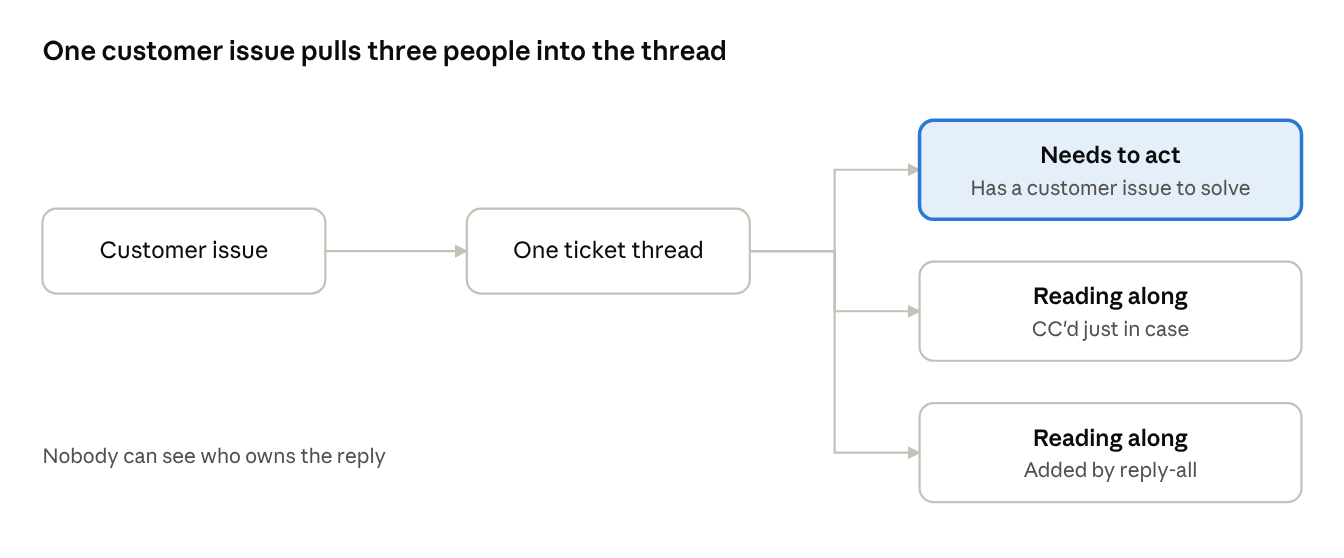
It is always the same behavior: a support ticket comes in, someone CCs a manager "just in case", the manager replies-all with a question. Now three people are on a thread meant for one customer issue, and two of them are reading messages that don't require anything from them.
Multiply that by every ticket a team handles in a week, and CC and reply-all stop being a minor habit: they become a measurable pain on the team's time, mental load, trust, and ability to resolve anything.
In an AI-first customer support model, where an AI agent takes the first reply and humans own the escalations, that cost is easier to see and easier to remove, because the real problem was never etiquette: it was that nobody could see who owned the conversation and acknowledge resolution.
This article isn't a productivity-blog complaint about "too much email." It's a specific, data-backed look at what CC and reply-all cost a support team, drawn from research on trust, time and customer experience, and at what the architecture behind a conversation should do instead in 2026 and beyond.
Key findings
- Six studies of more than 900 working adults at Cambridge Judge Business School (2017) found that copying a supervisor more often made colleagues feel less trusted, in Western and Chinese samples alike.
- In McKinsey's 2012 study, interaction workers spent an estimated 28% of the workweek managing email, so CC and reply-all volume multiplies a cost that is already large rather than adding a separate one.
- On teams running an AI agent, about 40% of conversations close with no human involved, so they never reach a thread anyone could be copied on.
- 25% of US brands declined in Forrester's 2025 CX Index, the second straight year of decline, so a duplicate or contradictory reply lands on customers who already expect less.
Finding 1: CC doesn't build trust, it erodes it
The instinct behind CCing a manager or teammate on a customer thread is usually good: keep people informed, stay transparent, cover the bases. A 2017 series of six studies led by David De Cremer at Cambridge Judge Business School, outlined in Harvard Business Review, found the opposite effect: The core result came from 594 working adults who responded to scenarios where a supervisor was always, sometimes, or almost never copied.
When the supervisor was always copied, recipients felt trusted significantly less, and the result held in both Western and Chinese samples.
The mechanism matters for a support team: when CC becomes the default way of keeping people in the loop, it doesn't land as transparency with the person receiving it.
In a further survey of 345 employees, frequent copying of a supervisor left people feeling less trusted and led them to infer that the wider culture was low in trust, with a culture of fear and low psychological safety.
De Cremer's conclusion is that electronic transparency, however well-intentioned, can make employees suspicious and prove counterproductive: what the sender means as transparency, the recipient reads as distrust.
It points at the real problem: CC is an indirect, unreliable stand-in for a shared view of who is already on a conversation.
Finding 2: every email CC and reply-all email is a loss in productivity
Email management already consumes a disproportionate share of the workweek before CC and reply-all habits are added on top. In McKinsey Global Institute's 2012 study, the average interaction worker spent an estimated 28% of the workweek managing email and nearly 20% looking for internal information or tracking down colleagues who could help.
CC and reply-all don't create a separate cost category, they inflate both numbers: every person added to a thread who doesn't need to act on it still has to read it, judge whether it's relevant, and decide whether to respond. That is work that produces no forward progress on the actual customer issue, but creates mental load, and time lost.
Finding 3: the customer-facing version costs even more
Inside a support team, CC and reply-all culture has a second, sharper failure mode. It is often the exact mechanism that produces duplicate or contradictory replies to a customer. A message CC'd to three people with no explicit owner creates the same ambiguity as a shared inbox without collision detection: everyone assumes someone else is handling it, or several people handle it independently at once.
That failure is expensive in a way internal email fatigue is not, because the customer sees it. Two answers that contradict each other, or a follow-up nobody owns, tell the customer the team itself doesn't know who is handling their issue. It lands on an experience that is already slipping: in Forrester's 2025 CX Index, built on more than 275,000 customers, 25% of US brands declined in CX quality, the second straight year of decline.
The cost of a confusing internal CC chain doesn't stay internal once it produces a visible inconsistency the customer actually sees.
What the data means for support teams
None of this means copying a colleague is always wrong. Sometimes a second set of eyes is genuinely needed. What the data supports is narrower: CC and reply-all are poor default mechanisms for coordinating customer conversations, because they optimize for informing people, not for assigning ownership.
A thread with five people CC'd lists who might be involved, not who replies. That ambiguity is where duplicate replies and dropped conversations come from. Removing it is the core of omnichannel support.
Crisp's State of AI Support report found that on teams running an AI agent, about 40% of conversations closed with no human involved, and the median AI first response was 7 seconds against about 14 minutes for humans. A conversation resolved at the first turn never reaches a CC thread, and one that escalates arrives in a single shared conversation with an owner.
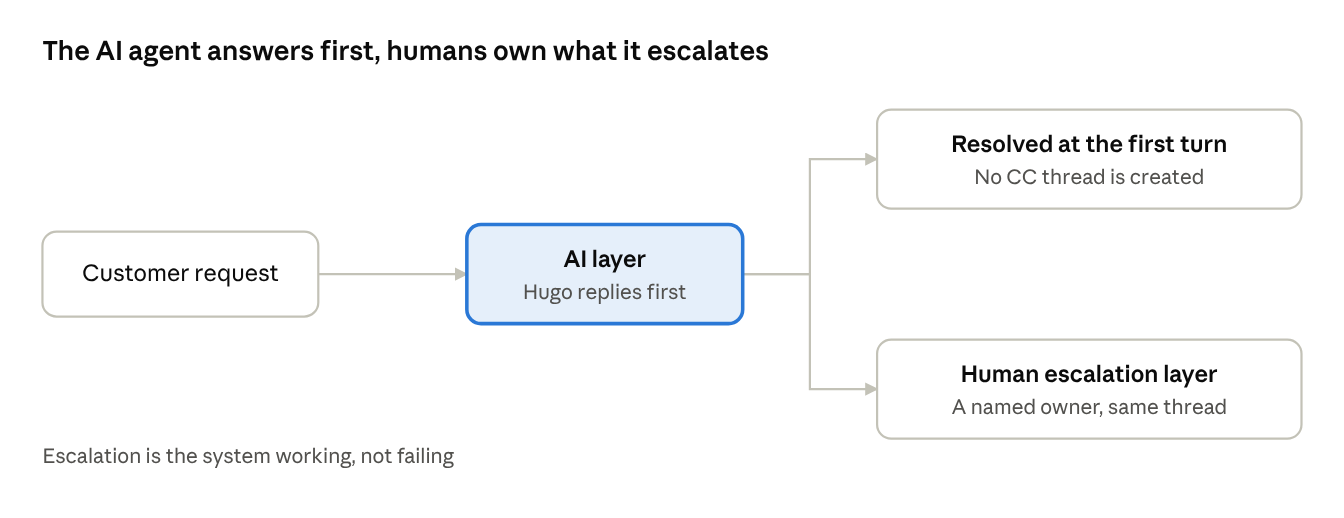
When a second person does need to be involved, the choice is about their role, not habit. If they need to act, they become the owner. If they only need to weigh in, they add an internal note inside the conversation. If they only need awareness, seeing who is already on the conversation does the job, with no copy sent.
The metrics that matter
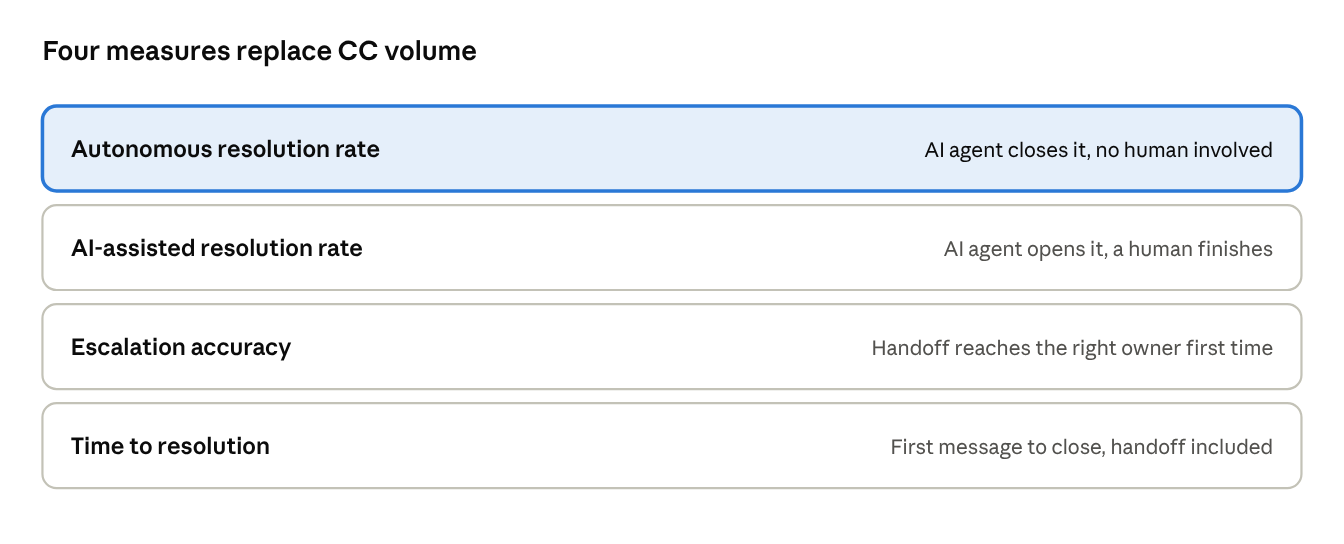
Counting who was copied measures noise. Four measures describe whether the system is working:
- Autonomous resolution rate: the share of conversations the AI agent closes with no human involved.
- AI-assisted resolution rate: the share where the AI agent opens the conversation and a human finishes it.
- Escalation accuracy: the share of handoffs that reach the right owner the first time.
- Time to resolution: how long a conversation takes from first message to close, handoff included.
An escalation is the system working as designed, so it isn't a number to drive to zero. Expect the human queue to look slower, too: on teams running an AI agent, human-only conversations reached a median first response of about 32 minutes, against 13 minutes on teams without one, because the AI leaves people the harder cases.
How Crisp fits into this
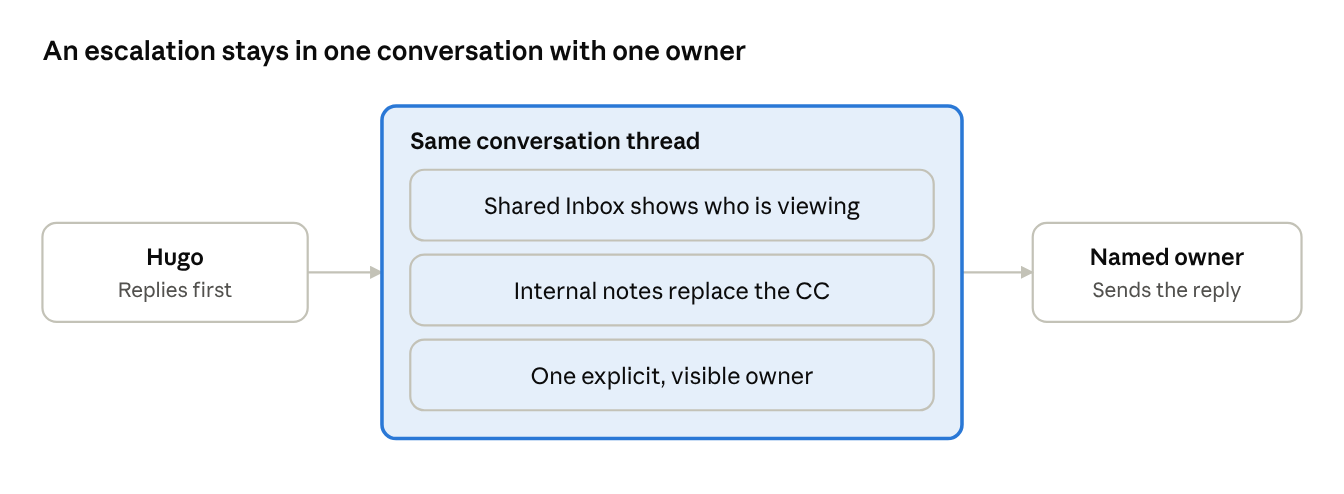
Hugo, Crisp's AI agent, takes the first reply on email, chat and every other connected channel. When it can't finish a conversation, a human picks it up in the Shared Inbox as the same thread, with its full history, not as a forwarded copy with a CC list attached.
The rest of the CC habit has a native replacement too:
- One owner instead of a CC list. Routing assigns every conversation to one named operator, so responsibility sits on the conversation itself, not on whoever was looped in.
- Private notes instead of reply-all. Colleagues weigh in with notes and mentions inside the conversation. The customer never sees them, and nobody has to reconcile a parallel thread.
- AI Copilot instead of looping in a manager. /summary briefs anyone who joins a conversation in seconds, and /handover writes the brief when a case moves to another team.
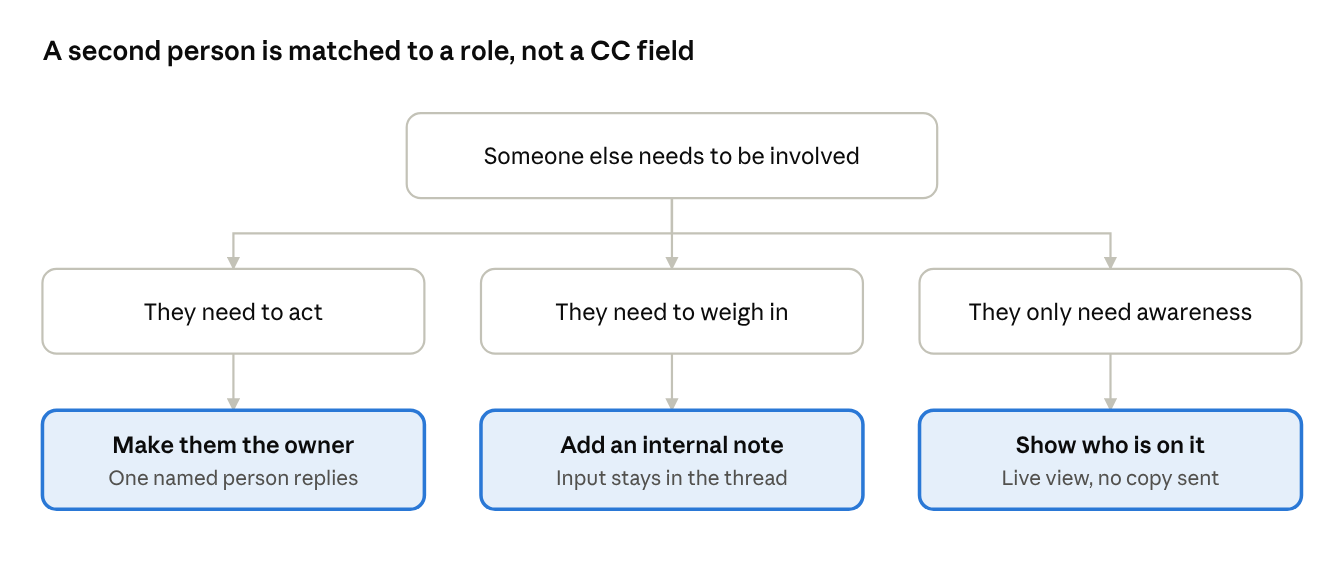
The handoff happens inside the same conversation, so visibility, notes, and ownership replace the CC list.
Once that visibility exists natively in the inbox, the impulse to CC someone "just in case" mostly stops being necessary. Still running support from a shared mailbox? Start with these shared inbox tips, then compare the best shared inbox software.
Ready to replace CC with actual visibility?
Crisp's Shared Inbox shows your whole team who's already on a conversation, in real time, while Hugo takes the first reply. No CC required.
Frequently Asked Questions
Why is CC bad in customer support?
CC tells people a conversation exists without saying who owns it. Everyone copied has to read it and decide whether it concerns them, and the person writing to the customer can't tell who is already replying. That ambiguity creates duplicate answers, dropped threads, and a quiet loss of trust between colleagues over time.
When should you CC someone on a customer email?
Only when someone needs awareness and has no other way to see the conversation, such as a partner outside your support tool. Inside the team, CC is the wrong tool. If they need to act, assign them the conversation. If they need to weigh in, mention them in a private note, so the customer thread stays clean and ownership stays clear.
Should you reply or reply all to a customer email?
Reply to the customer, and keep internal discussion out of the customer thread. Use reply all only when everyone already on the thread needs the answer, such as a customer who copied their own colleagues. Internal follow-up belongs in a private note, not in another reply-all.
What should replace CC and reply-all on a support team?
Three things: a shared view of who is looking at each conversation, internal notes for colleagues to contribute, and one named owner. Together they do what CC was trying to do, informing people and gathering input, without a parallel email thread that someone must read and reconcile with the customer-facing reply.
How do you stop two agents replying to the same customer?
Make ownership visible before anyone starts typing but also, your customer support tools should support ticket colision. When every teammate can see who is already viewing a conversation, and each conversation has one named owner, nobody has to guess.
How does AI-first support reduce CC and reply-all?
When an AI agent takes the first reply and resolves routine questions, those conversations never reach a human, so there is nothing to copy anyone on. The ones that escalate arrive in one shared thread with a clear owner.
Who should own a customer conversation that involves several teammates?
One person, named in the conversation itself. Others contribute through internal notes, but the owner is responsible for the customer-facing reply and for closing the loop.
Sources
Crisp, The State of AI Customer Support 2026: https://crisp.chat/en/reports/state-of-ai-support/
Cambridge Judge Business School, Cc'ing the boss can 'backfire': https://www.jbs.cam.ac.uk/2017/ccing-the-boss-can-backfire-2/
McKinsey Global Institute, The social economy: Unlocking value and productivity through social technologies: https://www.mckinsey.com/industries/technology-media-and-telecommunications/our-insights/the-social-economy
Forrester, Forrester's 2025 Global Customer Experience Index Rankings: https://www.forrester.com/press-newsroom/forrester-global-customer-experience-index-2025-rankings/

Omnichannel customer support: how to never miss a customer request
Customer requests rarely get ignored on purpose. They slip between channels, sit unassigned or close without a fix. Here is how to centralize every channel, route automatically and track each request to resolution, with AI answering first.

Reduce Repetitive Support Tickets With a Self-Service Knowledge Base
A knowledge base only cuts tickets if customers find the answer before they write. Here is how to build one that does: answer-first articles, search that matches real phrasing, multilingual coverage and upkeep driven by data.

Internal Notes vs. Email Forwarding: The Better Way Your Team Should Be Collaborating on Customer Tickets
Forwarding a customer email to ask a teammate creates two threads that drift apart. Internal notes keep the question, the answer and the customer history in one place, which matters more once AI hands over only the hard cases.