Reduce Subscription Churn with 24-7 Support and Fast Response
Slow support means cancellations you can't prevent. We have gathered a list of use-case that leverage Crisp AI chatbot for customer support to help you reduce churn. Check it out!

It's 11:04 PM on a Thursday.
A customer you've had for eight months opens your chat widget. Their card just got declined on renewal. They don't know why. The charge looked wrong. They're confused, slightly annoyed, and, crucially, still on your site.
Nobody answers.
Hours later, they've Googled a competitor. By midnight, they've started a free trial. By the time your team reads the ticket on Friday morning, the subscription is already cancelled.
This isn't a hypothetical. It's the single most common form of voluntary churn. And, it has almost nothing to do with your product.
68% of customer churn happens because customers feel unappreciated, not because they found a better tool. The cancellation decision rarely comes from a single catastrophic failure. It comes from a slow accumulation of moments where the customer felt ignored: a delayed ticket, a generic auto-reply, a billing confusion that dragged on for days.
At some point, the mental calculus tips. The friction of staying outweighs the cost of leaving.
For subscription businesses, this compounds fast. Lose 5% of your subscribers each month, and you've lost over half your base within a year.
The economics of recovery are brutal: acquiring a new customer costs 5–25× more than keeping an existing one, and even a 5% improvement in retention can increase profits by 25–95%.
The lever most teams underinvest in? The quality and speed of their customer support, particularly outside business hours.
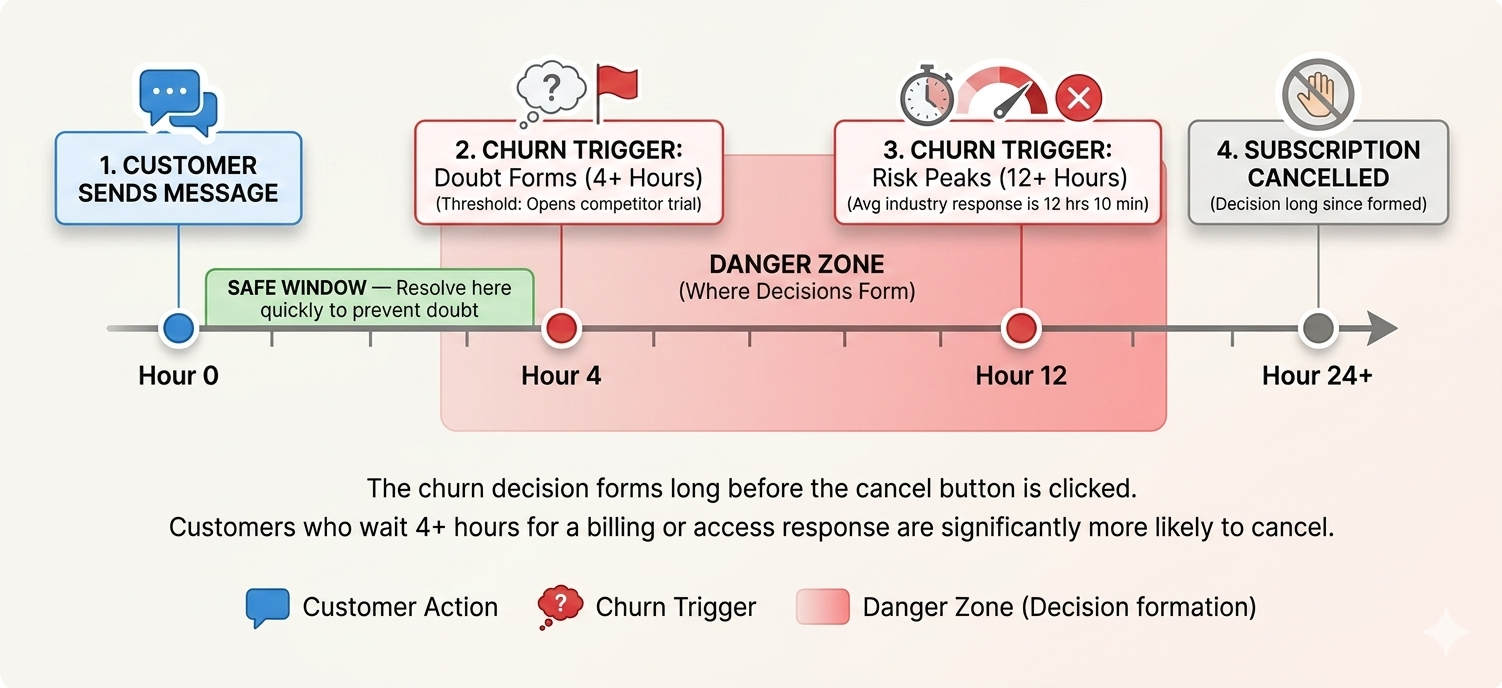
Why support quality drives more churn than most teams think
Most subscription businesses attribute churn to price, feature gaps, or competition. These factors are real, but they rarely tell the full story.
When researchers examine exit surveys and cancellation flows, a different picture emerges. Support failures (slow responses, unresolved tickets, cold or impersonal interactions) are consistently among the top drivers of voluntary cancellation. The relationship is direct: a customer who contacts support and doesn't get a timely, useful response is far more likely to churn than one who never had an issue at all.
90% of customers rate an "immediate" response as essential when they have a question, and 60% define "immediate" as within 10 minutes. The industry average for email response, meanwhile, sits at over 12 hours. That gap is where churn decisions get made.
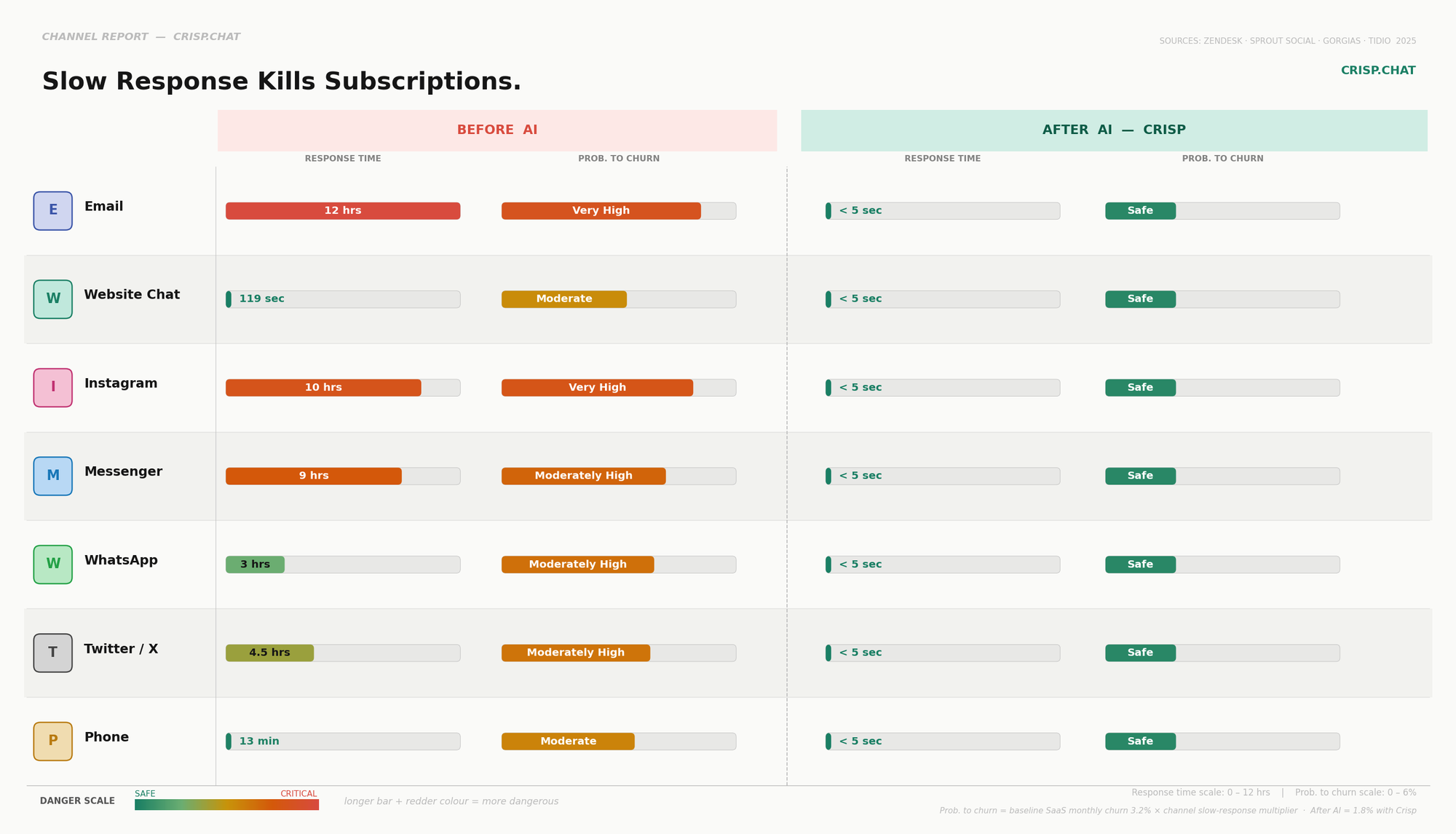
The asymmetry here matters: customers who receive a fast, helpful response are often more loyal afterward than customers who never had a problem. A well-handled support interaction creates trust. Handled poorly — or left pending — it accelerates disengagement.
For subscription businesses in particular, the timing of support failures is disproportionately damaging. A customer questioning a billing charge, unable to access a feature they expected, or confused about their plan has a short decision window. If you're not reachable in that window, the doubt compounds.
They open a competitor's site. The next morning when your team replies, the subscription is already cancelled.

Reactive vs proactive support: the retention gap
Most support teams operate reactively by design. A ticket arrives; a team member handles it. The system works fine until two conditions collide: the ticket is high-stakes, and the team is unavailable.
Proactive support breaks this dependency. Instead of waiting for distress signals, it intercepts them — before the customer has consciously decided to leave. The table below shows what that difference looks like operationally:
The gap between these two models isn't a technology gap. It's a structural one. The businesses with the lowest churn rates have made proactive, 24/7 support structurally impossible to skip, not as a differentiator, but as a baseline expectation.
How to retain customers through support: 5 use cases where Crisp AI prevents churn
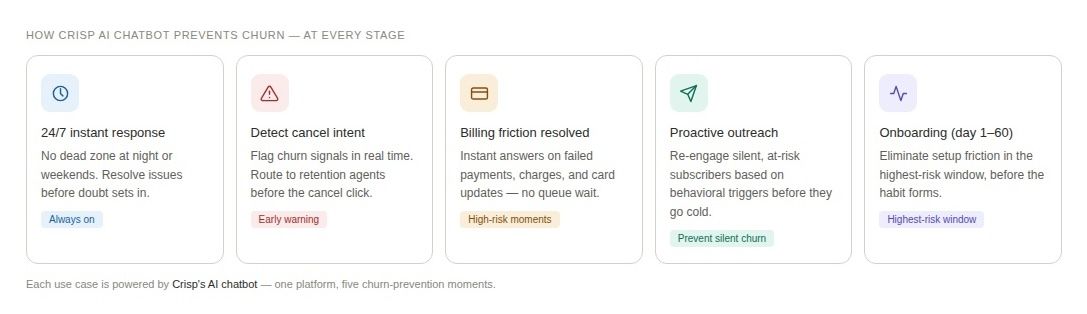
1. Instant response at any hour
SaaS users onboard at midnight. E-commerce subscribers contact support on Sunday afternoons. Every hour a support request sits unanswered is an hour the customer spends reconsidering their subscription.
Think about what's happening in that silence. The customer doesn't think 'they're just offline.' They think 'they don't care.' That's the distinction that matters for retention.
For billing or access issues specifically, customers who wait more than 4 hours are significantly more likely to cancel than those who receive a response within the hour.
How Crisp does it: Crisp's AI chatbot handles inbound support conversations 24/7 — not with scripted deflection, but with genuine resolution. Trained on your knowledge base, it answers account questions, explains plan features, guides users through common issues, and escalates to a human when the situation requires it. For most routine inquiries, it resolves the issue entirely before a human agent ever needs to step in.

2. Detecting cancellation intent before the customer reaches the cancel button
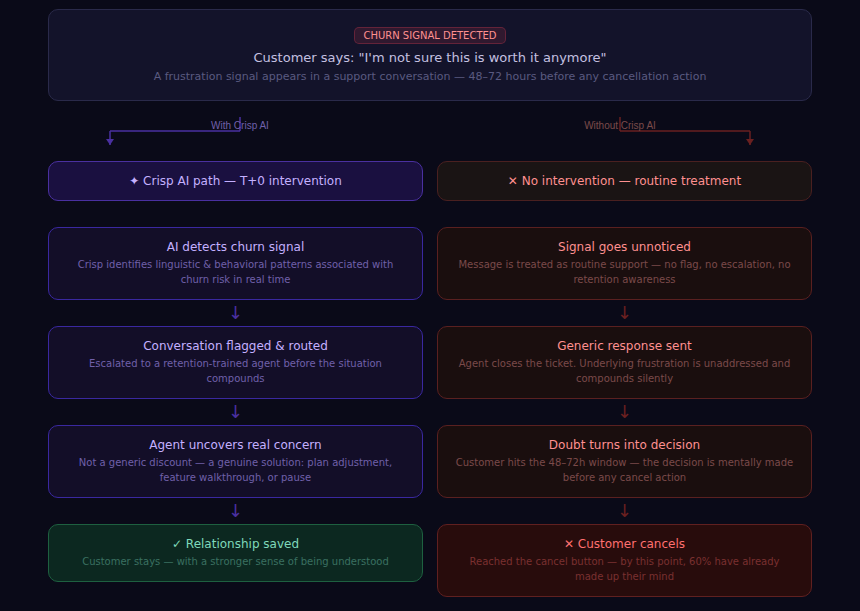
By the time a subscriber clicks 'cancel,' the decision is usually already made, sometimes, way back in the past. Around 60% of customers who reach the cancellation flow have already made up their mind. The window to save the relationship was 48–72 hours earlier.
Fortunately, customers telegraph churn intent in support conversations before they act on it. Complaints about value, questions comparing plans, sudden spikes in frustration, all these signals appear in chat data well before a formal cancellation. Most support teams aren't watching for them. Even teams that do so can do it effectively at scale.
How Crisp does it: Crisp's AI chatbot can be configured to detect linguistic and behavioral signals associated with churn risk in real time (and at a scale), and flag or route those conversations to a retention-trained agent before they escalate. That agent's job isn't to deliver a generic discount. It's to understand the underlying concern and offer a genuine solution: a plan adjustment, a walkthrough of an underused feature, a temporary pause instead of a cancellation.
3. Resolving billing issues before they become cancellation reasons
Billing friction is one of the highest-churn triggers in subscription businesses. Failed payments, unexpected charges, confusion about renewal dates; each one creates a moment where the customer weighs whether the service is worth the hassle.
Failed payments carry a dual risk: they trigger involuntary churn directly if unresolved, and they trigger voluntary churn when the handling feels cold. The customer who receives three generic dunning emails and nothing else doesn't feel like a valued subscriber.
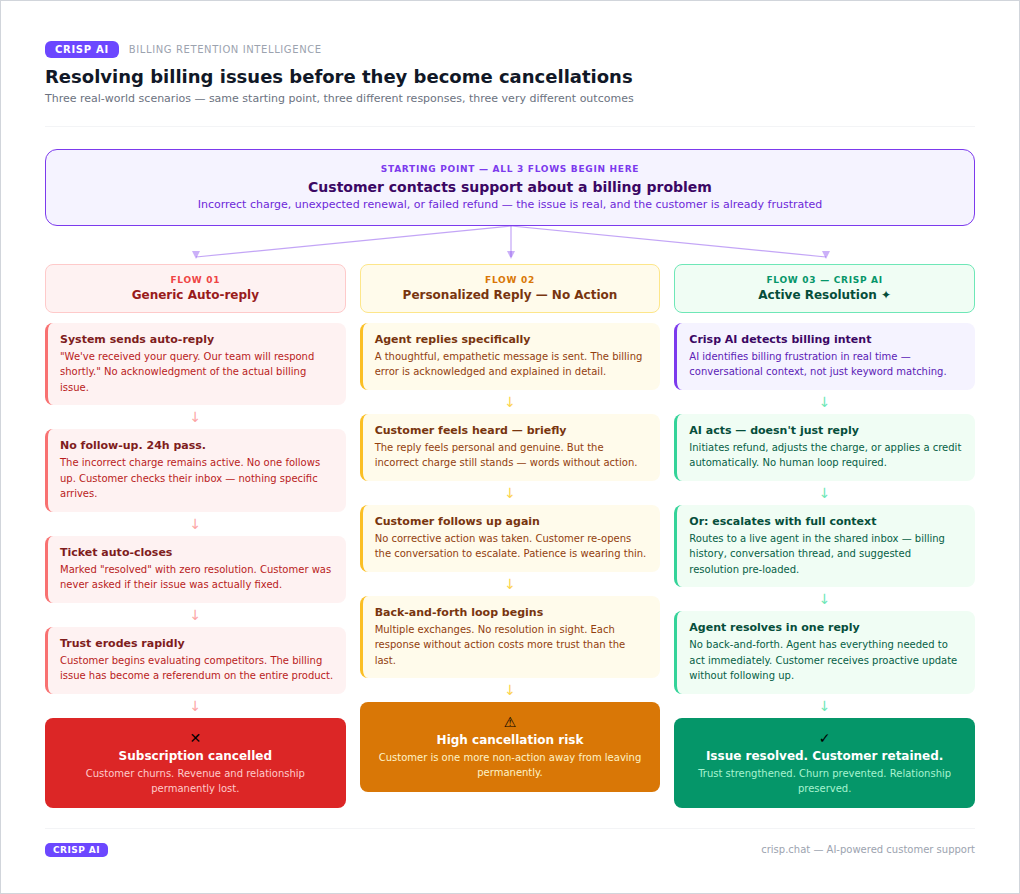
How Crisp does it: Crisp's AI Support Chatbot handles incoming billing inquiries instantly — explaining failed payments, walking customers through card updates, and surfacing relevant account information without requiring the customer to wait for a human agent. For more sensitive billing escalations, it routes immediately to a live agent with full conversation context already loaded. Crisp's shared inbox ensures the agent sees the customer's billing history, plan details, and prior support interactions in a single view.
4. Proactive outreach to at-risk subscribers
Reactive support, by definition, waits for the customer to raise a problem. But the subscribers most likely to churn often don't complain; they just disengage quietly. Usage drops, logins become infrequent, and feature adoption stalls. By the time they contact support, they've already decided to leave.
Churn prediction depends on identifying disengagement early. McKinsey research shows that companies using predictive analytics in customer experience workflows reduce churn by up to 25%. The intervention point is before the customer goes cold — not after.
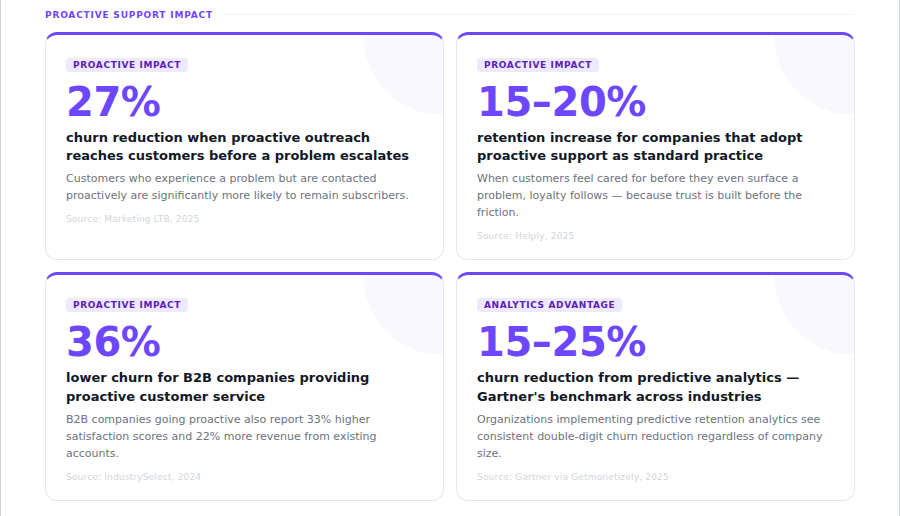
How Crisp does it: Crisp's AI chatbot can trigger proactive messages based on behavioral signals — a customer who hasn't logged in for an extended period, who hasn't completed onboarding, or whose usage of a key feature has dropped below a threshold. These messages aren't mass campaigns; they're targeted, personalized outreach based on what that specific customer was trying to achieve. A timely check-in — "We noticed you haven't used [feature] yet — want a quick walkthrough?" — costs almost nothing to send and can prevent a cancellation that would cost months of revenue to replace.
5. Reducing friction in the first 60 days — when churn risk is highest
Most subscription churn is concentrated in the early lifecycle. A new customer who doesn't reach activation — who doesn't connect your product to a meaningful outcome in their workflow — is far more likely to cancel than a long-term subscriber. The first 60 days determine whether someone becomes a retained customer or a churned trial.
Onboarding support quality is a direct predictor of long-term retention. Customers who get fast, effective answers to setup and usage questions in the first weeks are more likely to reach the "aha moment" that makes the subscription feel essential. Those who encounter friction (slow responses, unclear documentation, unanswered questions) disengage before they ever experience the product's value.
How Crisp does it: Crisp's AI chatbot provides instant, contextual onboarding support at every step — answering "how do I" questions in seconds, surfacing the right documentation automatically, and offering guided walkthroughs for common setup flows. First-contact resolution improvements reduce churn by 67% — and the highest-leverage place to deliver first-contact resolution is in the onboarding phase, when the customer is most engaged and most educable. Crisp's chatbot ensures no new subscriber falls through the cracks simply because they couldn't get a quick answer at the moment they needed it.
What does it mean to "retain customers"?
Customer retention is the ability to keep existing subscribers active across renewal cycles. In a subscription context, retention is measured by the inverse of churn: a business retaining 95% of its subscribers month over month has a 5% monthly churn rate, which compounds to roughly 46% annual loss.
Retaining customers requires more than delivering a good product. It requires being available when customers need help, resolving issues before they become cancellation decisions, and making each subscriber feel that the relationship is worth continuing. The businesses with the lowest churn rates are typically those that have made fast, high-quality support structurally impossible to skip — not as a differentiator, but as a baseline expectation.
What to avoid
- Generic auto-replies. An auto-reply that says "We've received your message and will get back to you within 24–48 hours" is not a response — it's an invitation to cancel. In the time between that message and an actual resolution, the customer has already made their decision.
- Treating billing issues as low-priority tickets. Any ticket that involves a payment, a charge question, or an access problem should be treated as a potential churn event. Routing it through a standard queue with a two-day SLA is a structural churn generator.
- Waiting for customers to reach out. The subscribers most likely to churn are often the quietest ones. If your retention strategy only activates when a customer complains, you're working with a fraction of the at-risk population.
- Using AI as a deflection layer. Deploying a chatbot to reduce ticket volume is different from deploying one to retain customers. A bot that tells people to "check the FAQ" without actually resolving the issue doesn't prevent churn — it accelerates it.
- Measuring only speed, not resolution. First Response Time is a useful metric, but it doesn't tell you whether the customer's problem was solved. An unresolved ticket from five days ago, combined with a renewal notice tomorrow is a near-certain churn event. Track Time to Resolution alongside response speed.
Crisp AI chatbot: built for subscription retention
Crisp's AI chatbot is purpose-built for businesses where retention is a revenue variable. It handles multichannel inbound support 24/7, detects at-risk language in real time, routes escalations to live agents with full conversation context, and enables proactive outreach based on behavioral triggers — all from a single platform.
Crisp's shared inbox gives your team a unified view of every customer interaction across channels, so no billing question gets lost, no cancellation signal goes unnoticed, and no at-risk subscriber slips through because the conversation happened on a channel no one was watching.
For subscription businesses, the cost of slow support isn't a support metric — it's a revenue metric. AI customer service investments generate $3.50 in return for every $1 invested, with top-performing organizations achieving 8× ROI. The businesses seeing those returns aren't treating support as overhead. They're treating it as the retention infrastructure it actually is.
The support gap is where subscribers become cancellations
Churn doesn't announce itself. It accumulates — in unanswered tickets, in billing friction that dragged on a day too long, in the support interaction that made a subscriber feel like a number instead of a customer.
The businesses that reduce subscription churn most effectively aren't those with the best retention playbooks. They're the ones that have made it structurally impossible for a subscriber to feel ignored at a critical moment. 24/7 AI support that actually resolves issues, combined with proactive signals that catch cancellation intent before it hardens — that's the infrastructure that changes the retention curve.
If your support goes dark at 6 PM, your churn doesn't.
Frequently Asked Questions
How much does slow support actually contribute to churn?
More than most teams expect. A customer who contacts support and receives no response within 4 hours is significantly more likely to cancel than one who gets an instant reply.
Can AI really detect when a customer is about to cancel?
Yes — with the right configuration. Churn-intent language can be detected in real time from conversation data. Crisp's AI can flag and route these conversations before they reach the cancellation flow, giving a retention-trained agent the window to intervene.
What's the ROI on AI customer service investment?
AI customer service investments generate $3.50 in return for every $1 invested, with top-performing organizations achieving 8× ROI.
Sources
PwC, "68% of customer churn driven by feeling unappreciated.", https://www.pwc.com/future-of-cx
Salesforce, "90% of customers expect immediate response; 60% define as ≤ 10 min.", https://www.salesforce.com/state-of-the-connected-customer/
Bain & Company, "5% retention improvement = 25–95% profit uplift.", https://www.bain.com/insights/prescription-for-cutting-costs/
Harvard Business Review, "Acquisition costs 5–25× more than retention.", https://hbr.org/2014/10/the-value-of-keeping-the-right-customers
McKinsey & Company, "Predictive analytics reduces churn by up to 25%.", https://www.mckinsey.com/capabilities/growth-marketing-and-sales/our-insights/the-value-of-getting-personalization-right-or-wrong-it-is-multiplying
Salesforce, "$3.50 return per $1 invested; top performers at 8× ROI.", https://www.salesforce.com/news/stories/ai-roi-customer-service-report/

The Future of Agent Onboarding: Conversational AI as Your Trainer
Want to get a glimpse of your future support agent onboarding? Here is how conversational AI as a trainer can help your business surf the AI wave.

April 2026 - Product Update
Discover 30+ new features released by the Crisp team in April 2026.

AI Tools for HR and Customer Support Onboarding
HR handles paperwork, benefits and compliance. CS onboarding is different: helping new agents learn your product, helpdesk, tone of voice, and resolve tickets without escalating every single issue.