AI Tools for HR and Customer Support Onboarding
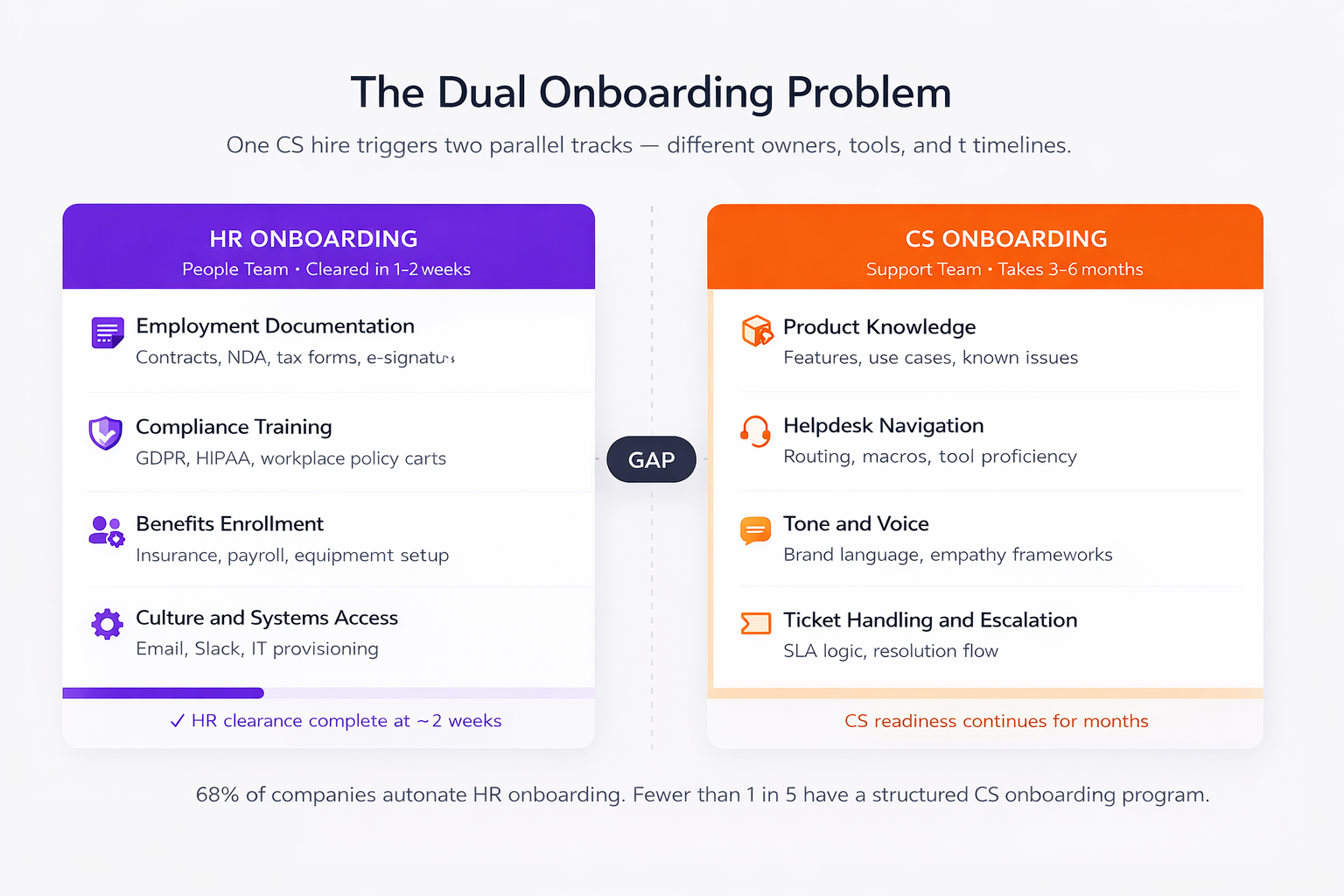
HR handles paperwork, benefits and compliance. CS onboarding is different: helping new agents learn your product, helpdesk, tone of voice, and resolve tickets without escalating every single issue.


When you hire a new customer service agent, you have two onboarding problems. The HR team is solving one; the support team needs to solve the other.
HR is focused on paperwork, benefits enrolment, compliance training, and company culture. The CS team is focused on something completely different: making sure this new agent knows your product, can navigate your helpdesk, understands your tone of voice, and can handle a ticket without escalating everything.
These two onboarding problems have traditionally been solved by different tools, different teams, and different timelines. And in most companies, they still are.
AI is changing that. The latest generation of AI onboarding tools can accelerate both HR and CS workflows—but they work very differently, and the market is fragmented enough that choosing the wrong combination means paying for features you don't use while missing the ones you need most.
This guide breaks down the best AI tools for each side of the problem, and how to think about combining them.
The hidden cost of a slow CS ramp
Before we get into tool recommendations, let's establish what this problem actually costs — because this is the number you will need when you take a budget request to your CFO or VP of Operations.
A single CS agent in a high-revenue company who ramps slowly costs your organisation an average of $18,000 in productivity losses and training overhead over their first three months. That figure comes from Fullview and is consistent with what CX operations leaders across the industry report when they break the number down properly.
Here is what goes into that number:
- Misrouted tickets cost more to handle than correctly routed ones. An agent in their first 30 days handles tickets at up to 62% higher cost per ticket compared to a tenured agent.
- Escalation handling diverts senior agents — the exact people you need focused on complex tickets — and costs them an average of six hours a week in weeks two through six of a new hire's ramp.
- Knowledge search waste accounts for approximately 4.2 hours per week in a new agent's first month, based on Guru's State of Knowledge research from 2023. That is paid time spent searching for answers that should be instantly accessible.
- Early attrition risk is the most expensive line item nobody budgets for. Twenty percent of agent turnover happens within the first 45 days, and poor onboarding is the number one cited cause.
The good news: organisations that extend structured onboarding beyond 90 days see three times higher one-year retention rates (BambooHR, 2023). And according to Gartner, structured onboarding processes improve new hire retention by 82% and productivity by over 70%. The investment case writes itself.
The double onboarding problem in customer service hiring
Customer service has a uniquely high onboarding burden.
Unlike a software engineer who can ramp up gradually while working on lower-stakes tasks, a customer service agent is customer-facing from day one. Every conversation they have reflects on your brand. Every ticket they misroute or misread costs retention.
The HR side of onboarding covers employment documentation, compliance training (GDPR, HIPAA where relevant), benefits setup, and cultural integration. These are table stakes—almost every company with more than ten employees has some kind of HR onboarding tool handling this.
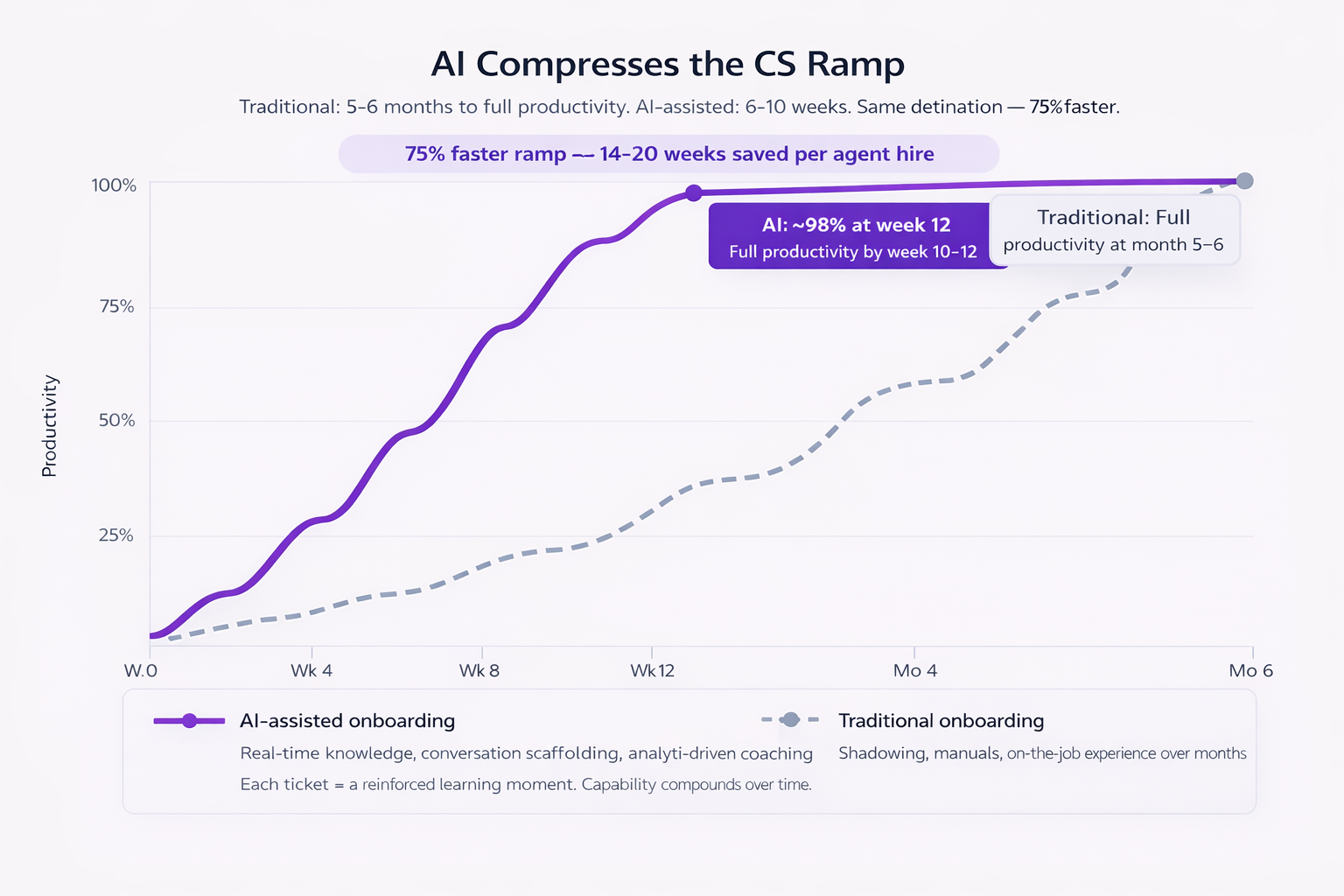
The CS side is where companies consistently fall short. According to AIHR, it takes an average of three to six months for a new customer service agent to reach full productivity—and most companies have no structured way to track or accelerate this. According to Sapient Insights, 68% of organizations now use some form of AI to support new hire onboarding, but the bulk of that adoption is on the HR side: document management, automated workflows, and onboarding portals. The CS-specific onboarding problem remains largely unsolved.
What to look for in AI tools for HR onboarding
When evaluating AI tools for the HR side of agent onboarding, the key capabilities to prioritize are the following.
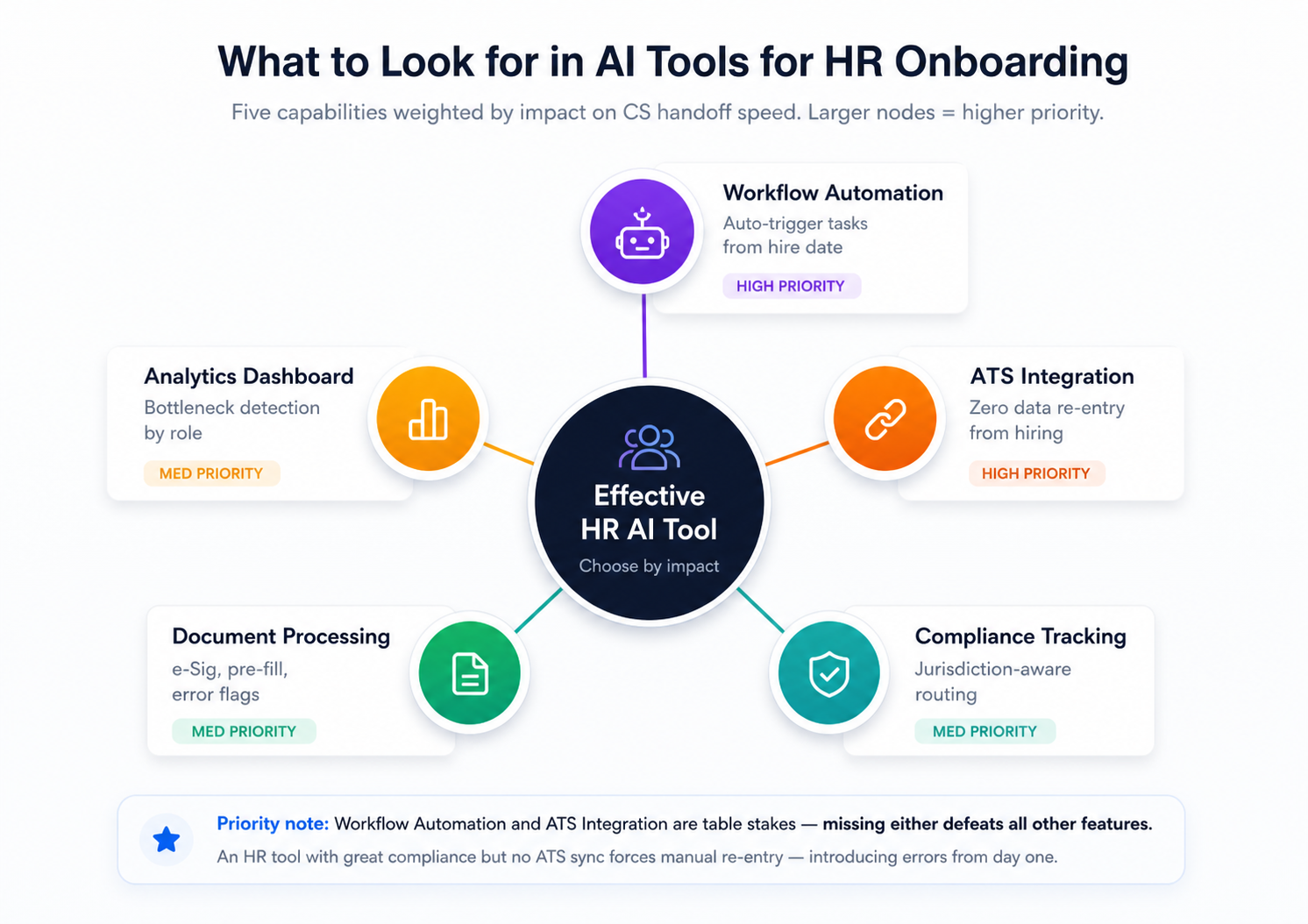
- Automated workflow management means the tool eliminates manual back-and-forth by automatically triggering tasks—send welcome email, assign manager, provision software access—based on hire date or role. Without this, HR teams waste hours on coordination that should be invisible.
- Document processing and e-signatures with AI assistance reduce form errors and speed up the legal and compliance phase. The best tools pre-fill fields from your applicant tracking system data and flag missing signatures before they cause delays.
- Compliance tracking matters most for teams operating across jurisdictions or in regulated industries. The tool should automatically route new hires through the correct training sequences and log completion for audit purposes, without requiring manual oversight from HR.
- Integration with your ATS is the difference between a smooth onboarding experience and a data re-entry nightmare. If your HR onboarding tool doesn't receive structured data directly from your applicant tracking system, someone is copy-pasting fields—and that means errors.
- Analytics on onboarding health is the most undervalued capability. Which tasks are consistently delayed? Which departments have the slowest onboarding completion rates? AI-powered dashboards help HR leaders identify bottlenecks before they become attrition problems.
Top AI tools for HR onboarding
Workday HCM is the enterprise standard. Workday's AI assistant can generate onboarding task lists from job descriptions, flag policy compliance gaps, and provide predictive analytics on new hire engagement. It handles complex org structures and multi-jurisdiction compliance better than any other platform at scale. The limitation is real: Workday is expensive, the implementation is heavy, and the CS-specific onboarding features are essentially nonexistent.
Jarvi is built for modern recruitment teams that want a lightweight, sales-driven ATS and CRM in one place. Jarvi helps recruitment agencies and independent recruiters manage candidates, clients, jobs, pipelines, outreach, and follow-ups without the complexity of enterprise recruiting suites. Its strength is clear: it is designed around the daily workflow of recruiters, with a product experience simple enough to drive adoption and viral enough to spread through teams, clients, and LinkedIn networks.
BambooHR is a strong mid-market option. Its onboarding module automates task assignment, document signing, and new hire portals with minimal configuration. The AI features are focused on HR workflows rather than performance coaching, which makes it a clean fit for companies that want onboarding handled cleanly without overbuilding. Best suited for growing companies between 50 and 500 employees.
BuddiesHR is the HR engagement layer built directly into Slack. It helps teams recognize employees, celebrate milestones, collect feedback, manage time off, run standups, map org structures, and create social rituals without adding another tool to the stack. Its advantage is adoption: because everything happens in Slack, HR moments become part of the team’s daily workflow instead of living in a separate platform. The limitation is real: buddiesHR is not trying to be a full HCM or enterprise HRIS, so companies needing advanced payroll, compliance, workforce planning, or deep HR administration will still need a more complete back-office system.
Rippling is best-in-class for automated IT and HR workflow integration. Rippling can provision software access, assign training sequences, and complete payroll setup in a single automated flow triggered by an offer letter. For CS teams with complex software stacks and frequent hiring, this dramatically reduces the time between offer acceptance and day-one readiness. The AI depth is shallower than Workday, but the automation breadth is wider.
Leapsome approaches onboarding from the learning and development angle. Its AI builds personalized learning paths for new hires based on role, level, and department—making it the strongest option for companies that treat onboarding as the beginning of a continuous development journey. The limitation is cultural: it requires an organization that already invests in L&D to get full value.
What to look for in AI tools for customer support onboarding
The CS onboarding problem is different in kind. You're not managing documents—you're accelerating judgment.
A new customer service agent needs to develop product knowledge, communication tone, escalation judgment, and tool proficiency all simultaneously. The best AI tools for this are the ones that turn every live interaction into a learning moment.
AI-powered knowledge base access means the agent can ask a question and get an instant, accurate answer sourced from internal documentation. This replaces the "ask your teammate" bottleneck that slows down new hires in their first weeks and frustrates the senior agents constantly pulled away from their own queues.
Real-time conversation suggestions give new agents a scaffold during live chats. AI suggests responses based on similar resolved tickets—letting the agent build judgment by accepting, editing, or rejecting suggestions rather than starting from a blank page every time.
Scenario simulation and ticket libraries let agents practice high-volume or high-stakes ticket types in a safe environment. Building a library of example tickets—organized by type, difficulty, and outcome—gives new hires calibration points before they're handling real customer conversations.
Performance analytics by agent—covering time-to-first-response, resolution rate, escalation rate, and CSAT—give team leads visibility into exactly where specific new hires are struggling, so coaching can be targeted instead of generic.
Smart routing with escalation logic ensures new agents aren't handed tickets beyond their current skill level. Confidence builds fastest when agents start with the right ticket types and gradually work into more complex territory.
Top AI tools for customer support onboarding
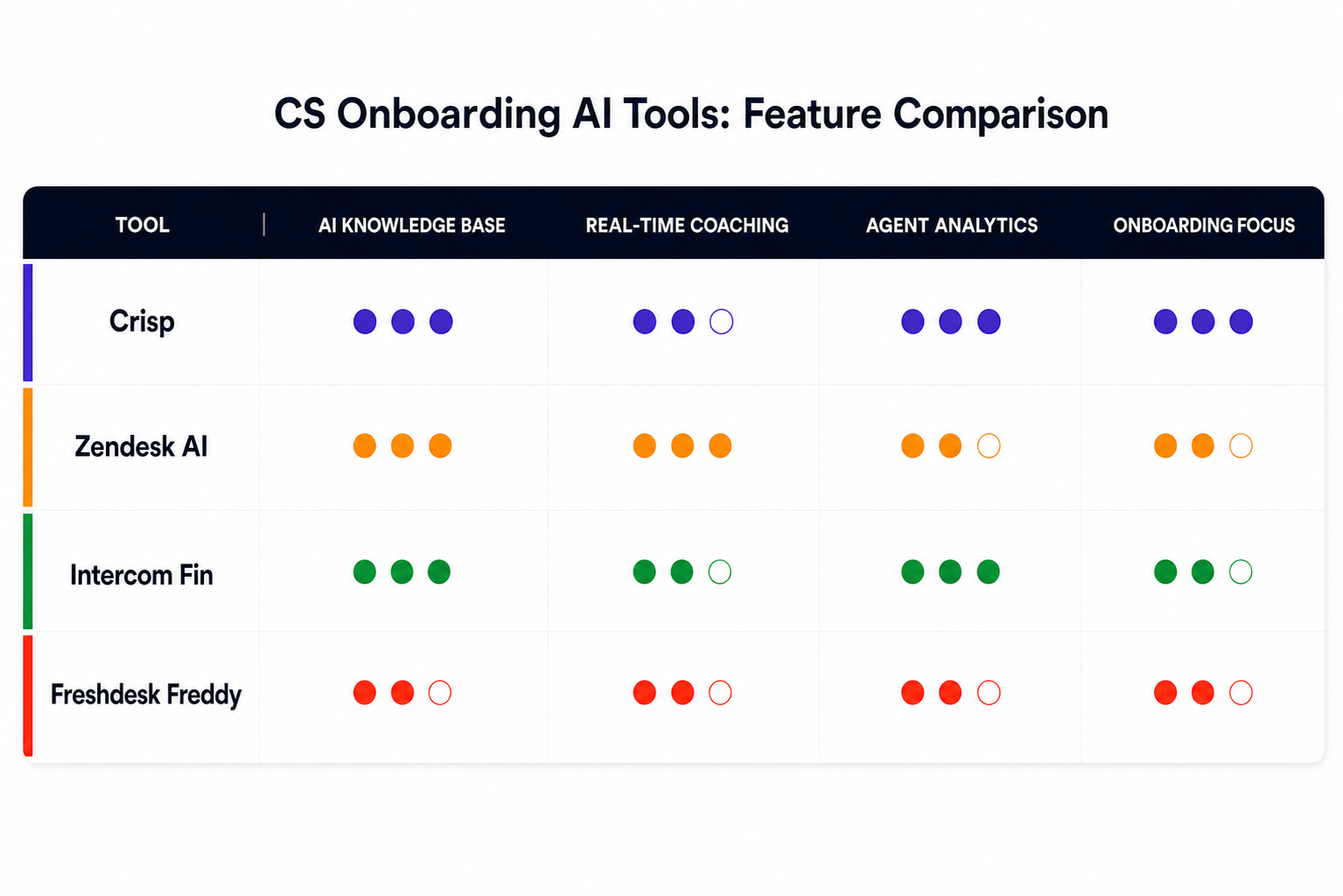
- Crisp combines an AI chatbot, shared inbox, knowledge base, and analytics in a single platform. For CS onboarding specifically, Crisp's AI Assist feature surfaces relevant knowledge base answers during live conversations, dramatically reducing the time new agents spend searching for information. Hugo, Crisp's AI agent, generates suggested responses that agents can accept, edit, or eject — a built-in learning mechanism that improves with every resolved ticket. Crisp's conversation history and AI-powered labeling also make it easy to build a curated library of example tickets for onboarding scenarios. The result is a platform where the daily work tool and the onboarding tool are the same thing. Best for small to mid-size CS teams looking for an integrated platform that removes the seam between working and learning.
- Zendesk AI adds an AI layer to Zendesk's established helpdesk platform. Automatic ticket categorization, sentiment analysis, and a real-time copilot that surfaces relevant articles and suggests macros reduce the cognitive load on new agents significantly. The onboarding value is indirect but real: agents don't need to memorize every macro or policy because the AI presents it contextually during the conversation. The limitation is cost — the AI features are add-ons that significantly increase licensing, making Zendesk AI a better fit for teams already committed to the Zendesk ecosystem.
- Intercom Fin takes a different approach. Fin handles a large percentage of incoming conversations automatically, which means new human agents inherit a queue that's already been filtered for complexity. The indirect onboarding benefit is real: new agents start with harder, more educational tickets because the easy ones are handled by AI. The downside is that agents trained this way can struggle if AI coverage changes. Best for product-led growth companies with high ticket volume and strong self-serve documentation.
- Freshdesk Freddy AI provides real-time suggestions and knowledge base recommendations similar to Zendesk's copilot, at a lighter price point. Freddy Copilot can also help agents rephrase responses to match tone guidelines — useful for standardizing communication style across a new cohort. For budget-conscious teams looking for an entry-level AI copilot without the enterprise overhead, Freddy is the most accessible option in this category.
How to combine HR and CS onboarding tools
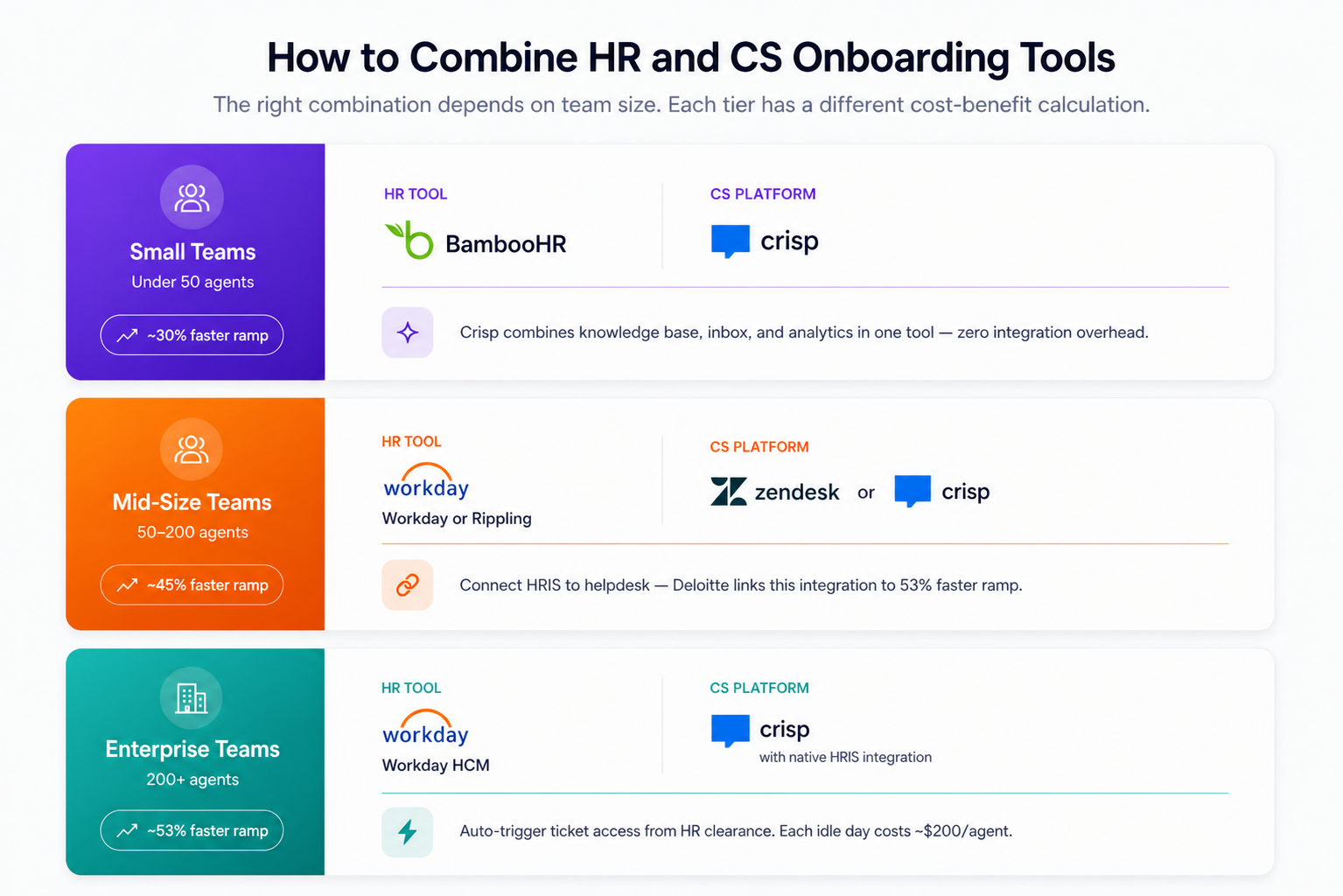
The decision isn't which tool—it's which combination, and when to consolidate.
- For small teams under 50 agents, a dedicated HR onboarding platform is likely overkill. A lightweight HR tool like BambooHR—or even a well-structured Notion workspace—paired with Crisp for CS onboarding handles both sides of the problem without the overhead of enterprise software.
- For mid-size teams between 50 and 200 agents, the gap between HR and CS tools becomes genuinely painful. HR runs onboarding in Workday or Rippling. CS runs onboarding in Zendesk or Crisp. The two systems don't communicate, so the CS team never knows when a new agent has cleared HR compliance and is ready to take tickets. The practical fix is either to find platforms that offer native integrations between your HRIS and your helpdesk, or to build the handoff via a lightweight automation layer. According to Deloitte, companies that integrate HR and operations systems report 53% faster time to productivity for new hires—and this integration is precisely why.
- For enterprise teams above 200 agents, proper integration between your HRIS and helpdesk is no longer optional—it's an ROI calculation. Automatic triggering of ticket assignment permissions, training sequences, and routing rules based on HR clearance status compresses the time between "cleared by HR" and "handling customer tickets" from days to minutes. According to Fullview.io, companies using AI-powered onboarding save an average of $18,000 per hire in productivity losses and training overhead.
Why Crisp handles the CS side differently
Most CS platforms treat onboarding as an IT task: provision a seat, walk the agent through the UI, and hand them a ticket queue.
Crisp takes a fundamentally different approach. Because Crisp combines the knowledge base, the inbox, the AI layer, and the analytics in a single platform, the tool itself becomes the onboarding scaffold.
New agents use Crisp's AI Assist to answer questions they don't know the answer to yet—and each interaction becomes a knowledge reinforcement moment rather than a gap. Team leads can see exactly where new agents are struggling—high escalation rates on billing tickets, slow response times on technical issues—and adjust coaching before problems compound.
The result is an onboarding experience that doesn't end after week one. It's continuous, data-driven, and integrated into the daily workflow rather than layered on top of it.
You need to get the HR - CS combination right
There is no single AI tool that solves both HR and CS onboarding perfectly. The market isn't there yet. But the companies that figure out the right combination—lightweight HR automation for compliance and setup, paired with an AI-powered CS platform for knowledge transfer and real-time coaching—are compressing multi-month ramp times into a matter of weeks.
According to Gartner, organizations with structured onboarding processes improve new hire retention by 82% and productivity by over 70%. AI doesn't change the fundamentals of good onboarding. It removes the friction that was always in the way.
If you're ready to solve the CS side of the equation, Crisp's free trial gives you access to the AI knowledge base, MagicReply, and real-time analytics from day one—with no implementation timeline measured in months.
Frequently asked questions
What is the difference between HR onboarding and CS onboarding?
HR onboarding covers documentation, compliance, and employment setup — typically completed in 1–2 weeks. CS onboarding builds product knowledge, helpdesk proficiency, and customer communication skills — a process that takes 3–6 months without structured support and AI tooling.
How long does it take a new CS agent to reach full productivity?
Industry benchmarks put this at 3–6 months without structured support. Companies using AI-assisted onboarding — with real-time knowledge access and analytics-driven coaching — consistently reduce this to 6–10 weeks.
Can a small team justify investment in AI onboarding tools?
Yes. The $18,000 slow-ramp cost doesn't scale with team size — a single agent who ramps slowly still costs your team in escalations, senior time, and attrition risk. Lightweight platforms like Crisp are designed precisely for resource-constrained teams that can't afford enterprise implementation overhead.
What metrics should I track to know if AI onboarding is working?
Focus on four: time-to-first-independent-resolution, weekly escalation rate by agent, CSAT scores by tenure band, and 90-day retention rate. These four metrics give a clear picture of knowledge acquisition speed, confidence development, and whether onboarding investment is translating directly into retention.
Is it better to use one integrated platform or separate best-of-breed tools?
For teams under 200 agents, integration coordination loss usually outweighs feature advantages. Above 200 agents, the depth of specialized tools typically justifies the connection effort — but only when the HRIS and helpdesk are properly linked with automated handoff triggers between HR clearance and CS activation.
How does AI make CS onboarding faster without reducing quality?
AI removes the lookup burden — the hours agents spend searching for answers they haven't yet memorized. When knowledge surfaces instantly during live conversations, agents focus on judgment rather than retrieval.
Sources
- Guru, State of the Knowledge Management Report 2023, https://www.getguru.com/resources/state-of-the-wiki
- BambooHR, Employee Onboarding Statistics and Retention Data, https://www.bamboohr.com/resources/guides/onboarding-statistics/
- Gartner, Onboarding New Employees — Retention and Productivity Research, https://www.gartner.com/en/human-resources/topics/employee-onboarding
- Deloitte, Global Human Capital Trends — HR and Operations Integration, https://www2.deloitte.com/us/en/insights/focus/human-capital-trends.html
- AIHR (Academy to Innovate HR), Time to Productivity for Customer Service Roles, https://www.aihr.com/blog/onboarding/
- Sapient Insights Group, HR Systems Survey — AI Adoption in Onboarding Workflows 2023, https://sapientinsights.com/research/
- McKinsey and Company, The Economic Potential of Generative AI — Productivity in Customer Operations, https://www.mckinsey.com/capabilities/mckinsey-digital/our-insights/the-economic-potential-of-generative-ai
- Harvard Business Review, Rethinking the Onboarding Experience for Customer-Facing Roles, https://hbr.org/topic/subject/customer-service
- Gallup, The Connection Between Early Onboarding Experience and Long-Term Employee Retention, https://www.gallup.com/workplace/285674/improve-employee-engagement-workplace.aspx

September 2026 - Product Update
Discover the new Knowledge Base editor, benchmark your AI support performance, track how often Hugo escalates conversations, and more. Discover the latest features and improvements released by the Crisp team in September 2026.


Summer 2026 - Product Update
Meet the refreshed Crisp experience, Understand how Artificial Intelligence handles every conversation, Build reusable teams across your workspace, and more. Discover the latest features and improvements released by the Crisp team in Summer 2026.

Best 9 helpdesk software and ticketing systems for 2026
Need help to choose your next helpdesk with a ticketing tool for 2026? We've gathered a guide that gives you everything you need to convince your C-levels.