Internal Notes vs. Email Forwarding: The Better Way Your Team Should Be Collaborating on Customer Tickets
Forwarding a customer email to ask a teammate creates two threads that drift apart. Internal notes keep the question, the answer and the customer history in one place, which matters more once AI hands over only the hard cases.


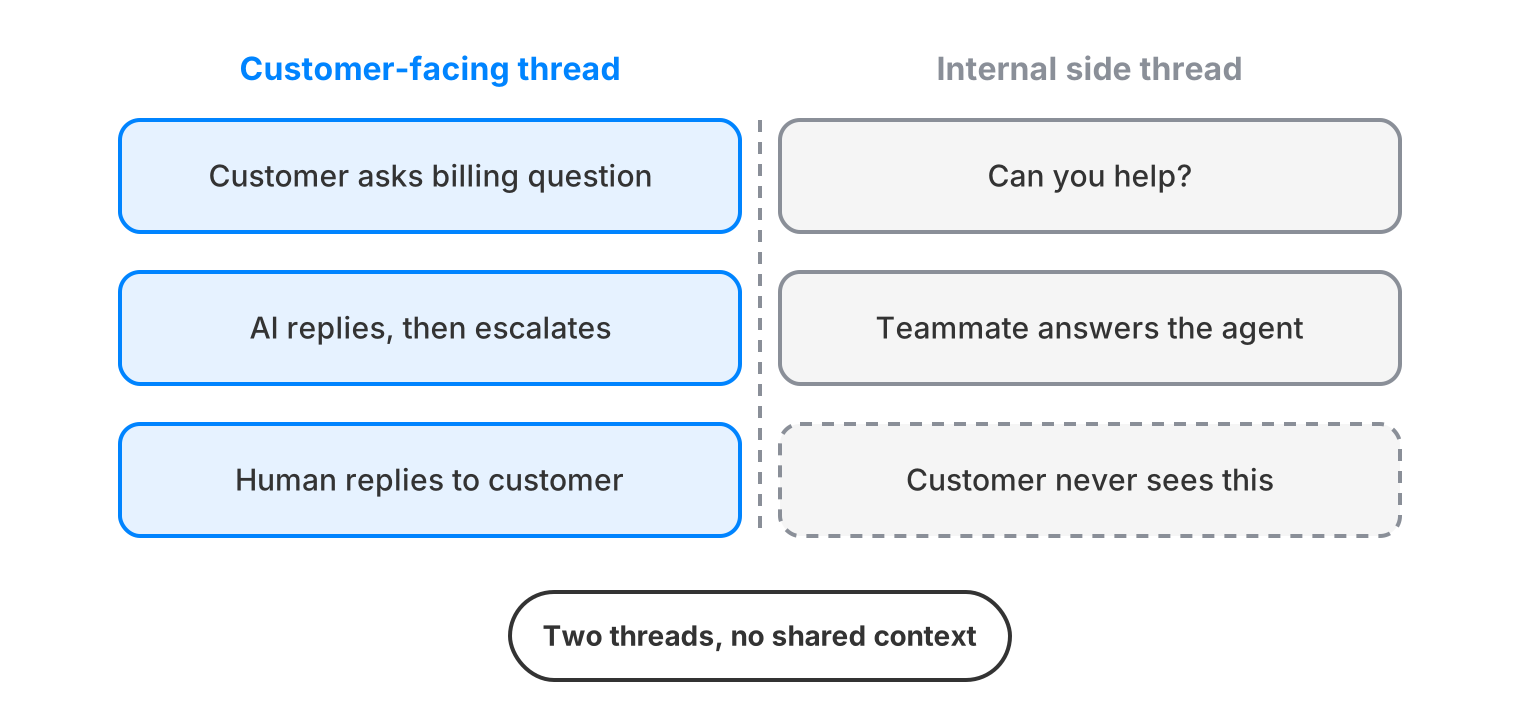
An AI agent answers a customer's billing question, reaches the edge of what it can resolve, and hands the case to a human. The human isn't sure either, so they forward the customer's email to a teammate with "can you help?" typed above it. The teammate replies to the forwarder, not the customer. Now there are two email threads about one customer issue, the original and the internal side conversation, and neither one has the full picture the other does.
This is such a normal way of working that most teams don't notice it's a workaround. Forwarding was built for moving a message from one person to another, not for internal collaboration. In a support system where AI takes the first turn, the escalation layer is where context either survives or gets lost, and forwarding is where it gets lost.
What is an Internal note?
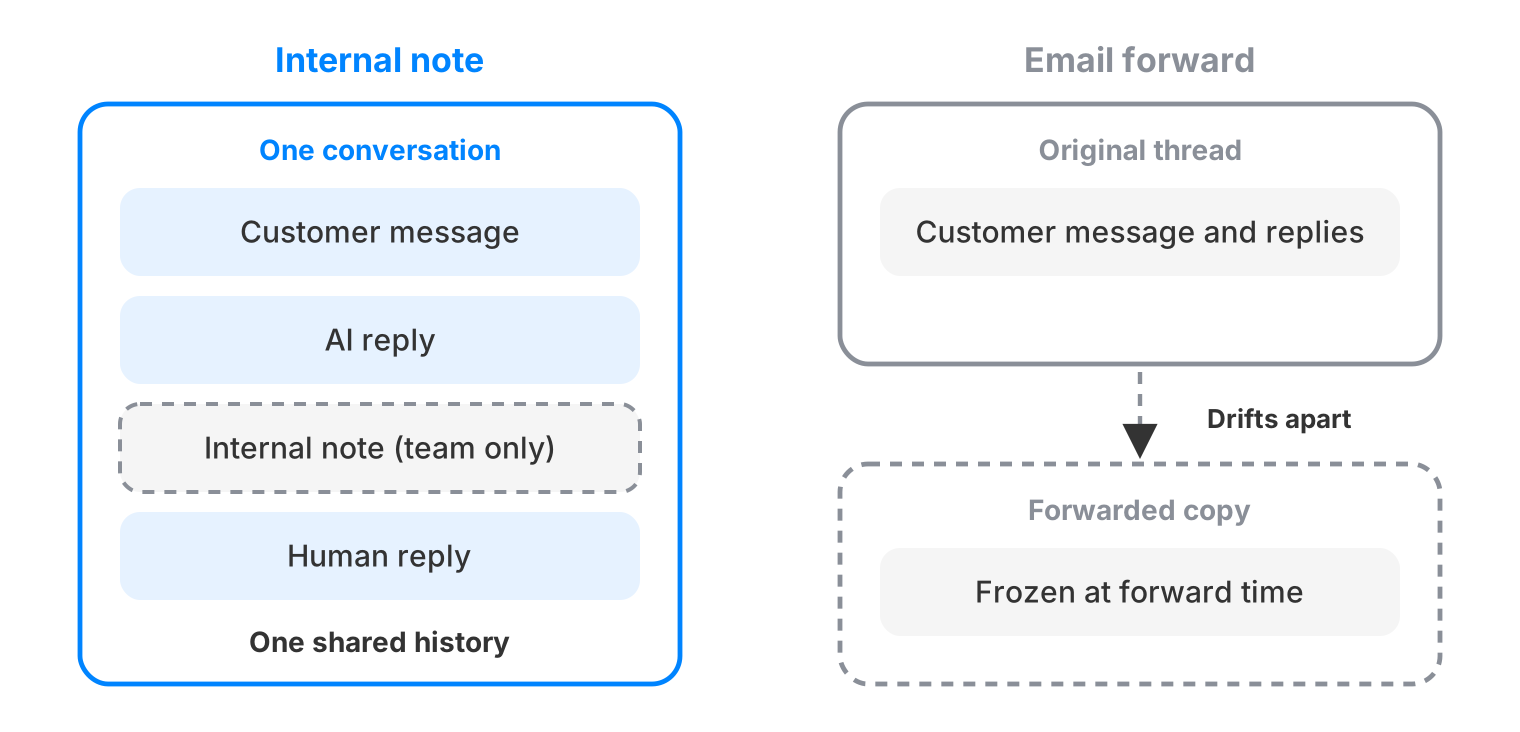
An internal note is a comment attached directly to a customer conversation, visible only to the team, that lives inside that conversation's own history rather than as a separate message. It's a feature offered by numerous customer support software to make email collaborative between teams. When an AI agent escalates a case, the person who picks it up, and anyone they pull in, sees the same history: everything the customer said, everything the AI replied, and every internal comment in between.
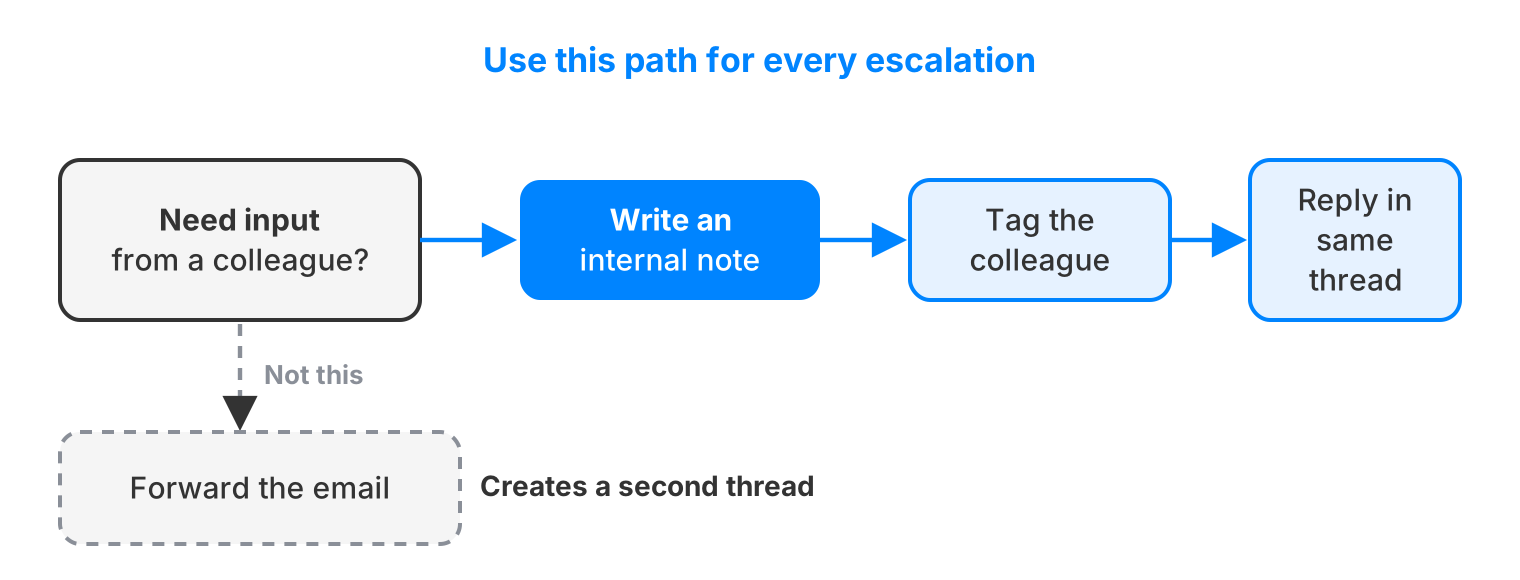
Email forwarding, by contrast, creates an entirely new message: it carries a copy of the original thread at the point it was forwarded, but any later activity on the original conversation doesn't appear in the forwarded copy, and vice versa. The two threads drift apart the moment a fourth or fifth message gets added to either one.
Why forwarding feels fine until it doesn't
For an occasional question, email forwarding works well enough that the problem stays invisible. It compounds as AI takes more of the first-line volume, because the conversations that reach people are the ones that need judgment, which are also the ones most likely to need a second opinion.
What is left for people is a smaller but more demanding queue. On conversations humans still handle without AI, median first response rose to roughly 32 minutes, against around 13 minutes for teams that never adopted an AI Agent, a pattern the report reads as a queue filtered toward cases that need investigation or judgment.
Every forwarded internal question adds to both, on top of the time the original conversation already required.
The signals that a team has outgrown forwarding as its collaboration method:
- A conversation has two email threads about it, the customer-facing one and the internal "can you help" one, and they've started to say different things.
- Someone has replied to the wrong thread, sending an internal comment straight to the customer by mistake.
- Onboarding a new hire involves explaining, out loud, which of several forwarded copies of a conversation is the current one.
- Nobody can reconstruct, after the fact, who weighed in on a specific customer issue, what the AI handled before the escalation, and what the human said after.
- The internal conversation is so long and cluttered that it becomes impossible to read and understand.
What good internal collaboration actually requires
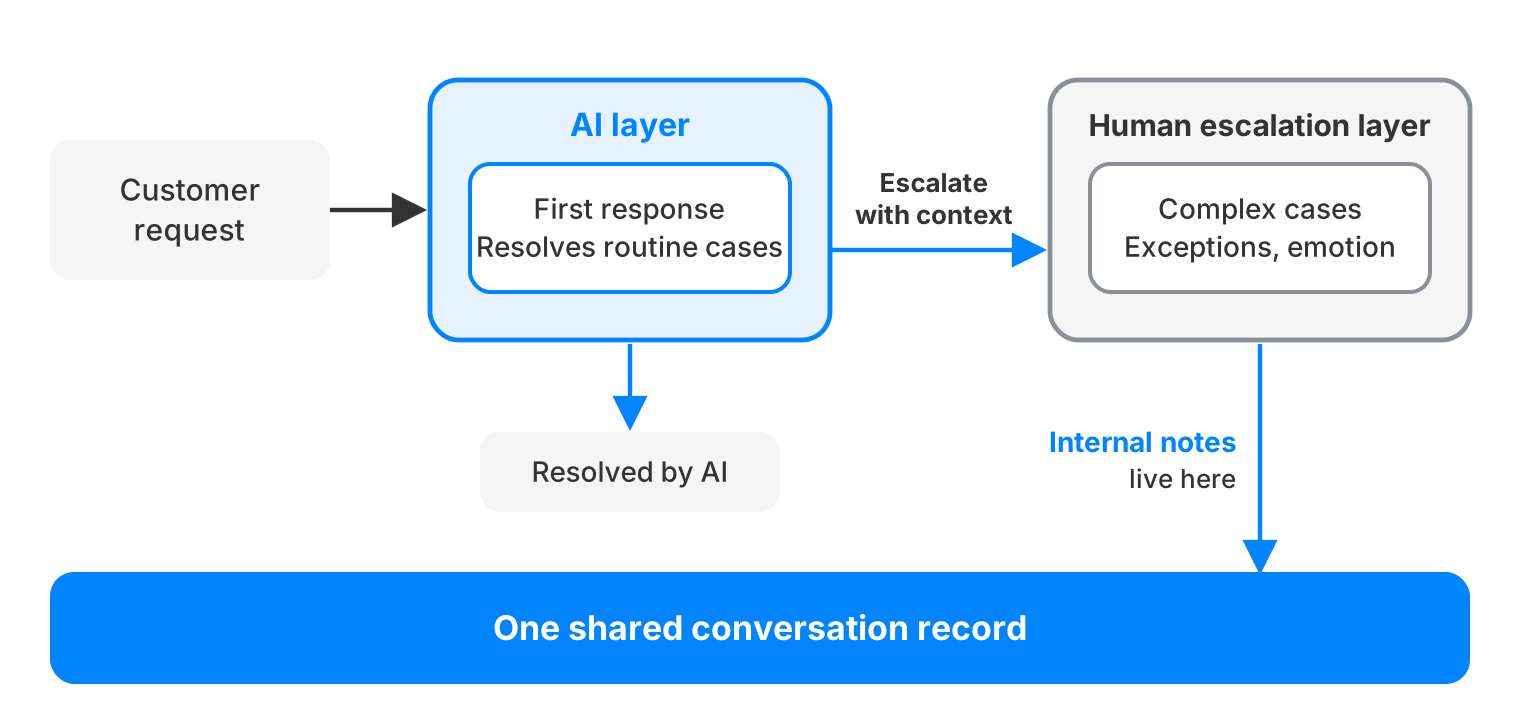
Solving this isn't about telling the team to forward less. It's about removing the reason forwarding exists as a workaround in the first place. In an AI-first setup, that means one conversation record that the AI, the person who takes the escalation, and any colleague they pull in all work inside. A standard email client doesn't provide these four things:
- Comments attached to the conversation itself, not a separate message that has to be manually kept in sync
- Full context visible to whoever is asked for input: the entire conversation history, including what the AI said and did, not just whatever the forwarder chose to copy
- A clear boundary between internal and customer-facing text, so a comment meant for a teammate can never accidentally go to the customer
- Searchable history, a record of who weighed in on a given conversation, findable later without reconstructing a chain of forwarded emails
How to build a shared inbox that prevents email forwarding from happening
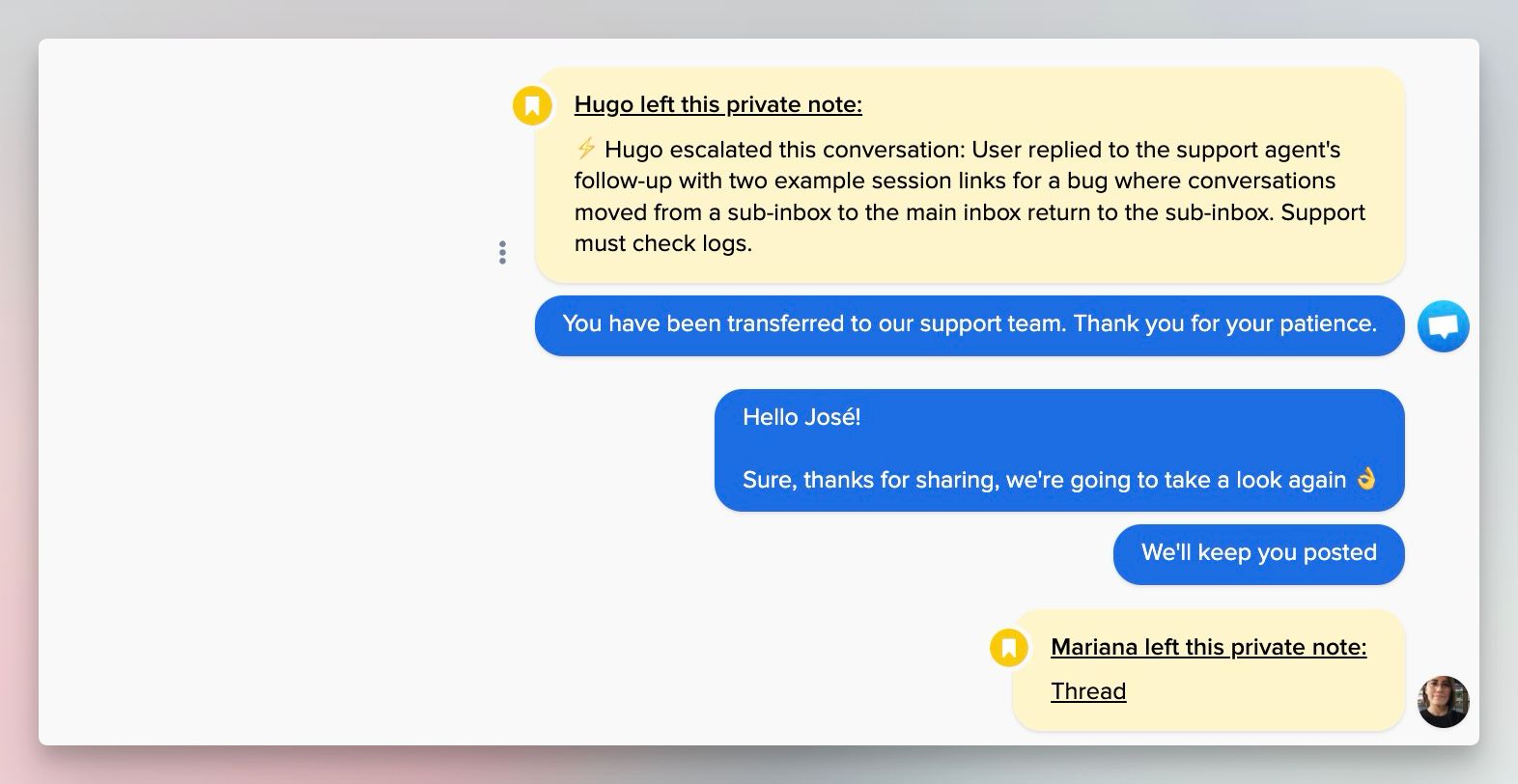
Crisp is built around this handoff Hugo, Crisp's AI agent, takes the first turn, and the conversations it hands over reach the team in the Shared Inbox. Crisp's inbox centralizes conversations from any channels your company deals, and your teams, so internal notes are then left inside a collaborative tool, with the full message history already in view and zero risk of an internal comment reaching the customer. The note is visually and structurally distinct from the customer-facing reply at all times.
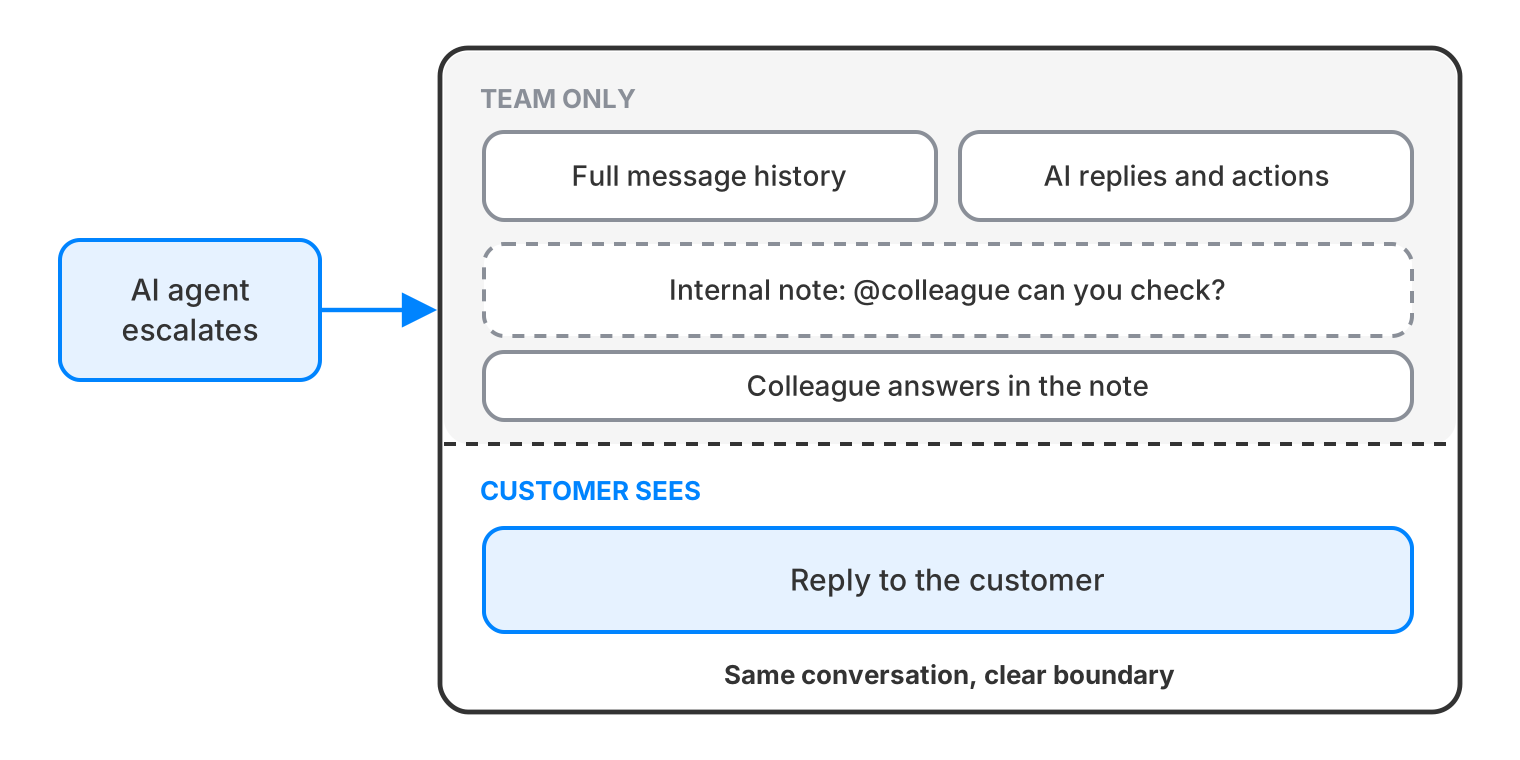
The escalated conversation keeps its full history, with a clear line between what the team sees and what the customer sees.
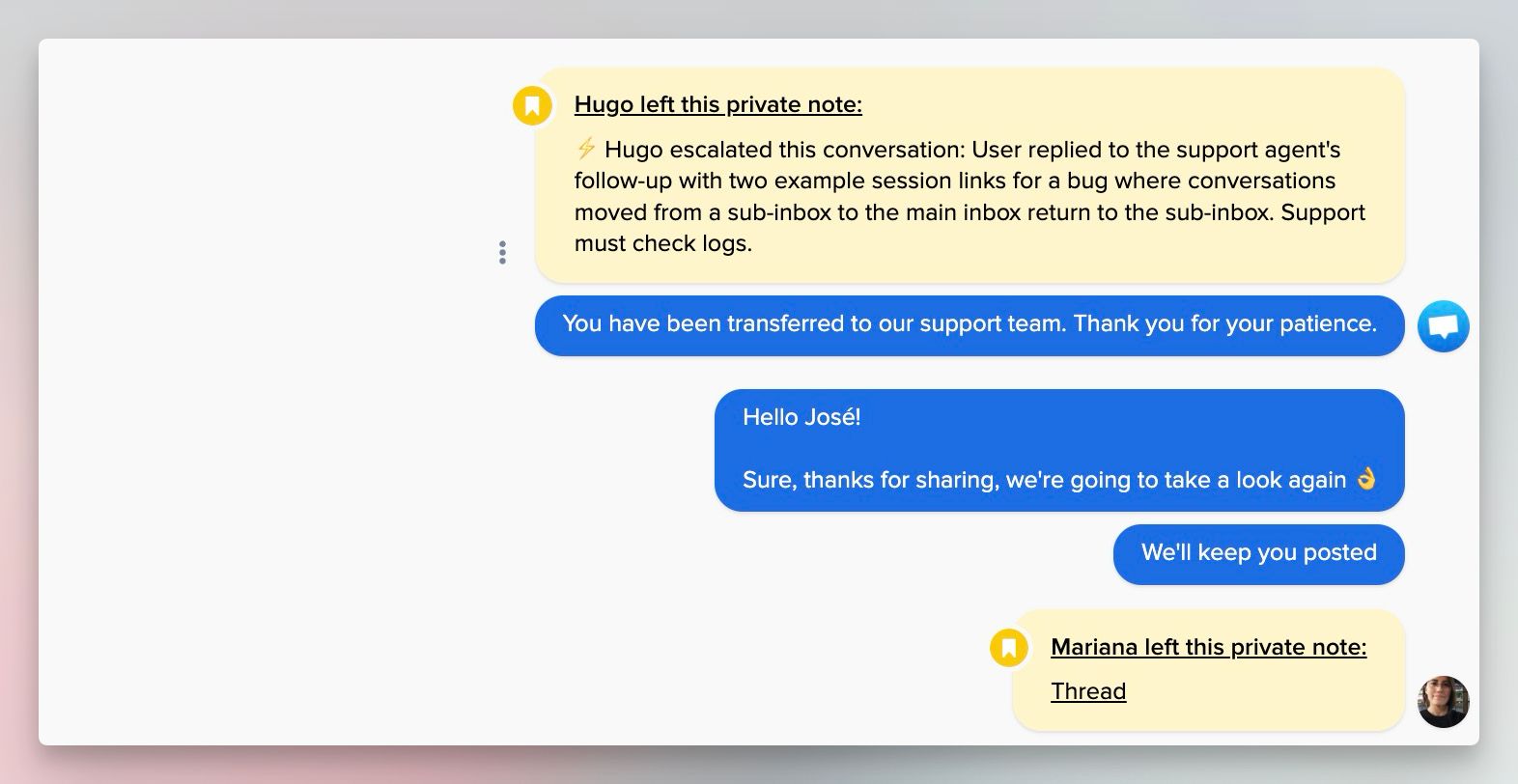
Getting this right matters beyond internal convenience:
That window is the one the handoff has to protect, and it is easier to shorten when the person answering has the full history in front of them instead of a forwarded copy.
Direct answer: what's the difference between an internal note and email forwarding?
An internal note is a comment attached to a customer conversation, visible only to the team, that stays synchronized with that conversation's full history, including everything the AI agent did before it escalated, it lives inside a shared inbox that makes email collaborative. Email forwarding creates a separate, disconnected copy of the conversation at a single point in time, which then drifts out of sync as either the original or the forwarded copy continues to receive replies.
Internal notes solve the specific problem forwarding was never designed for: ongoing, in-context collaboration on a single, shared conversation.
Common mistakes when making the switch
- Keeping forwarding as a fallback "for anything complicated." The moment a team decides some conversations still get forwarded, the two-thread problem returns for exactly the conversations most likely to need clean internal collaboration. Those are the complicated ones, and they are the ones that reach people once AI has taken the routine volume.
- Not training the team on the internal/external boundary. A comment box that looks similar to the reply box is a real risk if nobody has walked through, explicitly, what a customer will and won't see. The first accidentally external internal note is usually what finally forces the conversation, and a customer reading a comment never meant for them is a trust problem no workflow fixes after the fact.
- Not forwarding team questions received in a personal email. Sometimes, you'll still receive emails in a personal, not shared email, and that is fine. But the good move here is to forward it to the shared inbox so the team can acknowledge and take the lead from there.
- Assuming the switch is obvious without a nudge. Old habits are sticky. A team that has forwarded for years won't spontaneously stop just because a notes feature exists. It usually takes one visible example of the new way working better before the habit actually shifts.
Ready to stop forwarding emails just to ask a question?
Crisp's internal notes let your team collaborate directly inside every conversation, with full context and zero risk of a note reaching the customer by mistake.
Frequently Asked Questions
What is an internal note in customer support?
An internal note is a comment attached to a customer conversation that only your team can see. It lives inside the conversation's history instead of becoming a separate email, so a colleague asked for input sees the whole thread, including what the AI agent already handled, and the discussion stays findable later.
Why shouldn't support teams forward emails to ask a colleague for help?
Forwarding creates a disconnected copy of the conversation. Replies go to the forwarder, not the customer, and the two threads drift apart as messages are added. Context splits, internal comments can reach the customer by mistake, and nobody can later reconstruct who weighed in on the issue or what they said.
Can customers see internal notes?
No. An internal note is visible only to your team and is kept visually and structurally separate from the customer-facing reply at all times. That boundary is the point: a teammate can be tagged and asked a candid question inside the conversation without any risk of the comment being sent to the customer by accident.
How do internal notes help when AI hands a conversation to a human?
When an AI agent escalates, the person taking over needs the full history, not a summary someone retyped. Internal notes keep the AI's replies, the customer's messages, and any colleague input in one place, so the handoff carries context forward and the person answering can resolve the case without chasing details.
Should we keep forwarding for complicated cases?
No. Complicated cases are exactly where a second opinion is most likely, so they bring the two-thread problem back at the worst moment. Once AI takes routine requests, the conversations reaching people are the harder ones. Using internal notes for every escalation keeps one clean record for each customer issue, whatever its difficulty.
How do you get a team to stop forwarding emails?
Show, don't announce. Pick one real escalation and handle it with an internal note while the team watches, then point to the single clean thread afterward. Train everyone on what customers can and cannot see, and remove forwarding as a fallback so old habits have nowhere to return when a case gets tricky.
Sources
Crisp, The State of AI Customer Support 2026: AI Customer Service Statistics & Benchmarks, https://crisp.chat/en/reports/state-of-ai-support/
Gartner, Gartner Survey Finds 62% of Customer Service Channel Transitions are "High-Effort", https://www.gartner.com/en/newsroom/press-releases/2023-07-11-gartner-survey-finds-62-percent-of-customer-service-channel-transitions-are-high-effort
Harvard Business Review, How Much Time and Energy Do We Waste Toggling Between Applications?, https://store.hbr.org/product/how-much-time-and-energy-do-we-waste-toggling-between-applications/H0777V
Forrester, Customer Service Agent Collaboration Helps Move The Needle On FCR and Customer Satisfaction, https://www.forrester.com/blogs/12-05-12-customer_service_agent_collaboration_helps_move_the_needle_on_fcr_and_customer_satisfaction

Reduce Repetitive Support Tickets With a Self-Service Knowledge Base
A knowledge base only cuts tickets if customers find the answer before they write. Here is how to build one that does: answer-first articles, search that matches real phrasing, multilingual coverage and upkeep driven by data.

Ticket routing rules: how to build rules that keep working
Ticket routing rules rarely fail at launch. They fail six months later. Here is how to keep a rule set legible, catch every unmatched conversation, review it on a cadence and fast-track what cannot wait.

October 2026 - Product Update
Create custom skills for Hugo Copilot, Write and improve Knowledge Base articles with Copilot, Analyze your support data with Copilot, and more. Discover the latest features and improvements released by the Crisp team in October 2026.