How to Reduce Customer Service Costs With AI (Without Cutting Quality)
CFOs think cutting costs = cutting staff. This is very wrong. Instead think about how AI can lowers costs while keeping CX strong and conversation's volume grow.


It's 2:47 a.m. A customer in Singapore can't access her account. Her subscription renews in three hours. She types her first message. Four seconds later, she has a response. Not a form. Not a 'we'll be in touch.' A complete, accurate answer that resolves her issue on the spot.
No agent logged in, no ticket created, no cost beyond fractions of a cent.
Somewhere else, a support director at a mid-market SaaS company is reviewing Friday's numbers. His team resolved 2,340 tickets this week. His AI handled 1,560 of them (67%) without a single human touching a keyboard. His cost-per-resolution dropped from $11.40 to $1.87. His CSAT score went up.
These are not projections. They are documented, repeatable outcomes from companies that made one strategic decision: stop treating customer support as a headcount problem and start treating it as an automation problem.
AI-powered customer service now saves businesses $8 billion annually. By 2026, conversational AI alone is projected to cut global contact center labor costs by $80 billion. The teams capturing those savings are not cutting corners. They are cutting waste: the 40-60% of support volume that never required a human in the first place.
This guide shows you exactly how to get there.



The real cost of traditional support: why the math has changed
Most cost-reduction conversations in customer service start the same way: someone in finance looks at headcount, points at the support team, and asks what can be cut. It is the wrong question.
The right question is: where is money being wasted on work that does not require a human?
The numbers are worse than most leaders realize. A single human agent interaction costs between $8 and $15 on average , and up to $60 in enterprise environments. The same routine query handled by an AI chatbot resolves for $0.50 to $0.70 per interaction. That is a 95% cost reduction per ticket.
AI does not just answer the same question cheaper. It answers it instantly, at 3 a.m., in 35 languages, without a queue. The cost advantage compounds every hour of every day.
The assumption that reducing support costs means worse outcomes is a relic of the era when efficiency meant fewer agents handling more tickets.
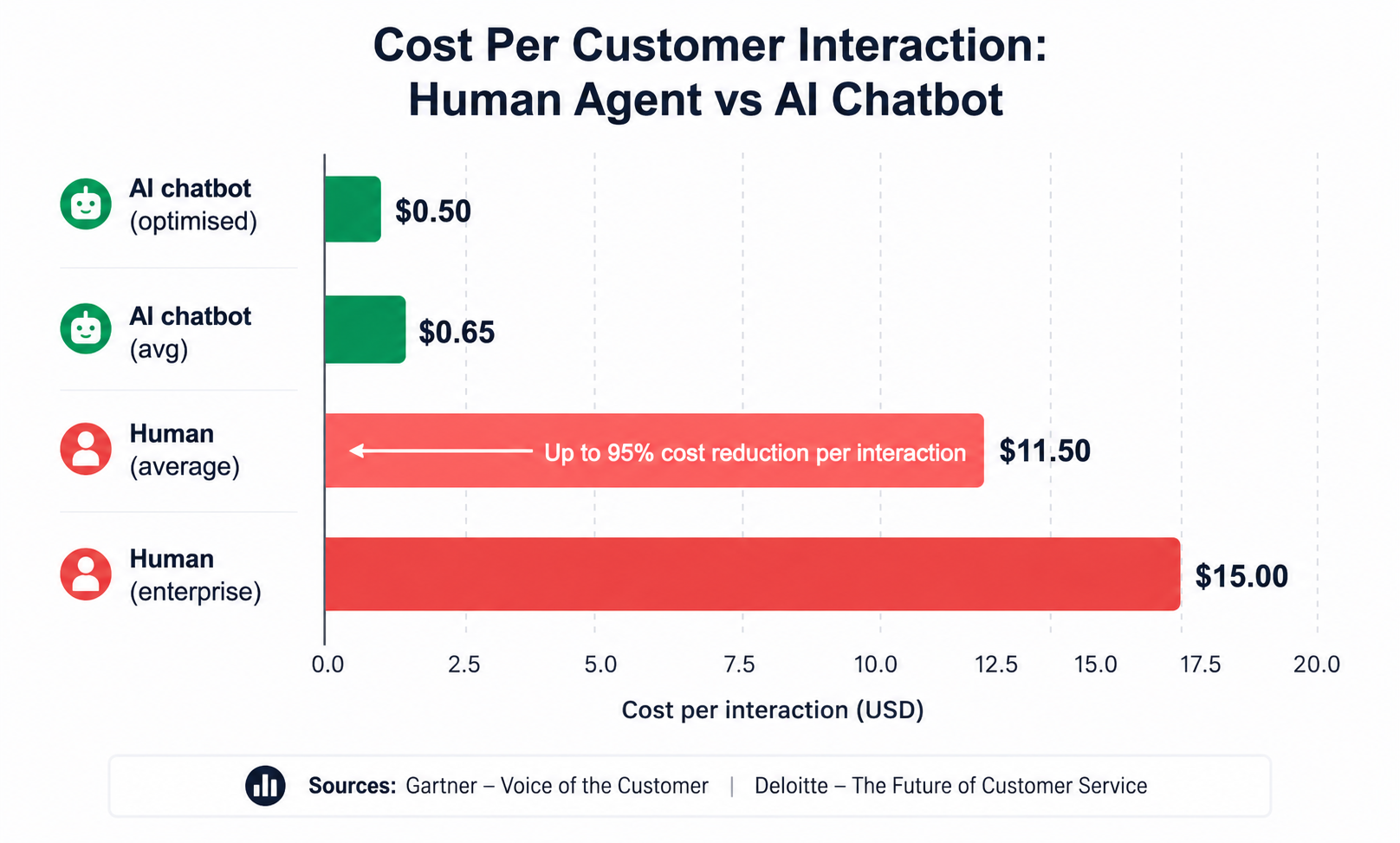
The numbers do not lie: before AI vs after AI
The most persuasive argument for AI in customer service is empirical. Below is what actually changes when support teams implement AI at scale, measured across response time, resolution time, cost, capacity, and customer satisfaction.
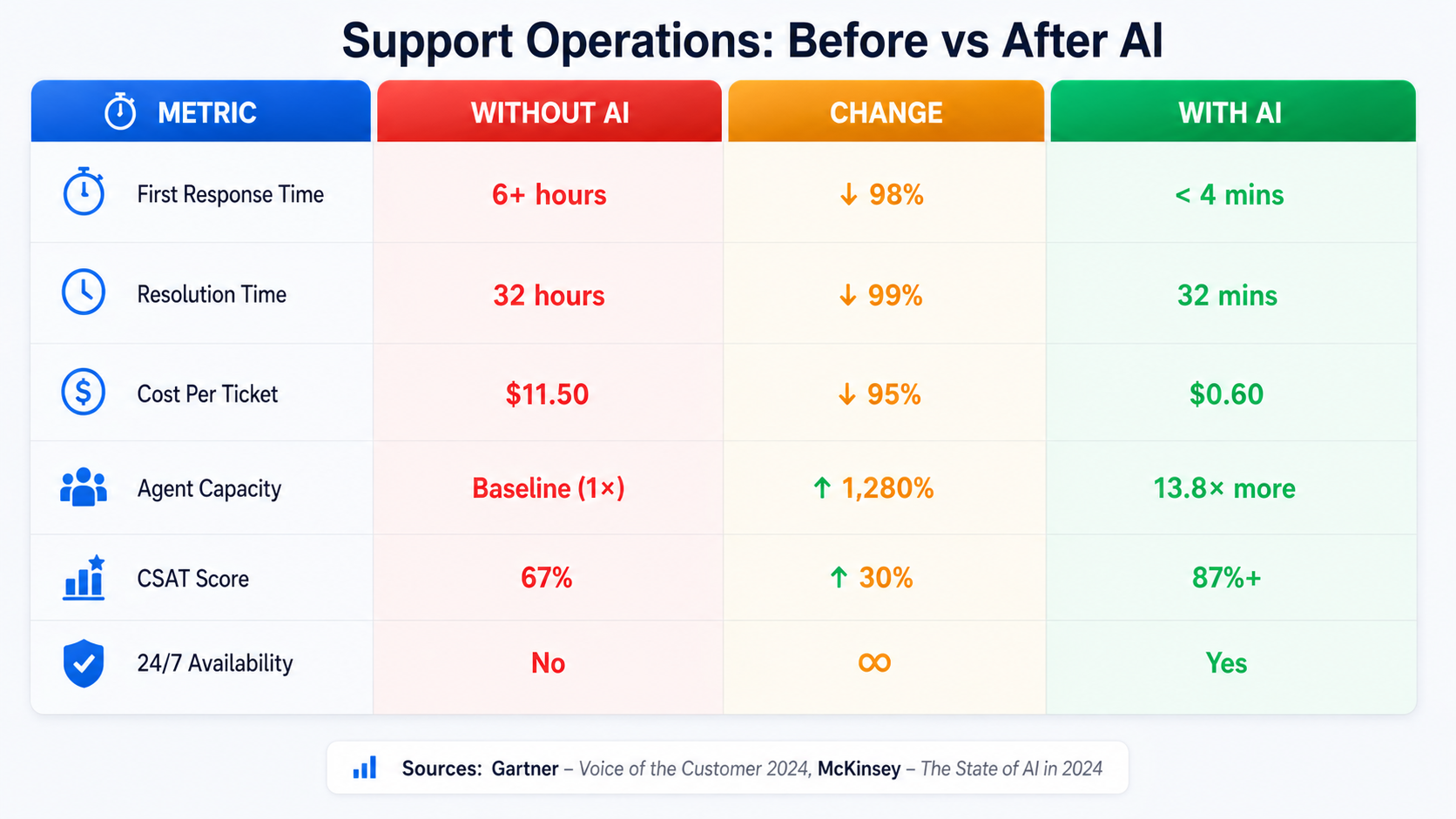
AI resolves tickets 52% faster than traditional methods, reducing first response times from over six hours to under four minutes. Companies using AI in customer support have reported a 42% reduction in first response time across industries. Also, AI-powered systems have led to a 31.5% boost in customer satisfaction scores and a 24.8% increase in customer retention.
The case of a SaaS with AI for Customer Support
Due to its rapid growth Submagic faced a lot of struggle in terms of customer support :
- High volume: Over 3,500 conversations per month.
- Slow response times: An average response time of 1 hour and 26 minutes, which was overwhelming their support agents and annoy customers'.
By implementing Crisp AI, Submagic automated responses to common inquiries (like FAQs, and product questions) and used smart routing to direct complex issues to human agents.
This led to:
- A 95% faster response time (from 1h26m to 5m33s).
- A 65% reduction in new conversations created thanks to Crisp Overlay, the website search widget..
- Stabilized customer satisfaction (CSAT) around 4.3 .
Below, a short explanations shared by Stefan Sekovski, customer support specialist at Submagic, on how they've been leveraging AI to improve customer support.
We've reduced the timing by being able to quickly identify the importance of the user's case. We have clear categorization & prioritization, we use automation and self-service with the help-desk articles our AI help library and with the AI bot answering tier1 questions on the help live-chat. Our agents are able to resolve any issues by having clear decision trees and case examples that they can review for assistance. We have internal com channels (WhatsApp/Discord) where we report/escalate issues and have them resolved super fast. We use also shortcuts to reduce the time between replying and increase the communication efficiency.
In summary, Crisp's AI helped the company to automate and scale its customer support, enabling it to grow efficiently to $8M in Annual Recurring Revenue (ARR).
The playbook: six proven ways to actually scale support costs
If you’re expecting some magical “install AI, save millions overnight” button… yeah, that’s not how this works. The teams seeing those wild cost drops are following a tight and practical set of strategies.
Each strategy below targets a different leak in your support operation. Stack them together, and you'll be trimming cost and redesigning how your support scales.
Strategy 1: Automate tier 1 queries first
The fastest, highest-ROI move is also the simplest: identify your most frequent, lowest-complexity tickets and automate them before touching anything else.
In most support operations, 40-60% of inbound volume is repetitive: the same questions are asked thousands of times a month. Password resets. Shipping status. Subscription changes. Refund policies. None of these requires human judgment. All of them cost the same per ticket as a complex escalation.
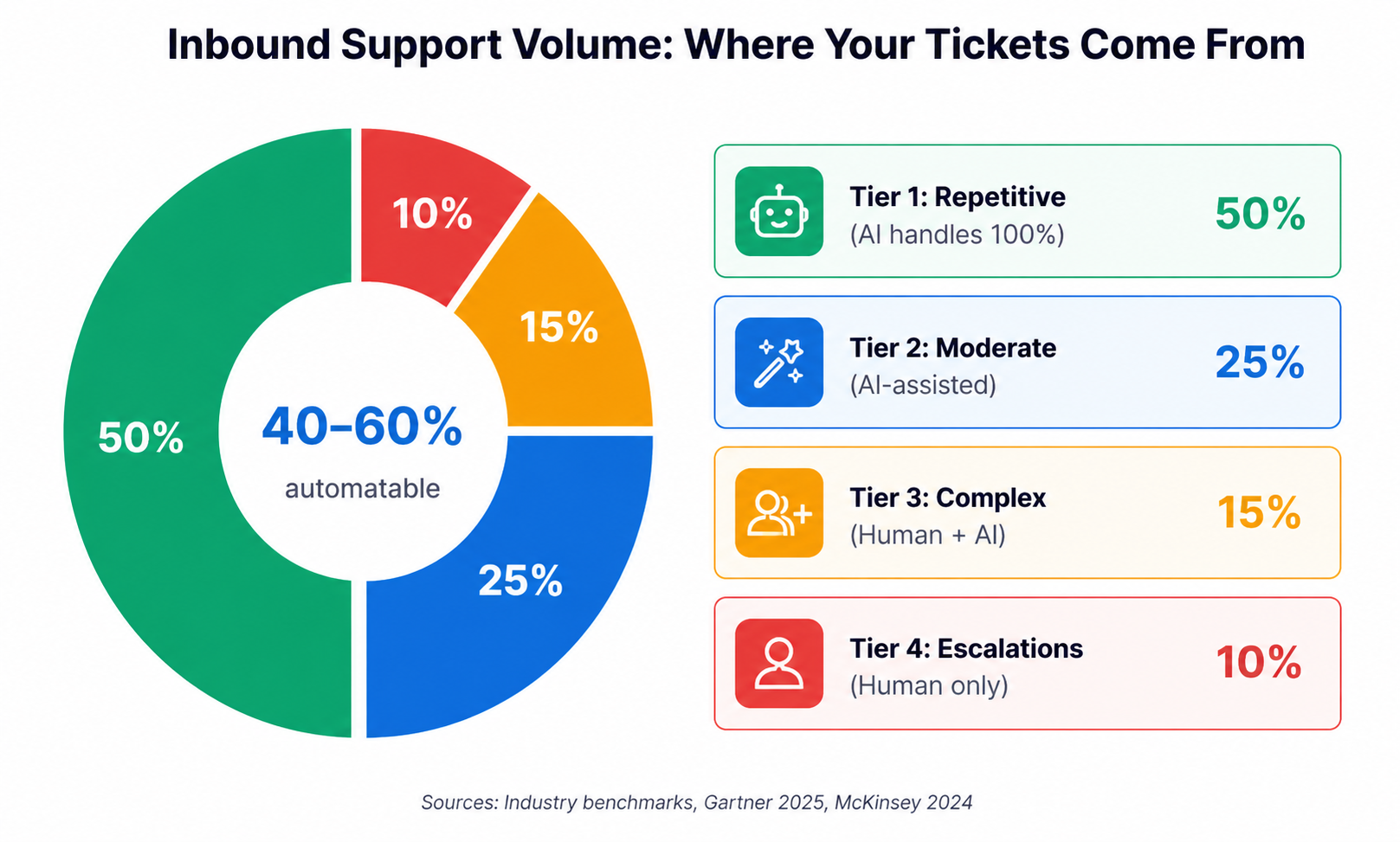
On average, 80% of daily inbound support queries are repetitive. Yet most traditional systems fail to resolve them on first contact. AI resolves these queries instantly, at scale, without a queue. For most teams, targeting the top 10 most-asked questions and building chatbot flows around just those 10 will immediately deflect 30-40% of total inbound volume.
Strategy 2: Use AI to accelerate agent resolution, not just replace agents
The second largest cost driver in support is handle time. The longer each conversation takes, the more expensive your operation is, regardless of headcount.
AI-assisted agents resolve issues significantly faster. Real-time reply suggestions, automatic ticket summarization, instant context pulled from past conversations: these tools mean an agent spends less time digging and more time actually resolving.
And the stats are really positive on this.
According to McKinsey, Gen AI-enabled customer service agents saw a 14% increase in issue resolution per hour and a 9% reduction in time spent handling issues, a compounding effect that becomes more pronounced at scale. Support agents using AI tools can manage 13.8% more customer inquiries per hour without additional hiring.
Think of it this way: a surgeon does not become less valuable when given better instruments. They become more precise, more efficient, and more capable of handling complexity. AI-assisted agents operate on the same principle. The same human expertise, amplified by machine-speed context retrieval.
Strategy 3: expand self-service so customers help themselves
Every ticket that does not get submitted is a ticket you do not have to pay to resolve. A well-structured help center, surfaced by an AI chatbot that understands natural language queries, can deflect support volume before a customer ever opens a chat window.
A contact resolved through self-service costs $1.84, versus $13.50 for a human agent. That is a 7x cost difference per interaction.
Real self-service deflects 40-60% of incoming tickets when built correctly. Yet 83.3% of companies cite outdated content as their top knowledge base challenge The gap between a deflecting help center and a useless one is almost always a content quality problem, not a technology problem.
When customers find accurate answers in 30 seconds without waiting, they do not just save you money. They leave happier than if they had waited for an agent. The self-service experience should feel helpful, not like a wall between the customer and a human.
A quick win you can try right away is to audit your help center for your 20 most common support topics. If an article does not exist or is hard to find, write it first. Then train your AI on it.
Strategy 4: Reduce staffing pressure without reducing headcount
One of the least-discussed benefits of AI in support is its impact on hiring cycles. Teams without AI need to hire linearly with volume: more customers means more agents. AI breaks that ratio entirely.
AI can reduce staffing needs by up to 68% during peak support seasons.
Emma App, the consumer finance management platform, deployed Crisp's AI chatbot across its support inbox — covering mobile, in-app, and social channels. The result:
- 130% more conversations handled without adding a single headcount.
- Weekend support became 100% automated, eliminating the Monday morning queue that had been creating recurring team burnout.
Geoffrey Safar, Head of Operations: "It's not about replacing support. It's about keeping customers cared for — even when no one's online."
Seasonal spikes, product launches, and rapid growth no longer automatically require emergency hiring. According to Gartner, 80% of companies are either using or planning to adopt AI-powered chatbots for customer service. The gap between early movers and laggards is already measurable in cost structures.
Strategy 5: build the human-AI hybrid model, not just automation
The highest-performing support organizations are not using AI to eliminate human judgment. They are using it to protect human judgment, ensuring every agent hour is spent on conversations that genuinely require empathy, expertise, or authority.
The hybrid model is not 'AI tries first, human cleans up the mess.' It is a structured routing architecture where query type, emotional valence, account value, and complexity all determine who responds.
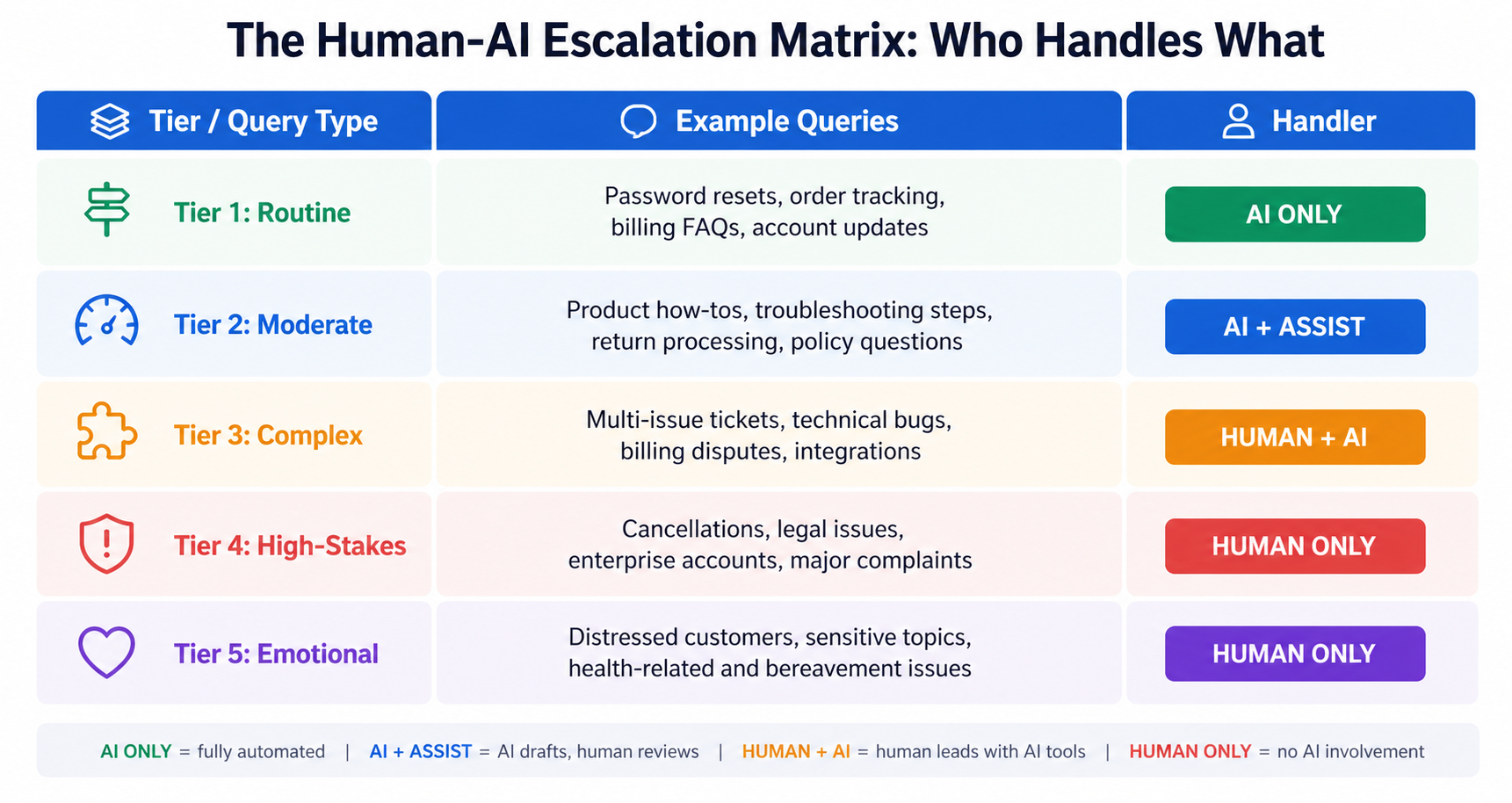
According to a Deloitte report, companies using generative AI are 35% less likely to report that human agents feel overwhelmed by the volume of information during customer calls. The hybrid model does not just cut costs, it makes the people on your team better at their jobs.
Tier 4 and Tier 5 conversations (billing disputes, cancellations, distressed customers, legal matters) should never be handled by AI alone. These are moments where human connection is not a preference; it is a retention event. Route them immediately, every time.
Think of the hybrid model like an emergency room triage system. Not every patient needs a surgeon. The intake process routes low-acuity cases to practitioners who can handle them efficiently, freeing the surgeon's full attention for cases that genuinely demand it. Your support routing should work exactly the same way.
A quick win you can try is to map your last 100 escalated tickets. Which could have been handled at tier 1 but were misrouted? That gap is where your next automation build should focus.
Strategy 6: measure what actually drives cost
You cannot reduce what you cannot see. Most support teams track CSAT and response time, but not the unit economics underneath: cost per ticket, cost per resolution, labor cost as a percentage of revenue.
AI introduces a new set of metrics that matter: deflection rate, containment rate, AI resolution accuracy, and escalation ratio. These numbers tell you exactly where your automation is working and where it is leaking value.
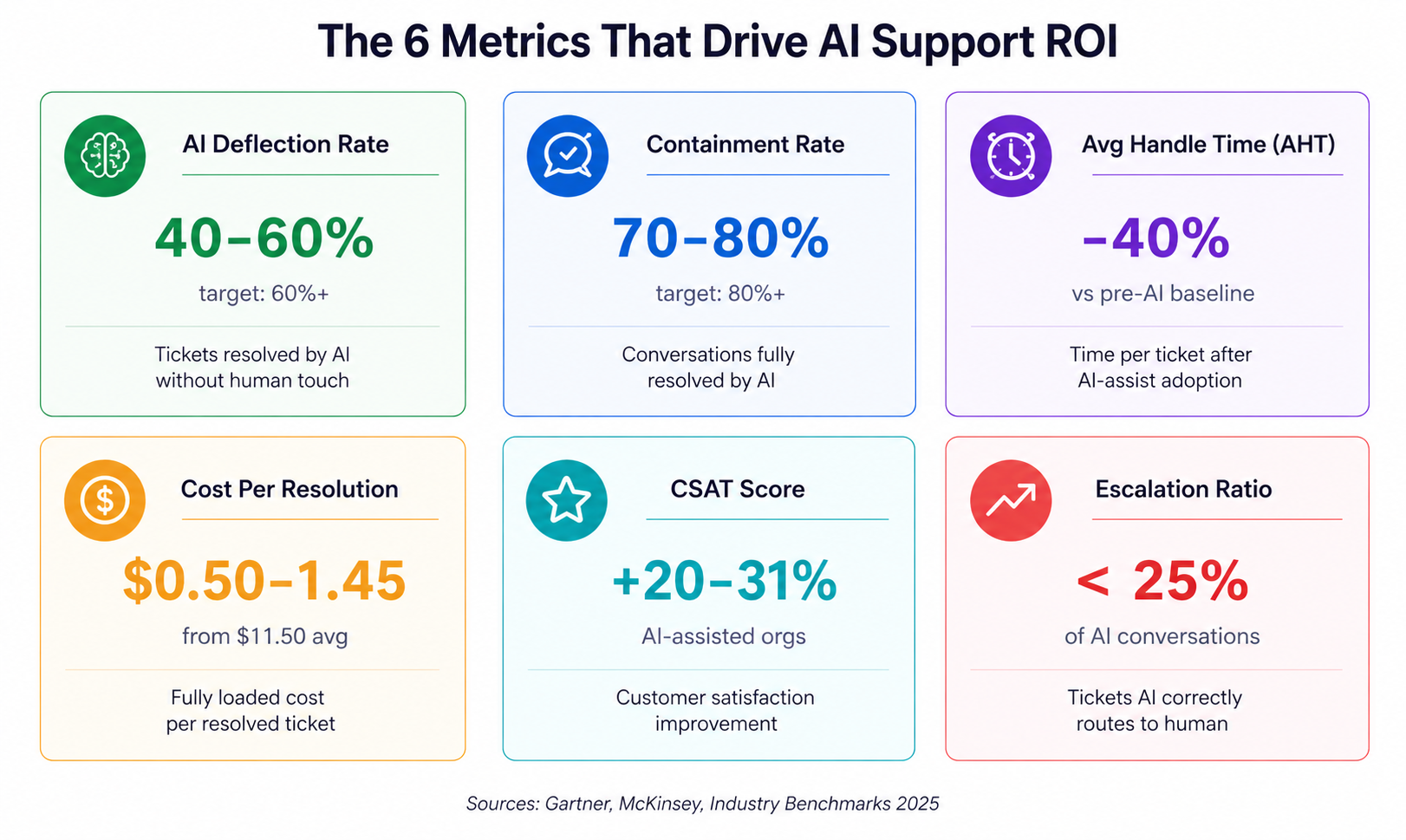
Lots of companies have seen significant and replicable cost reduction. NIB Health Insurance reduced customer service costs by 60% after implementing AI support, saving $22 million and decreasing calls with human agents by 15%.
Companies see an average return of $3.50 for every $1 invested in AI customer service, with leading organizations achieving up to 8x ROI. Those results are not accidental. They come from teams that review deflection rate, AHT, and cost-per-resolution every single week, not quarterly.
When will you see returns? The AI customer service ROI timeline
This is the question most discussions skip because it's sometimes not necessarily as rosy as they would want to portray. But it is also a question every budget owner actually needs answered. The honest answer: it depends on scope, training quality, and ticket volume. But industry data gives us reliable benchmarks.
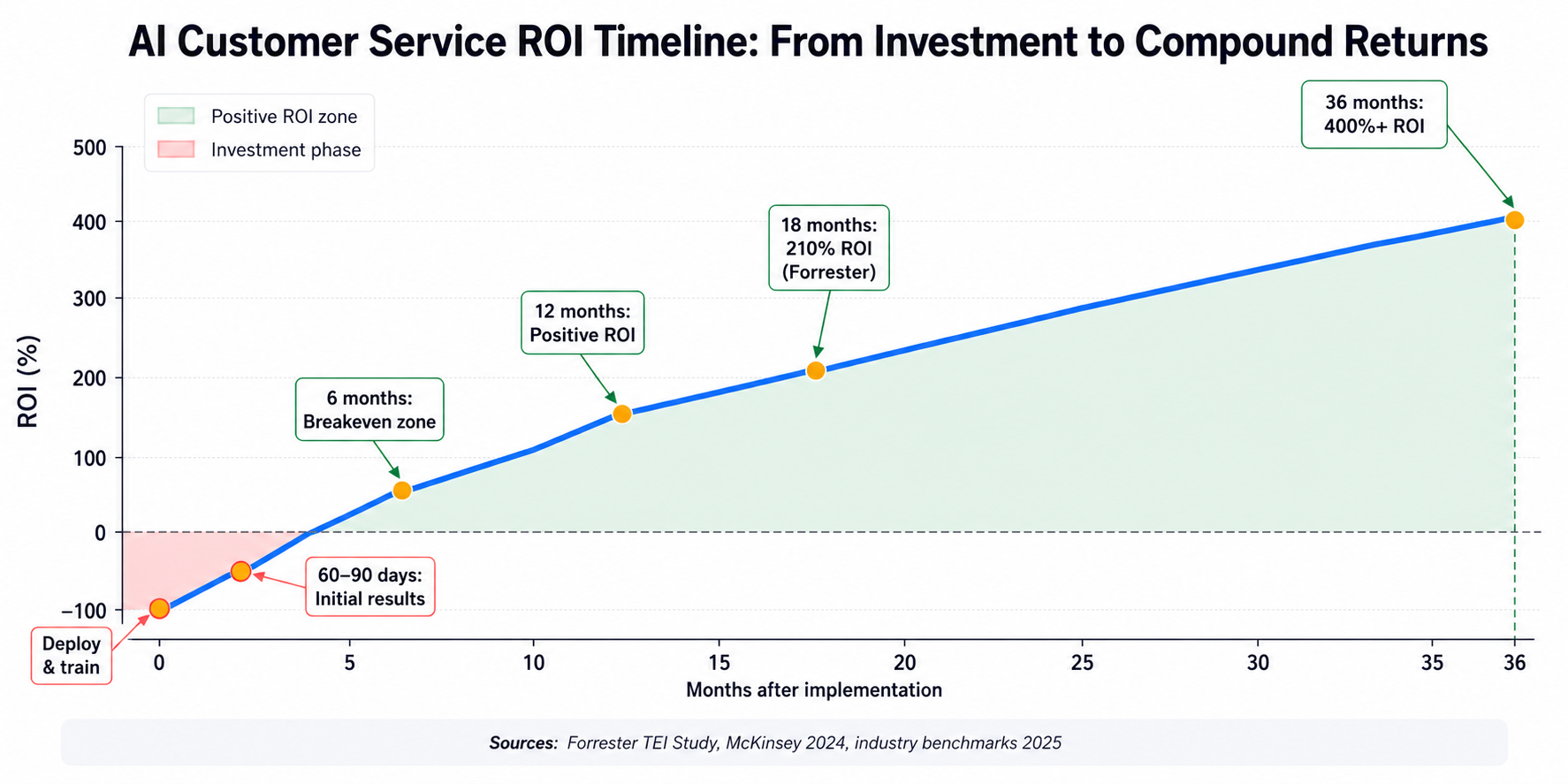
A Forrester Total Economic Impact study found the breakeven point typically occurs within 9-15 months for mid-sized companies. Modeled customers achieved 210% ROI over three years with payback periods under 6 months. The average ROI curve runs at 41% in year one, 87% by year two, and over 124% by year three as systems learn and improve on your actual data.
The variance in ROI outcomes is almost entirely explained by implementation approach, not technology selection. Organizations that start narrow, automating a focused set of high-volume tier 1 queries before expanding, achieve 30-40% higher ROI in the first two years compared to those attempting complete overhauls. So, start narrow. Prove it. Then expand.
The implementation roadmap: start narrow, prove fast, scale confidently
The teams that see the fastest results follow a consistent pattern. Here is the framework.
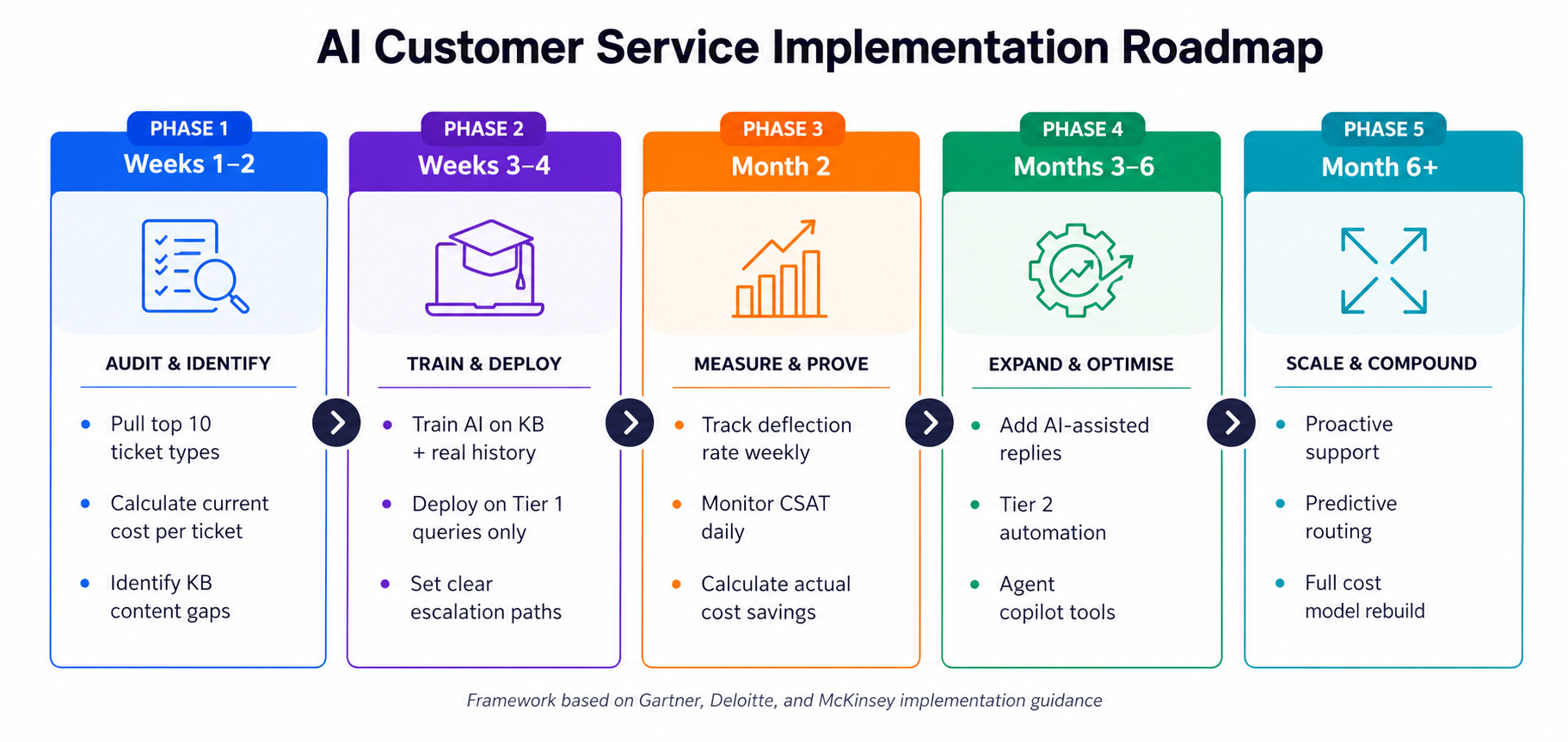
Phase 1 is always audit and identify: pull your top 10 ticket types, calculate current cost-per-ticket, and identify gaps in your knowledge base. This is not glamorous work. It determines everything that follows.
Phase 2 is train and deploy: get your AI trained on your actual knowledge base and real conversation history, then deploy on tier 1 queries only. Set escalation paths clearly before going live.
Phase 3 is measure and prove: after 30 days, track deflection rate, CSAT, and cost-per-resolution. If deflection is above 30% and CSAT has held or improved, you have your business case. Expand from there.
According to the Deloitte Customer Service Excellence report 2025, 42% of companies abandoned most AI initiatives in 2025, up from 17% in 2024. Most failures trace to poor training data and unrealistic scope. This validates the long-held knowledge that the most common implementation failure is scope creep. Teams that try to automate everything at once end up with a partially trained AI that frustrates customers across all their query types simultaneously. Resist the temptation.
What to avoid when reducing support costs with AI
So, if you're ready to take action to cut your support cost, here are a few things you need to pay attention to:
Deploying AI without enough training data
An AI chatbot trained on 10 help articles will frustrate more customers than it helps. Train your AI on your full knowledge base, real conversation history, and your most common edge cases before you go live. The quality of your training data is the absolute ceiling of your AI's performance. No platform overcomes a sparse knowledge base.
Hiding the escalation path
Customers accept AI for simple questions. They resent it when they cannot reach a human for something complex. Only 42% of consumers currently trust businesses to use AI ethically (Gartner). That number drops every time a customer gets trapped in a bot loop. Always surface a clear 'I want to talk to someone' option.
Optimizing for deflection rate instead of resolution rate
A chatbot that closes conversations without actually resolving them inflates your deflection metric while tanking CSAT. Measure successful resolutions, not just contained conversations. These are different numbers. Know the difference.
Removing humans from high-stakes conversations
Billing disputes, cancellation conversations, complaints, and distressed customers all need human empathy. The cost of a poorly-handled cancellation conversation is not a ticket cost. It is a customer lifetime value cost. AI should route these immediately, not attempt to handle them.
Skipping the measurement infrastructure
You cannot optimize what you do not measure. Set up deflection rate, containment rate, and cost-per-resolution tracking before you launch. Teams that instrument from day one iterate significantly faster than those who add measurement after the fact.
What's Coming: the AI customer service horizon
The current state of AI in support (chatbots, AI-assisted agents, smart routing) is the foundation layer. The next evolution is already underway.
Proactive support, where AI identifies a customer is likely to have a problem before they contact you, is already live at companies like Bank of America, where it helps resolve 98% of queries within 44 seconds. American Express reported a 90% faster response time and a 22% CSAT increase after AI deployment in May 2025.
The teams building AI-powered support infrastructure now are the ones who will own the efficiency advantage in 2026 and beyond. The competitive gap between early adopters and laggards is already measurable. In 12 months, it will be structural.
Frequently Asked Questions
How much does it actually cost to implement AI customer service?
Implementation costs vary by scope. Basic AI chatbot platforms start at $50-500/month for SMBs. Mid-market implementations with API integrations and custom training typically cost $5,000-$25,000 in setup fees plus ongoing platform costs. Enterprise deployments can run $10,000-$100,000+ for custom development.
Will AI customer service hurt our CSAT scores?
When AI is well-trained on your actual knowledge base, routes high-stakes conversations to humans correctly, and gives customers clear access to escalation, CSAT typically improves.
What percentage of our support volume can realistically be automated?
Industry benchmarks put realistic automation rates at 40-60% for most B2C support operations and 30-50% for B2B. The upper end, achieved by companies like Klarna (67%) and Vodafone (70%), requires mature AI training, comprehensive knowledge bases, and continuous optimization.
How long before we see measurable ROI with AI support?
Most companies see initial results within 60-90 days, typically in the form of reduced ticket volume and faster resolution times on the queries the AI is handling. Measurable cost savings (cost-per-resolution declining) typically show up in months 2-3.
Can small or mid-sized companies afford AI customer service?
Yes, and they often see faster ROI than enterprise customers because they have less legacy infrastructure to work around. Modern platforms like Crisp are purpose-built for SMBs and scale from very accessible price points.
Sources
- Gartner, Agentic AI resolving 80% of customer service issues by 2029, operational cost reduction projections, https://www.gartner.com/en/newsroom/press-releases/2025-03-05-gartner-predicts-agentic-ai-will-autonomously-resolve-80-percent-of-common-customer-service-issues-without-human-intervention-by-20290
- McKinsey & Company, State of AI 2024, adoption rates, productivity gains, and ROI across business functions, https://www.mckinsey.com/capabilities/quantumblack/our-insights/the-state-of-ai
- McKinsey & Company, Generative AI in customer service, 14% issue resolution per hour increase and handle time reduction, https://www.mckinsey.com/capabilities/operations/our-insights/the-next-frontier-of-customer-engagement-ai-enabled-customer-service
- Forrester Research, Total Economic Impact study, AI customer service ROI and 210% three-year return data, https://tei.forrester.com/go/Salesforce/Agentforce/?lang=en-us
- Salesforce, State of Service 2024, agent productivity and AI adoption rates, https://www.salesforce.com/resources/research-reports/state-of-service/
- Deloitte, Customer Service Excellence 2025, AI implementation failure rates and phased ROI data, https://www.deloitte.com/global/en/services/consulting/research/generative-ai-in-customer-service.html
- Nielsen Norman Group, Support agent productivity study, 13.8% more inquiries per hour with AI tools, https://www.nngroup.com/articles/ai-productivity-customer-support/
- Accenture, Generative AI and automation investment survey 2024, 74% of organizations met or exceeded expectations, https://www.accenture.com/us-en/insights/technology/generative-ai
- Capgemini, Retail AI adoption report 2024, 94% of retail companies report operational cost decreases, https://www.capgemini.com/insights/research-library/ai-in-retail/
- Plivo, AI agent statistics 2025, comprehensive McKinsey, Gartner, and Deloitte benchmark compilation, https://www.plivo.com/blog/ai-agents-top-statistics/
- AI Business Weekly, 50 sourced AI customer service statistics 2026, cost, ROI, adoption, and performance data, https://aibusinessweekly.net/p/ai-customer-service-statistics
- Klarna, AI assistant press release 2024, 2.3M conversations per month and $40M profit improvement, https://www.klarna.com/international/press/klarna-ai-assistant-handles-two-thirds-of-customer-service-chats-in-its-first-month/

Summer 2026 - Product Update
Meet the refreshed Crisp experience, Understand how Artificial Intelligence handles every conversation, Build reusable teams across your workspace, and more. Discover the latest features and improvements released by the Crisp team in Summer 2026.


Best 9 helpdesk software and ticketing systems for 2026
Need help to choose your next helpdesk with a ticketing tool for 2026? We've gathered a guide that gives you everything you need to convince your C-levels.

Team workload management for support: how to balance the queue without burning anyone out
Ticket count hides real workload. Here's how to measure effort instead of count, route with capacity in mind, and stop burning out your best agents.