How AI Chatbots Help Train New Support Agents Faster
Onboarding new support agents can be intense in terms of human ressources, hence why an internal ai chatbot tied to your support software can help, this article describes it all.


Nobody pictures a chatbot when they think about training a new support agent.
They picture the classic playbook. Shadow a senior support manager. Read through the knowledge base (both public and private). Listen to recorded customer success calls. Take a few supervised tickets here and there. Repeat for six to eight weeks until the ramp-up cost feels justified.
It works. Eventually. But it costs more than most teams realize.
Replacing a new support hire who leaves in their first year costs between $12,000 and $35,000. And most of that money isn’t spent on recruiting. It goes toward weeks of shadowing senior agents, the tickets mishandled by someone who didn’t know the product yet, and the senior agent time consumed mentoring instead of resolving.
The longer the ramp, the longer the cash burn. And the cost isn’t always financial: a slow onboarding erodes confidence in new hires, strains experienced agents, and quietly degrades the customer experience while your new team member is finding their footing.
Research from AIHR puts the average ramp time for customer-facing roles at 1 to 3 months just to reach baseline productivity, not mastery.
That’s a long runway. And in support, where every slow ticket is a customer waiting, every mishandled case is a CSAT hit, and every escalation is a senior agent pulled from their own queue, “slow ramp” is never just an internal problem.
AI Copilots for customer support are changing that equation. Not by replacing your training program, but by compressing the distance between a new agent’s first day and their first confident, independent ticket management.
This article breaks down exactly how a company can leverage an AI Chatbot to help new comers resolve tickets faster, autonomously, accelerating the ramp up while preserving team's bandwith.
Why new agent onboarding takes longer than it should
The standard support onboarding model hasn’t changed in a decade. And the bottleneck isn’t effort. It’s information density.
Every ticket puts a new agent through three separate cognitive steps: understand what the customer actually needs, find where the answer lives, and phrase a response that matches the brand’s voice.
Experienced agents do all three simultaneously, almost without thinking. New agents do them sequentially, with a lot of tab-switching in between.
The result is high handle time, inconsistent quality, and a dependency on senior colleagues that drains the whole team. Add the pressure of a live customer waiting on the other end, and a new agent’s confidence takes hits it can’t easily absorb in week one.
There’s also a less visible cost that most teams undercount: early attrition. New agents who feel unsupported in their first weeks leave faster. And a support hire who exits before month three hasn’t just failed to contribute. They’ve consumed training resources, occupied senior agent time, and left a gap in the queue on the way out.
The fix isn’t more shadowing. It’s reducing the information gap in real time. That’s where AI enters.
4 ways AI chatbots compress the agent learning curve
1. Reply Suggestions That Close the Knowledge Gap Instantly
The fastest way to shorten ramp time isn’t to teach new agents everything before they start. It’s to surface the right answer at the exact moment they need it.
A landmark study from the Quarterly Journal of Economics by Brynjolfsson, Li, and Raymond found that AI access increased customer service agent productivity by 15% on average, with the largest gains among new and lower-skilled workers.
The reason: AI effectively transfers the accumulated knowledge of experienced agents to people who are just starting out.
When a new hire sees a suggested reply that accurately addresses the customer’s question in the right tone, they don’t just send it. They learn from it. Each suggestion is a micro-training moment embedded inside real work. The kind that sticks.

2. Instant Knowledge Base Access During Live Conversations
Most knowledge bases are built for search, not speed. A new agent mid-conversation doesn’t have time to open a second tab, type a query, skim three articles, and extract an answer. By the time they do, the customer is waiting and the agent is stressed.
AI changes the query model entirely. When the knowledge base is connected to the AI layer, the relevant article, procedure, or policy surfaces automatically based on what the customer has typed, before the agent even starts looking.
McKinsey’s research on generative AI copilots in customer service found a 10% reduction in average handle time and up to a 14% productivity gain when AI assistants are deployed alongside human agents. Handle time drops because agents aren’t spending it searching.

3. Contextual Conversation History That Removes the Need to Ask Twice
One of the most confidence-draining experiences for a new agent is picking up a conversation mid-stream without context. What did the customer already try? Has someone else on the team spoken to them? What’s the current status of their issue?
Without that context, agents ask questions the customer has already answered. Which frustrates customers and, worse, exposes the agent’s inexperience in a way they can’t easily recover from.
AI-powered conversation summaries and context panels solve this structurally. The new agent opens a ticket and engage with the AI Chatbot for customer service to gain some context about the customer’s current situation. No scrolling through 14 messages. No guessing what was tried.
Gartner predicts that conversational AI will reduce contact center labor costs by $80 billion by 2026, largely because this kind of context retrieval removes the manual overhead that makes support so time-intensive.

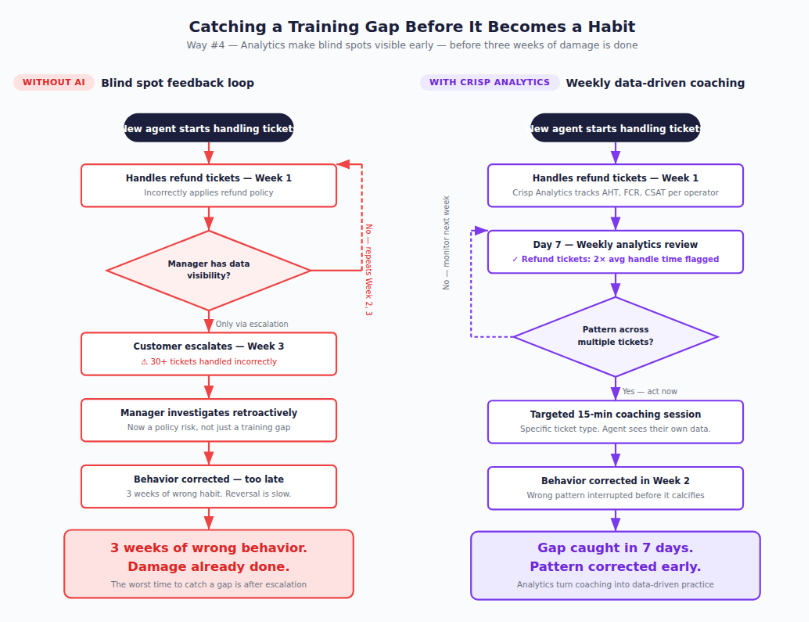
4. Analytics that identify support training gaps before they become habits
The worst time to discover a new agent has been handling a ticket type incorrectly is three weeks later, when a customer escalates. By then, the wrong behavior has been practiced 30+ times. Habits don’t break easily.
AI-powered support analytics make blind spots visible early. Response time by agent, first-contact resolution rate, CSAT scores, and conversation sentiment can all be tracked from day one, not as surveillance, but as a coaching signal.
New agents who see their own performance data weekly understand where they’re strong and where they need support. Managers who can see which ticket types generate the longest handle times for new hires know exactly where to focus training before the pattern sets.
Research from the St. Louis Federal Reserve Bank confirms that generative AI raises worker productivity, and that less experienced workers benefit most from direct AI assistance, while experienced workers benefit more from performance transparency. The implication: pair real-time AI assistance with weekly performance reviews.
5. Bridge the AI training gaps to increase AI automated conversation
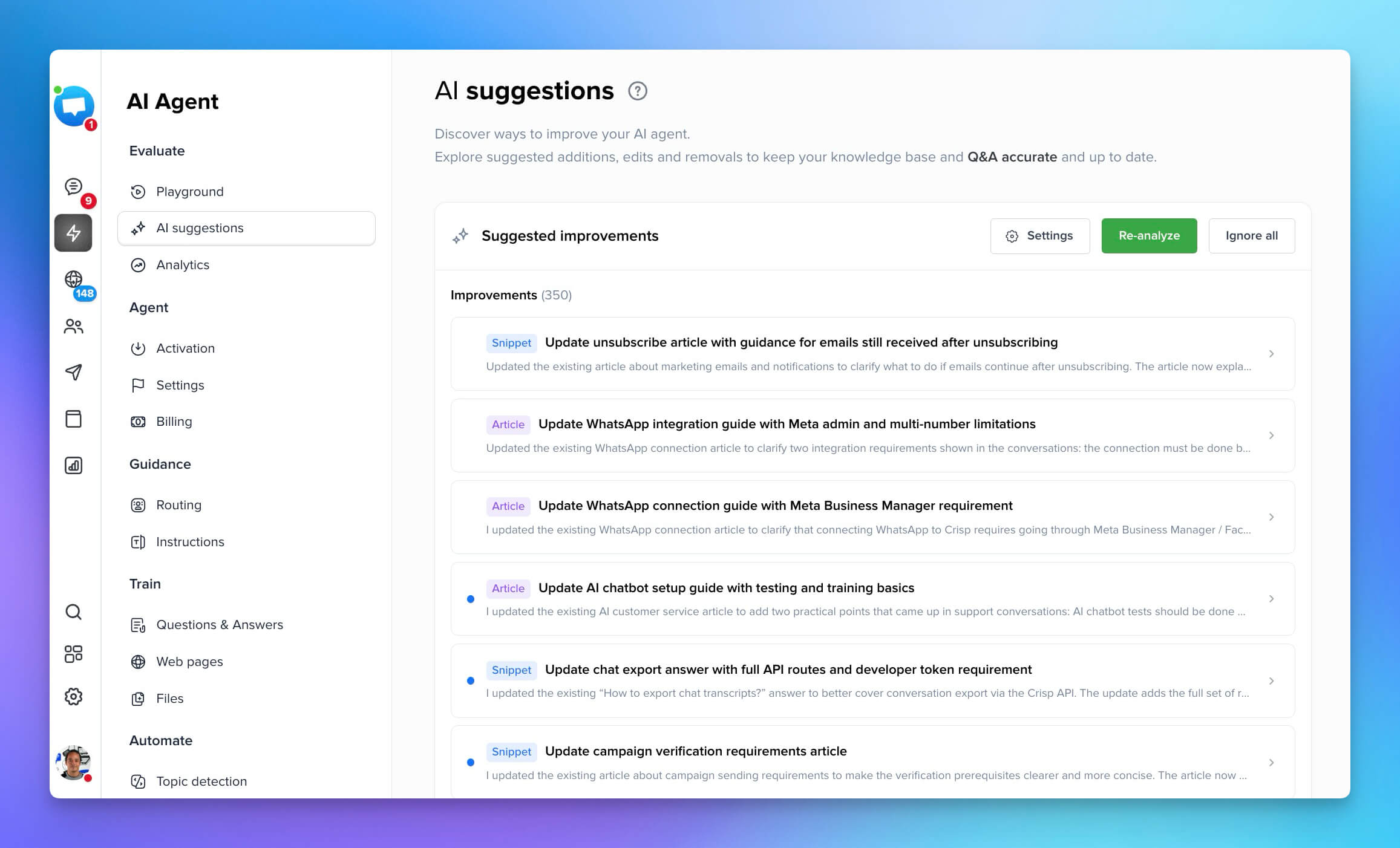
Not only the human knowledge is important, but also the AI knowledge and its training data set is vital when it comes to improving AI-powered support ticket resolution.
Recently, Crisp released a new product called AI Suggestions, which suggest improvements to be made on the companies' training set to prevent conversations from being escalated again.
What it sounds like when a new agent has AI in their corner
Your new hire, Alex, gets their first unassisted ticket on week two. The customer is frustrated — they've contacted support twice before and still haven't resolved a billing discrepancy. Alex has been with the team for nine days.
Without AI: Alex reads the full conversation history, opens the billing FAQ in another tab, realizes the answer isn't there, pings a senior colleague who's mid-ticket, and sends a holding reply while they wait. 14 minutes elapsed. Customer dissatisfied.
With Crisp: Alex opens the conversation. The history is summarized in three lines. Hugo has already suggested a response referencing the correct billing procedure. Alex reads it, adjusts the tone, and sends. 4 minutes elapsed. Customer satisfied. Alex learned how billing discrepancies are handled, not from a manual, but from doing.
What to avoid when using AI for agent training
Treating AI as a replacement for structured onboarding. AI accelerates the curve, it doesn't replace it. New agents still need a structured first week covering product fundamentals, escalation paths, and brand tone. Without that foundation, they'll approve AI suggestions they don't understand.
Turning on every feature on day one. Overwhelming a new agent with reply suggestions, knowledge base pop-ups, sentiment alerts, and analytics dashboards simultaneously creates cognitive overload. Stage the rollout: reply suggestions in week one, analytics review in week three.
Not reviewing AI-suggested replies. If agents send suggestions without editing, they stop learning. The goal is for AI to be a scaffold, not a shortcut. Require new agents to read and understand every suggestion before sending.
Skipping the knowledge base. AI can only surface information that exists in your knowledge base. If it's outdated or thin, the suggestions will be wrong — and new agents won't know the difference. Audit your knowledge base before onboarding season.
How Crisp supports new agent onboarding end-to-end
Crisp's AI Agent called Hugo analyzes customer intent and suggests a complete response the agent can use or edit. It draws from your knowledge base and previous successful conversations, making suggestions directly relevant to your team's product and tone.
Crisp's Knowledge Base acts as one of the source of truth the AI queries in real time. When it's well-maintained, it functions as an always-available trainer — one that never tires of answering the same question.
Crisp's Analytics give support managers a live view of every agent's performance metrics, making it possible to catch onboarding gaps early and adjust coaching before patterns solidify.
The faster path to a confident new agent
The companies that onboard support agents fastest aren't doing it by hiring more experienced people or running longer training programs. They're doing it by putting better tools in front of new hires during their first real interactions — tools that surface the right answer at the moment it's needed, rather than expecting agents to have memorized it before they start.
AI chatbots, used well, are not a shortcut. They're an accelerant: they compress the learning curve without compressing the learning.
Frequently asked questions
How much time can AI chatbots realistically cut from a new agent’s ramp-up period?
Based on current research and industry benchmarks, companies using AI onboarding tools report a 50–53% reduction in overall onboarding time. In practical terms, that means an agent who would typically take 6–8 weeks to reach baseline productivity may reach that milestone in 3–4 weeks with AI assistance.
Is the knowledge base really that important, or can AI train agents without one?
It’s not optional. The knowledge base is the foundation AI builds every suggestion from. Without a well-maintained knowledge base, AI reply drafts will be generic or flat-out wrong, and a new agent who doesn’t yet know your product won’t be able to spot the difference.
Does using AI chatbots for agent training add significant cost to the onboarding process?
In most cases, AI-assisted onboarding costs significantly less than the status quo, not more. The cost of a traditional ramp sits between $12,000 and $35,000 per hire. Crisp’s paid plans start at $45 per workspace per month, which covers the AI, knowledge base, shared inbox, and analytics for your entire team.
How do I know if AI-assisted onboarding is actually working? What metrics should I track?
Track four things: average handle time by agent (does it compress faster in weeks 1–2 than your historical baseline?), first-contact resolution rate (are new agents resolving more tickets on the first reply?), escalation rate (how often are new agents pulling in senior colleagues?), and early attrition (are you retaining new hires past the 90-day mark at a higher rate?).
Sources & Methodology
This article draws on peer-reviewed research, industry benchmarks, and Crisp’s own infrastructure data. All sources verified April 2026.
- Brynjolfsson, Li & Raymond, Generative AI at Work — The Quarterly Journal of Economics, Vol. 140, Issue 2 (2025), https://academic.oup.com/qje/article/140/2/889/7990658
- NBER Working Paper (pre-publication version), Generative AI at Work, Working Paper 31161, https://www.nber.org/papers/w31161
- McKinsey Global Institute, The Economic Potential of Generative AI: The Next Productivity Frontier (June 2023), https://www.mckinsey.com/capabilities/mckinsey-digital/our-insights/the-economic-potential-of-generative-ai-the-next-productivity-frontier
- Vonage / Como, Accelerate Contact Center Agent Onboarding: Ramp Agents 2X Faster (2025), https://www.vonage.com/resources/articles/agent-onboarding/
- iTacit, How AI Makes Employee Onboarding Faster: A Manager’s Guide (2025), https://itacit.com/blog/how-ai-makes-employee-onboarding-faster-a-managers-guide/

September 2026 - Product Update
Discover the new Knowledge Base editor, benchmark your AI support performance, track how often Hugo escalates conversations, and more. Discover the latest features and improvements released by the Crisp team in September 2026.


Summer 2026 - Product Update
Meet the refreshed Crisp experience, Understand how Artificial Intelligence handles every conversation, Build reusable teams across your workspace, and more. Discover the latest features and improvements released by the Crisp team in Summer 2026.

Best 9 helpdesk software and ticketing systems for 2026
Need help to choose your next helpdesk with a ticketing tool for 2026? We've gathered a guide that gives you everything you need to convince your C-levels.