How AI Self-Service Tools Prevents WISMO Queries (“Where Is My Order?”)
Want to get rid of WISMO requests? Here is what you should do to improve your ecommerce post-purchase customer support experience. See how AI and self-service tools can help improve your business.


Cyber monday and Black friday are gone but the real rush is only beginning. Now comes the time for delivery, product returns and the dreaded refund requests.
As an online merchant, you know the famous drill "Where is my order?" that resonates when support tickets spikes throughout your entire support inbox.
With the Christmas season just around the corner, you still have time to prevent it from happening again.
The truth is simple: WISMO isn't a support problem, it's an information-problem. Customers chase you only when they don't know what's happening. And during peak season, that silence turns a small delay into a big wave of support inquiries.
That’s where AI self-service becomes a competitive advantage — not a gadget, but the difference between a support team drowning in noise and a support team focused on actual business-impact.
In this article, we will review:
- the cost of WISMO order for an online merchants,
- Use-case where you can implement AI-powered tools that are helping online merchants deflects WISMO requests,
- Insightful advices shared from experts in the ecommerce industry
The hidden cost of "where is my order?" queries
With the rise of AI support chatbot software, each conversation is now to be paid. It means the more WISMO you have to deal, the more your support operationnal cost are rising. Even though an AI-powered support conversation is still cheaper than a support agent, it adds up to the long list of things online merchants are paying for.
Why WISMO is more than just a customer question
WISMO queries signal poor post-purchase communication, as well as poor customer account experience. Among the statistics we see, many merchants report that 30–40% of their support volume stems from WISMO; during peak seasons, this number can climb further.
Customers ask due to shipping delays or lack of visibility, causing anxiety and repeated checks.
Without transparent delivery updates, agents spend 2-3 hours daily on low-value tasks, missing opportunities to build customer loyalty through personalized interactions.
The real impact on your team, budget, and customer experience
It's commonly agreed in the support industry that a support ticket costs on average $8. On top of that, AI support agents for ecommerce such as Crisp, Gorgias or Zendesk are now charging a dynamic fee or 1$ or less for conversations their AI resolves.
Example of cost for WISMO request for an online merchant:
- 500 weekly support inquiries
- 40% are WISMO request
- AI-resolved tickets are 1$
- Human-resolved tickets are 8$
- AI resolves 80% WISMO tickets, humans 20%
Annual WISMO volume: 200 / week × 52 weeks = 10,400 WISMO tickets / year
AI-resolved (80%):
- 80% of 10,400 = 8,320 tickets / year
- cost: 8,320 × $1 = $8,320 per year
Human-resolved (20%):
- 20% of 10,400 = 2,080 tickets / year
- cost: 2,080 × $8 = $16,640 per year
Total WISMO cost with AI (40% share)
$8,320 (AI) + $16,640 (human) = $24,960 per year
Now you understand the real cost of WISMO requests. AI support bots are capable of answering these request but not resolving them at 100%. Even though AI-prices are going to go down thanks to better knowledge regarding these innovative practices, there are some prices that are incompressible.
How self-service experiences actually help avoid the WISMO problem
Below is how modern self-service actually works, far beyond the basic FAQ or chatbot many brands still rely on.
Leveraging dedicated post-purchase user interface
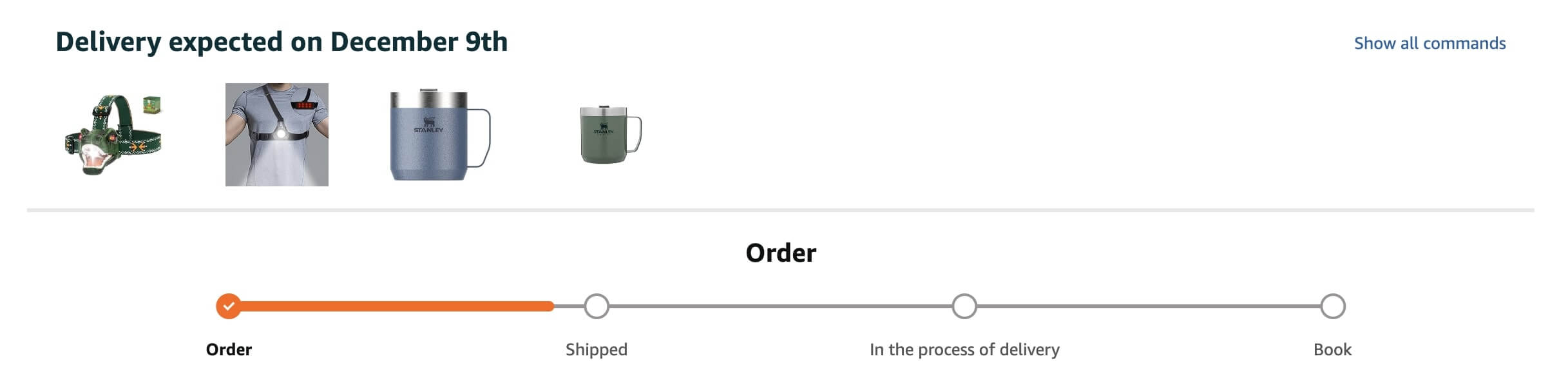
A dedicated post-purchase interface, whether it’s a tracking portal, an order-status page, or a branded delivery dashboard, is the most effective way to kill WISMO intent at the source.
A customer who can see their order doesn’t need to ask about it.
Modern interfaces do more than show “In transit.” They sync with carriers, display ETA windows, show delays proactively, and integrate with return flows. This transforms the traditional chaotic post-purchase experience into a predictable, transparent journey.
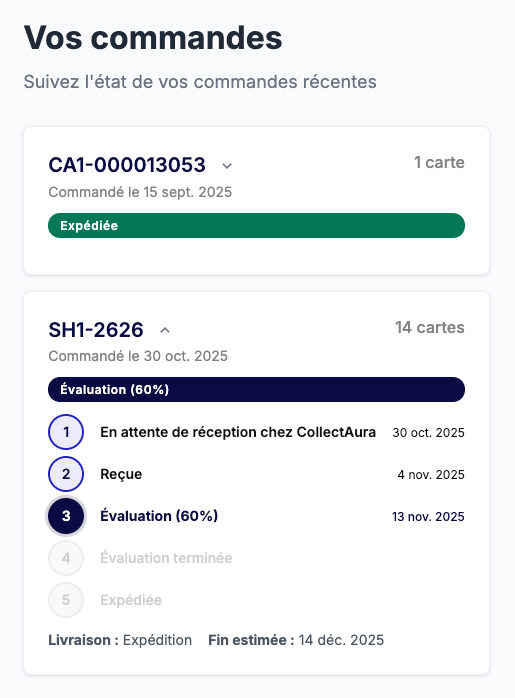
According to Paul-Louis Bénard, a recognized e-commerce content creator in France, Collect Aura does it very right because it allows to:
- See order's progress
- See the actual orders' status
- See a progression bar
- See an estimated date of delivery/treatment
The psychology behind it is simple: shoppers check order status 3–5 times per shipment, especially when shipping windows are vague. Giving them a place to check without contacting support drastically reduces anxiety, and therefore reduces ticket volume.
Moving beyond basic support chatbots to provide real answers
Let’s be honest: basic chatbots made WISMO worse. But with modern AI support bot, it's now easy to be done, and it doesn’t guess.
The support bot connects directly to your order management system or CMS (think WooCommerce or Adobe Commerce for example) and retrieves live information. If the package is at the local distribution hub, the system knows. If the carrier updated the ETA three minutes ago, the system reflects it instantly.
The power of deep integration for real-time updates
Deep integration is what unlocks the "self" in "self-service". When your post-purchase system is fully connected to your online store, your OMS, your carriers, and your company's knowledge, it can:
- pull the latest parcel scan
- detect delays before customers do
- trigger proactive multichannel notifications
- show accurate delivery windows
- escalate exceptions to humans automatically
In fact, data synchronization is the operational backbone that keeps WISMO from surfacing in your inbox.
From reactive answers to proactive notifications
Proactive notifications change everything because you're not waiting for your customer to reach out. You're warning him that the order has seen a change. Maybe it's the order status, maybe it's the delivery date ... Send automatic alerts via email; WhatsApp or SMS so customers get updates before they ask. This stops anxiety before it starts while preventing your support inbox from pilling up.
- Automated and instant, 24/7 order status updates on your website, app, SMS, or WhatsApp.
- Proactive multichannel notifications alert customers about shipping milestones or delays, preventing anxiety before it starts.
These tools transform frustration into trust. Customers feel informed and valued. Your team handles fewer routine queries. They focus on complex issues that need human touch. Result? Higher CSAT and lower costs leading to better margins for your brand.
The concrete benefits of automating WISMO responses with a support AI Chatbot
If you've followed us through the article, you know only a small bunch should land in your inbox. But you're still wondering if you should enable a WISMO AI-powered Chatbot for your customer experience? Below are some explanations that shall help convince you installing one.
Free up your support team for high-value interactions
WISMO is pure operational noise. It’s predictable, repetitive, and requires no emotional intelligence or product expertise, but it consumes hours of human time every single day.
The support bot will save your team from answering repetitive questions and dealing with repetitive tasks.
Reduce your operational costs
Even at a cost of 1$ per automated WISMO request through an AI-powered chatbot, you save a lot.
With an AI chatbot that is able to deal with 40% of WISMO requests, you can save a lot on your online operational costs. As per our previous analysis, implementing an AI chatbot can help your business save up to 70% of your operational costs compared with human-only customer support.
Improve customer satisfaction with instant, 24/7 support
WISMO questions appear when customers sit in uncertainty: a package running late, a vague delivery window, a missing update, and every minute of silence amplifies impatience and anxiety.
This is why instant, automated answers have such a dramatic impact on satisfaction. When a support AI chatbot provides real-time tracking updates around the clock, customers get clarity the moment they need it, not hours later when frustration has already formed.
That simple shift transforms “Where is my order?” into “Thanks for keeping me informed.” Customers reward predictability and punish uncertainty — and AI self-service resolves uncertainty at the exact moment it matters most.
Scale support effortlessly during peak seasons
WISMO volume is never steady, it spikes during promotions, product drops, shipping delays, and holiday peaks, creating volatility that human teams simply can’t scale around unless headcounts growth.
That’s why automating WISMO resolution fundamentally reshapes peak-season operations:
Capacity becomes elastic, whether you receive 200 extra requests or 20,000, the system absorbs the surge instantly without overtime, temporary hires, or burnout.
With the repetitive tracking questions handled automatically, agents keep their focus during the moments that usually create chaos — avoiding the slowdowns, backlogs, and frustration that dominate high-traffic periods.
And because each automated resolution costs around $1 instead of the $8–$15 required for human handling, operational costs stay predictable even when order volume explodes.
This is how ecommerce brands using AI don’t just survive peak season, they turn it into an advantage, maintaining speed, high CSAT, and control while competitors drown in backlog.
A simple 3-step plan to build a WISMO chatbot and eliminate WISMO tickets
Step 1: Centralize your customer data and conversations
To handle WISMO requests proactively, the first step is to centralize everything in one place. Crisp connects your ecommerce platform (like Shopify or WooCommerce), your email inbox, and your chat tools in a single workspace. This makes order details available instantly to your AI support agent.
Why it matters:
- No more switching tabs to find tracking info
- Your AI agent has full access to past conversations, customer identity, and order history
Step 2: Train the AI with your order information and knowledge base
Once your systems are connected, the Crisp AI support chatbot automatically understands how to retrieve and answer order-related questions.
For ecommerce brands, that means:
- Connecting your ecommerce integration (Shopify, WooCommerce, Prestashop, etc.) in the AI Agent plugin
- Enabling the "Get Order Details" skill in your tools selector
- Letting the agent pull real-time data from your order management system
You don’t need to manually write chatbot replies. The agent understands natural language and returns rich answers like:
Here's the latest update on your order:
• Order #1020, placed on Nov 24, 2025
• Status: Not yet fulfilled
• Shipping to: Paris, France
Step 3: Deploy, monitor, and stay in control
Once activated, the WISMO agent works 24/7 on your Crisp channels. It understands requests like "Where's my order?", fetches the data, and replies instantly.
You can:
- Monitor all conversations and resolution rates from the Crisp Inbox
- Escalate to a human agent if needed
- Improve resolution over time with custom knowledge and integrations
This way, you eliminate repetitive WISMO tickets while offering fast, accurate support, automatically.
Here is how you can create an AI-powered WISMO chatbot, follow this guide: https://help.crisp.chat/en/article/how-to-create-an-ai-wismo-chatbot-with-crisp-18grv8j
Measuring the real-world success of your AI self-service strategy
The key metrics that prove your WISMO problem is solved
AI Resolution % measures how many WISMO queries are solved automatically. This metric shows AI handles routine issues without human help. It’s the clearest ROI indicator.
>>> Download the AI KPI Cheatsheet for tracking your AI ROI in your company
Reducing WISMO tickets lowers costs significantly as per the calcul we did previously in this article.
Hours saved via automation boost team productivity: agents focus on complex cases instead of repetitive queries.
From a support cost center to a customer loyalty engine
Proactive order updates eliminate most WISMO queries before they ever reach your inbox. When customers receive real-time tracking notifications at every milestone, uncertainty disappears, trust increases, and the repetitive “Where is my order?” loop simply stops.
This is where AI transforms support from a cost center into a loyalty driver: by handling simple, predictable requests automatically, it frees agents to focus on high-impact conversations that strengthen retention and drive revenue.
The real ROI of AI self-service isn’t just fewer tickets: it’s the ability to turn post-purchase communication into a relationship-building engine.
Instead of letting WISMO tickets drain your team’s energy, real-time updates, AI-powered resolution and proactive alerts give customers the transparency they expect, at a light additional operational cost.
>>> Download the AI KPI Cheatsheet for tracking your AI ROI in your company
FAQ
What is AI self-service in customer support?
AI self-service means using intelligent tools to handle customer questions automatically, without human intervention. For example, when a customer asks "Where is my order?" (WISMO), an AI checks real-time shipping data and provides an instant answer. This reduces repetitive work for your team, cuts response times, and keeps customers informed 24/7.
Can AI help businesses generate revenue through support?
While AI can help generate business through product recommendations or feature adoption. It also saves costs and boosts revenue indirectly. By automating routine WISMO queries for example, you reduce support costs (saving $12 per ticket) and prevent customer churn from poor service. Happy customers buy more and refer others.
Is there a 30% rule for AI in support?
We don’t use the term "30% rule," but our data shows AI can resolve 30-40% of WISMO queries on its own when properly trained. This isn’t a hard rule—it depends on your data quality and integration. The key is starting small: let AI handle simple questions, then gradually expand. For example, we’ve seen teams reduce ticket volume by 50%+ by combining AI drafts with human oversight. Focus on results, not rigid percentages.
What AI skills do support teams need most?
The top skills are practical, not technical. You need people who can train AI with your specific data (order systems, knowledge base), monitor AI responses for accuracy, and adjust settings based on customer feedback. No coding required, modern tools let you do this with simple interfaces. Focus on understanding customer pain points and using AI to solve them, not on complex algorithms.

September 2026 - Product Update
Discover the new Knowledge Base editor, benchmark your AI support performance, track how often Hugo escalates conversations, and more. Discover the latest features and improvements released by the Crisp team in September 2026.


Summer 2026 - Product Update
Meet the refreshed Crisp experience, Understand how Artificial Intelligence handles every conversation, Build reusable teams across your workspace, and more. Discover the latest features and improvements released by the Crisp team in Summer 2026.

Best 9 helpdesk software and ticketing systems for 2026
Need help to choose your next helpdesk with a ticketing tool for 2026? We've gathered a guide that gives you everything you need to convince your C-levels.