The 10 Best Multichannel AI Support Platform in 2026
Want to understand what makes the best AI-powered multichannel support platform for your business? Take a look at this blog article!


You've built your brand's Instagram presence. Same for Facebook. Same for WhatsApp and Emails. And you've also got the website chat widget running.
With this, your customers have already drawn the natural conclusion: if they use those channels and you have a presence there, then you should offer support there as well.
The data confirms this has become normalized, fast.
90% of customers now expect consistent interactions across multiple channels. Not some customers. Nine out of ten. Data also shows that consumers switch between at least three channels during a single purchase journey. This means the customer you're talking to on Instagram today was probably on your website yesterday and could be on your support email tomorrow.
Customer satisfaction reaches 67% if you can mange this well with smooth omnichannel support, compared to just 28% for disconnected multichannel support.
Moral of the story? Multichannel support is super important. But which AI customer support platform can you trust to help you implement this?



Why should you trust this guide?
There are a lot of good software options out there.
One thing to be upfront about: we're Crisp, and Crisp is #1 on this list. You should know that going in, and judge the scoring on its own terms rather than take our word for it. Every dimension, weight, and platform note is laid out in the Methodology section at the bottom, unedited after scoring. If our scores don't hold up once you trial these platforms yourself, that's useful information too.
That sentence, on its own, is actually the problem. Good isn't the question. The question is: good for what, good for who, and good under which conditions. A tool that works perfectly for a B2B SaaS team can completely misfire for an e-commerce brand fielding returns on Instagram at midnight.
This guide is not a ranking of good software. It's a breakdown of fit. What makes each platform right for a particular type of operation.
We run support infrastructure at Crisp that powers millions of conversations. Not thousands. Millions, across real companies, dealing with real customers, involving real support teams whose jobs depend on the system holding up. That scale gives you a kind of visibility that no demo ever will.
That's the lens through which this guide is written.
The 10 platforms at a glance
Before we go deep, here's the honest one-line verdict on each platform. If any of these immediately matches where you are, jump straight to the detailed breakdown.
Crisp —The broadest AI- first native channel coverage at this price point, with excellent quality across web chat to WhatsApp to Instagram.
Intercom Fin — one of the gold standards for AI response quality, but that per-resolution pricing? Fine if your volume is predictable… painful if it’s not.
Gorgias — Built for e-commerce from the ground up, with tight Shopify integration.
Kustomer — Think CRM and support platform fused together, where the unified customer timeline makes AI replies feel like they actually know the user.
Heyy.io — The quickest way to get live with multichannel AI support, especially if your world revolves around WhatsApp, Messenger, and Instagram.
Ada — Enterprise territory only—insane deflection rates, but the cost and setup complexity make it a non-starter unless you’re operating at scale.
Yellow.ai — Massive global coverage with 35+ channels and 135+ languages—if you’re juggling regions and platforms, this is hard to beat.
Zendesk AI — Probably the widest channel support out there, but slower knowledge base responses and per-agent pricing chip away at ROI.
Freshchat — A strong mid-market option that delivers more than you’d expect for the price, especially if you need solid coverage without going full enterprise.
Lyro by Tidio — Not flashy, but dependable for small businesses
Quick comparison: scores and best fit
Every platform was scored across four dimensions weighted by operational impact. Here's where each one lands.
| Platform | Channel Coverage | Cross-Channel Consistency | Setup Ease | Human Handoff | Overall |
|---|---|---|---|---|---|
| Crisp | 4.5/5 | 4.5/5 | 4.5/5 | 4.5/5 | 4.5/5 |
| Intercom Fin | 4.0/5 | 4.0/5 | 3.5/5 | 4.5/5 | 4.0/5 |
| Gorgias | 4.0/5 | 4.0/5 | 4.0/5 | 4.0/5 | 4.0/5 |
| Heyy.io | 3.5/5 | 4.0/5 | 5.0/5 | 3.5/5 | 4.0/5 |
| Kustomer | 4.0/5 | 4.0/5 | 3.0/5 | 4.5/5 | 3.9/5 |
| Ada | 4.0/5 | 4.5/5 | 2.5/5 | 4.0/5 | 3.9/5 |
| Yellow.ai | 5.0/5 | 4.0/5 | 2.5/5 | 3.5/5 | 3.8/5 |
| Zendesk AI | 5.0/5 | 3.5/5 | 2.5/5 | 4.0/5 | 3.8/5 |
| Freshchat | 4.0/5 | 3.5/5 | 4.0/5 | 3.5/5 | 3.7/5 |
| Lyro / Tidio | 3.5/5 | 3.5/5 | 4.5/5 | 3.0/5 | 3.7/5 |
The 10 Best Multichannel AI Customer Support Platforms in 2026
1. Crisp
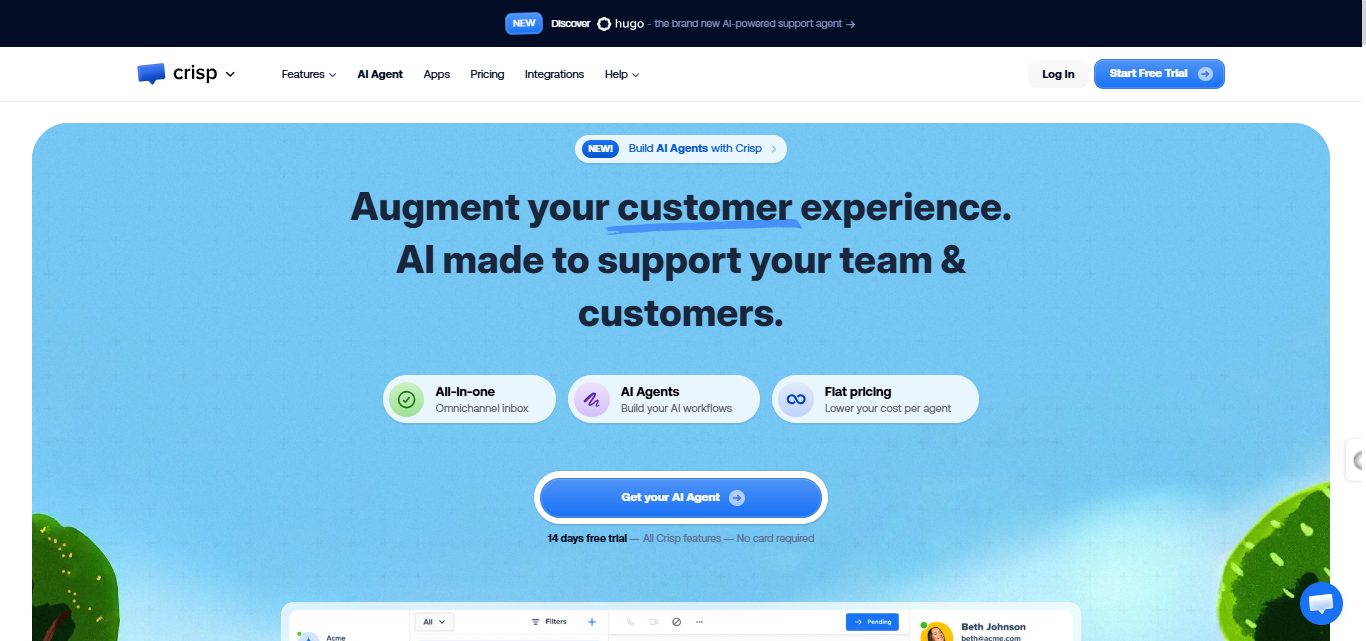
Crisp sits at the top of this list for a reason that matters more than any individual feature: it treats multichannel AI customer support unification as core architecture, not something bolted on later.
Most support platforms were built as ticketing or support chat tools and added channels over time. The result is a patchwork of integrations with inconsistent AI performance across surfaces. Crisp was built differently.
It is AI-native and Channel-agnostic from the start. Which is why its AI agent, Hugo, performs consistently whether the conversation originates from Email, WhatsApp, Instagram, Telegram, or a website chat widget. That consistency is rarer than the market would have you believe.
Channel Coverage 4.5/5
Here's what's native: website support chat, email, WhatsApp Business, Instagram, Messenger, Telegram, Line, Viber, SMS, Emails. Not connected apps with asterisks... actual first-class channels where Hugo is supporting customers on different channels. Two-way communication is supported everywhere. The unified inbox pulls all of it into one place. For SMB and mid-market teams, this is one of the widest native footprint you'll find.
Cross-Channel Consistency 4.5/5
Hugo's response quality stays the same irrespective of channel. Automation depth stays the same, whether the message came in from an Instagram DM at midnight or a website chat on a Tuesday afternoon. Images and files sent via WhatsApp or Messenger surface in the unified inbox with full context. That consistency across the core channels is genuinely strong. The caveat that keeps this at 4.5: on the more niche surfaces like Line and Viber. Not a deal breaker at all, but worth knowing if those channels are central to your support operation rather than peripheral.
Setup Speed and Ease of Use 4.5/5
No-code, start to finish. The visual workflow builder is something a support manager can actually operate... no engineering tickets required. Channel connections typically take under an hour each. The dashboard was designed with multichannel in mind, so all channels live in one inbox view, routing logic is visible, and automation rules don't require navigating nested menus. A team with zero technical background can realistically be live within a day. The reason this doesn't score a perfect 5: building advanced multi-condition workflows still takes time and patience to get right. But that's true of any tool with real depth.
Human Handoff and Collaboration 4.5/5
When Hugo reaches its limit... the handoff is clean. The complete conversation history follows the escalation, every channel the customer touched. Agents receive the entire thread, not a two-line summary. From there: conversation assignment, internal notes visible only to the team, teammate tagging, collision detection so two agents don't respond to the same ticket simultaneously. The transition is invisible to the customer. Team leads can monitor active conversations across channels in real time.
Pricing
Free plan available with an affordable Mini plan charged at $45 that unlocks AI Agent. Essentials at $95/month unlocks full AI features setup. Plus at $295/month adds additional AI resolutions and full ticketing. Priced per workspace, not per agent.
The most predictable billing model in this comparison.
Key features for multichannel AI support
- Hugo AI agent built natively for customer conversations, not retrofitted
- 10+ native channels: WhatsApp, Instagram, Messenger, Telegram, Line, Viber, email, SMS, web chat
- Single unified inbox with complete cross-channel conversation history
- No-code workflow builder to retrofit your own internal process
- Rich media support across WhatsApp, A Instagram and Messenger
- Seamless AI-to-human handoff with full context preserved
- Flat workspace pricing with no per-agent surprises as your team grows
Overall multichannel AI score: 4.5/5
Channel breadth and cross-channel consistency are both best-in-class at this tier. The per-workspace pricing makes it one of the most scalable option for teams growing headcount without wanting their support costs to grow at the same rate.
2. Intercom Fin
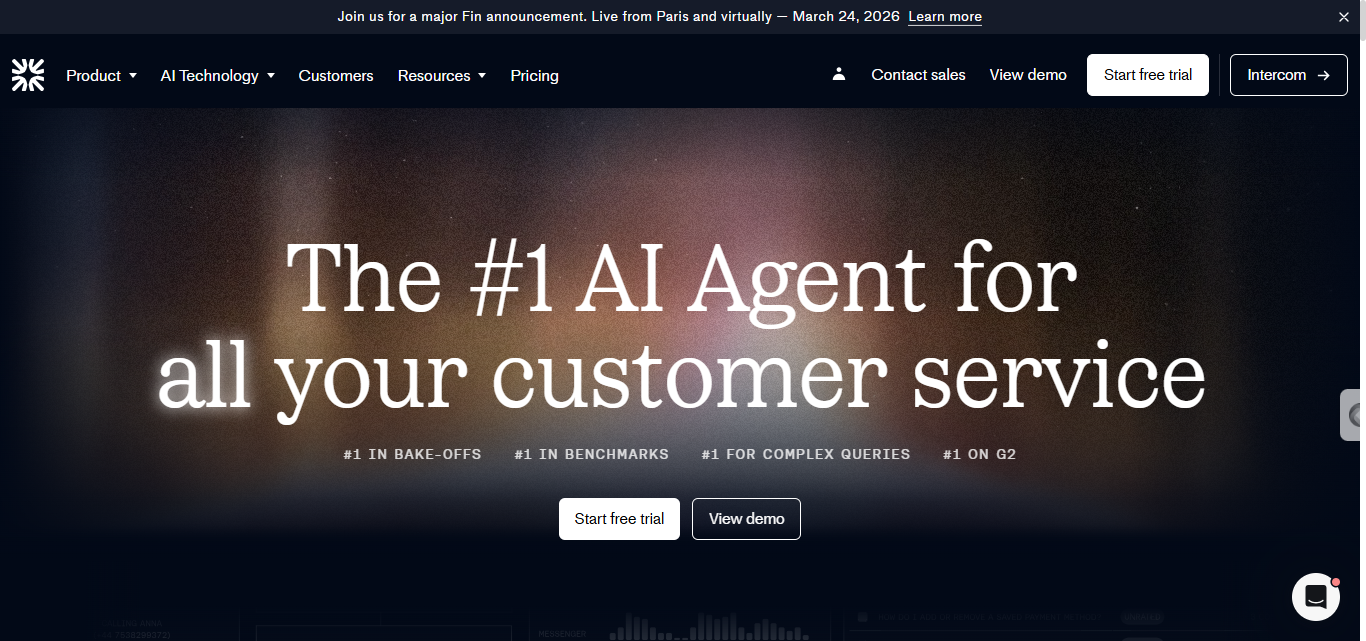
Intercom is one of the AI support tools considered as the benchmark for AI response quality. For teams already embedded in the Intercom ecosystem, the multichannel capability is genuinely strong. Fin, its AI agent, has gone through significant investment over the past two years... and what exists today is a materially different product from even few months ago.
Channel Coverage 4/5
Website chat, in-app messaging, email, WhatsApp, Instagram, Facebook Messenger, and SMS are all natively supported. Fin Voice, the phone AI, is still in limited release. The in-app messaging layer is a real differentiator if you're a SaaS company where product-embedded support matters. The unified inbox brings everything together. What's missing for some teams: Telegram and LINE aren't natively supported. If you have a significant customer base in Southeast Asia or Eastern Europe, that gap is worth flagging before you commit.
Cross-Channel Consistency 4/5
On web chat and in-app messaging, Fin's response quality is the highest on this list. The honest gap is that this level doesn't quite hold across every channel. Multilingual performance outside English has come up in community reviews as inconsistent... particularly on WhatsApp. Fin 3's Procedures close some of that gap by enabling multi-step agentic workflows across surfaces.
Setup Speed and Ease of Use 3.5/5
Getting Fin live on website chat can happen within days. The challenge is that expanding across channels and configuring procedures for complex workflows requires more time and technical effort. The Simulations feature is genuinely useful... it lets you test Fin's behavior across conversation paths before going live, which shortens the feedback loop meaningfully. If you're migrating from another platform, expect to invest real time integrating existing channel history. Not plug-and-play for multichannel.
Human Handoff and Collaboration 4.5/5
Handoffs are smooth. Fin escalates with full conversation context and the transition is invisible to the customer. The thing that sets Intercom apart here is the human-approval checkpoint: you can require a human to approve before the AI executes sensitive actions, like processing a refund or modifying an account. That's a real safety layer most platforms don't offer at this level of elegance. Team collaboration includes conversation assignment, internal notes, tagging, and collision detection.
Pricing $0.99 per successfully resolved conversation, on top of Intercom platform fees. At 10,000 monthly resolutions, AI fees alone reach $9,900 before the base subscription. Teams with high or variable volume should model this carefully before committing.
Key features for multichannel AI support
- Fin AI agent with industry-leading response accuracy on web and in-app channels
- Procedures for end-to-end agentic resolution workflows
- Human-approval checkpoints inside automated flows for sensitive actions
- Simulations for pre-deployment AI behaviour testing
- Strong conversation history and context tracking
- Broad channel coverage: chat, email, WhatsApp, Instagram, Facebook, SMS
Overall multichannel AI score: 4.0/5
A mature, high-accuracy AI agent that has moved well beyond basic Q&A into genuine agentic automation.
3. Gorgias
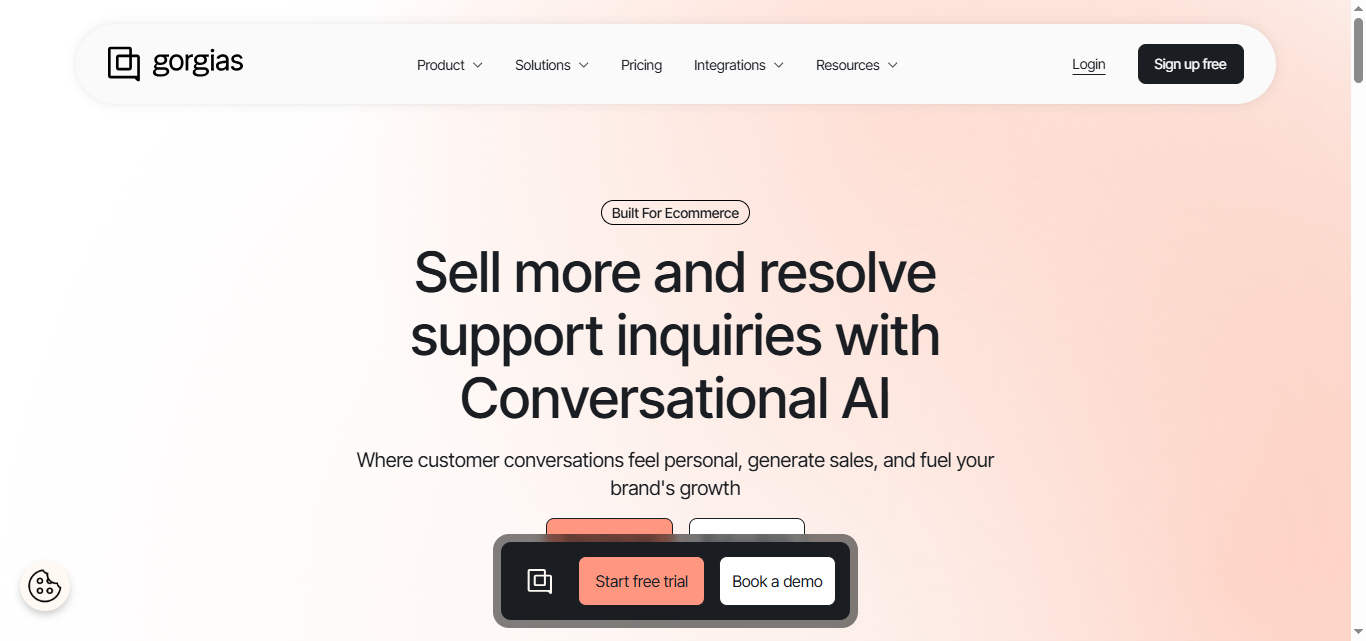
Gorgias was built for one primary audience: e-commerce operators. And the platform's depth in that vertical is genuinely impressive. If you sell online and your support team spends most of its time on order-related queries... this is the most purpose-fit platform on this list. If you don't sell online, the score drops significantly.
Channel Coverage 4/5
Email, live chat, social DMs (Facebook, Instagram, TikTok), WhatsApp, SMS, and voice all live in a single unified inbox. The differentiation isn't raw breadth. It's the depth of context layered underneath. Every channel conversation is displayed alongside the customer's order history, return status, and previous support interactions, pulled directly from Shopify, Magento, or WooCommerce.
Cross-Channel Consistency 4/5
The AI behaves consistently across channels because it's drawing from the same e-commerce backend regardless of where the conversation came from. Tone, policy application, action capability... all uniform. Voice is functional but not a primary focus, so if your support operation is heavily phone-based, you'll feel that gap.
Setup Speed and Ease of Use 4/5
For Shopify merchants specifically, setup is fast. Channel connections, store integration, and basic automation are guided and don't require technical expertise. The Guidance feature, where you write plain-language instructions to tell the AI how to handle specific scenarios, is much more accessible than traditional flow builders. More complex deployments across multiple storefronts or custom platforms take longer. Advanced automation rules can get complex to manage at scale, which is worth knowing upfront.
Human Handoff and Collaboration 4/5
Handoffs preserve full conversation and order context. Team collaboration runs on macros, which are templated responses with over 70 dynamic data variables pulled from integrated e-commerce platforms. When the AI or an agent sends a reply that references a specific order... that data is live, not copy-pasted. Conversation assignment, internal notes, tagging, and collision detection are all in place.
Pricing Ticket-based pricing. Basic at $60/month (500 billable tickets). Pro at $360/month (2,000 tickets). AI agent available as an add-on at approximately $1.00 per automated resolution. Be careful though, costs can become unpredictable at high volume.
Key features for multichannel AI support
- AI Agent 2.0 built natively for e-commerce workflows
- Image reading: resolves damaged goods and wrong order tickets autonomously
- Deep Shopify, Magento, BigCommerce, WooCommerce integration
- Unified multichannel inbox with live order context visible in every channel
- 70+ dynamic data variables in macro responses
Overall multichannel AI score: 4.0/5
One of the best platform in this comparison for Shopify-first e-commerce brands. The order-context depth and image-reading AI close support loops that most platforms leave open.
4. Kustomer
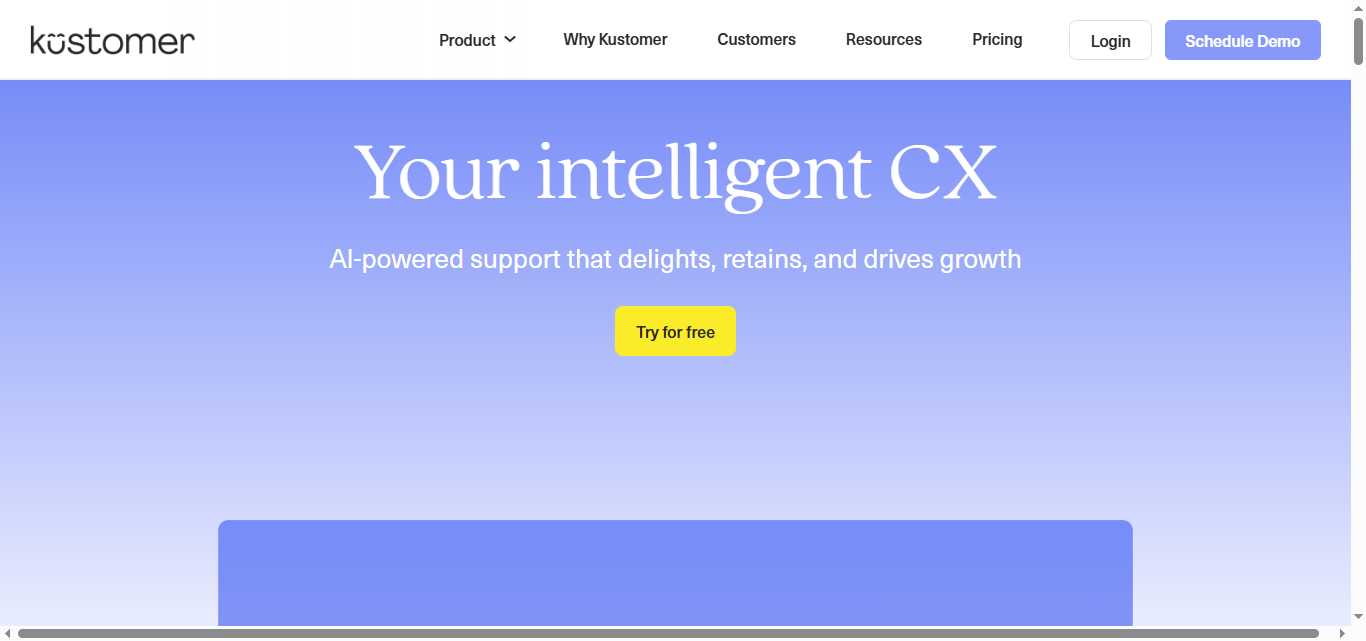
Kustomer's foundational idea is different from most platforms on this list. Instead of building a support tool that connects to your CRM... it built the CRM directly into the support platform. Every conversation lives on a customer timeline alongside order history, previous interactions, and external data from integrated systems.
Channel Coverage 4/5
Email, live chat, SMS, voice, WhatsApp, and social media channels all native. Voice runs through partners like Amazon Connect, Aircall, and 8x8 rather than being fully built-in, which matters if you're phone-heavy and want everything under one roof. The unified timeline is the real draw here: every interaction from every channel appears in one threaded conversation alongside full customer data.
Cross-Channel Consistency 4/5
Because the AI draws from a unified customer data model rather than just a knowledge base, responses feel more contextually personalised than most platforms. Real-time sentiment detection and smart routing operate consistently everywhere. Voice note transcription on messaging channels is limited, which is worth knowing if that's a common input from your customers.
Setup Speed and Ease of Use 3/5
Kustomer is powerful. That power comes with configuration requirements. The no-code AI Agent Studio lets support leaders manage workflows without a platform developer, which is genuinely useful. But the underlying object-based data model has a real learning curve. Teams coming from conventional helpdesks find the timeline view intuitive quickly... teams trying to replicate complex legacy workflows take considerably longer.
Human Handoff and Collaboration 4.5/5
This is where Kustomer earns its place near the top. Bi-directional handoffs mean the AI passes full context to the human agent, not a summary, not a link. The complete timeline. The agent sees every channel, every order, every prior interaction before they type the first word. Internal notes, conversation assignment, teammate tagging, and granular data permissioning so sensitive data is only visible to authorised roles.
Pricing
Seat-based plans starting at $89/agent/month. Conversation-based model also available. 8-seat minimum applies to seat-based pricing. Additional AI fees can increase total monthly costs for growing teams.
Key features for multichannel AI support
- Unified customer timeline: CRM and helpdesk in a single platform
- AI agents for autonomous customer resolution, plus AI copilot for agent assistance
- Bi-directional handoff with full cross-channel context
- Granular data permissioning and role-based access control
- 60+ integrations including Shopify, Salesforce, and Magento
Overall multichannel AI score: 3.9/5
The strongest handoff and collaboration layer in this comparison after Crisp. The unified data model makes AI responses feel genuinely contextual rather than generic.
5. Heyy.io
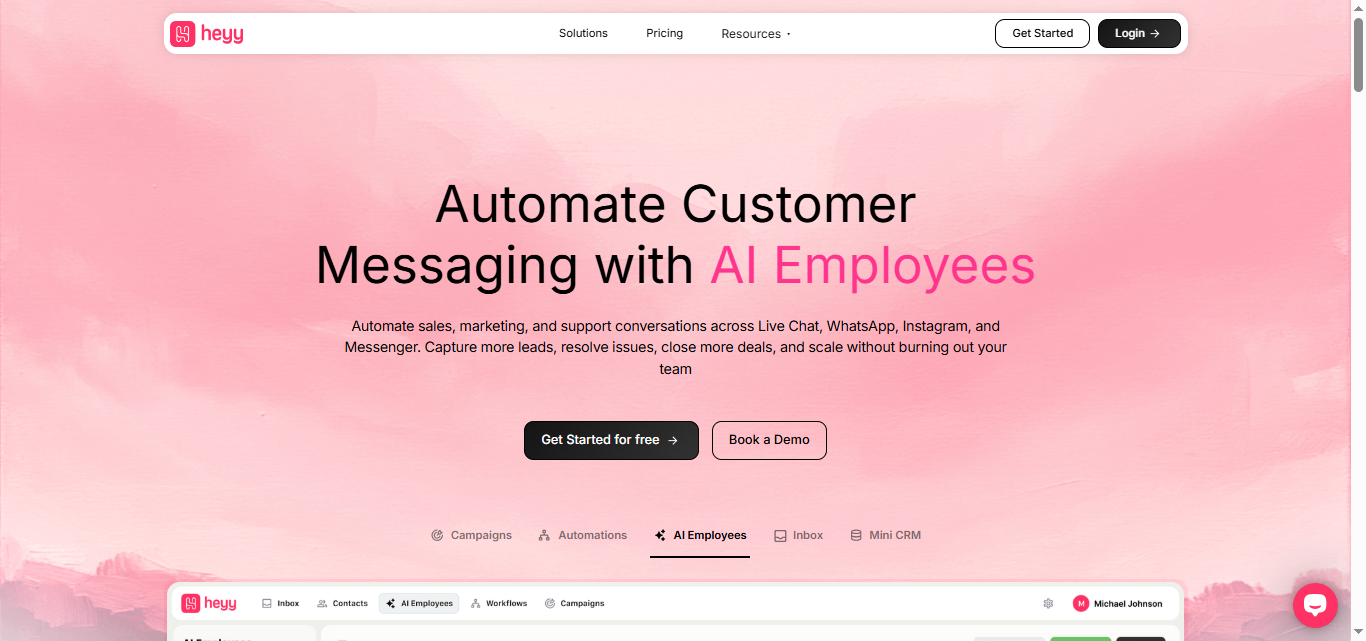
Most tools claim to support WhatsApp and Instagram. Heyy was specifically built to perform on them. One builder, one deployment across WhatsApp, Messenger, Instagram, web chat, and SMS. The AI agent, which Heyy calls an AI Employee, doesn't lose capability when it moves from website to social. For small and growing businesses where WhatsApp, webchat and Instagram are primary customer touchpoints rather than secondary channels... this matters enormously.
Channel Coverage 3.5/5
Native channels: WhatsApp, Instagram DMs, Facebook Messenger, website chat, and SMS. All five in one unified inbox. Two-way communication across all of them. The gaps are Telegram, and voice, which limits coverage for teams with significant demand on those surfaces. CRM, e-commerce, and ticketing integrations extend what the AI can do.
Cross-Channel Consistency 4/5
The AI Employee is configured once and deployed across all connected channels. Same training, same tone settings, same workflow logic... everywhere. And here's the thing that actually matters in practice: when someone asks about pricing on Instagram on Monday and messages again on WhatsApp on Wednesday, Heyy knows it's the same person. Full conversation history. No repeating the question. No starting from scratch. That cross-channel identity recognition is a meaningful operational advantage for social-first brands, and it's not as common as the marketing language in this industry would suggest. Voice note transcription is also natively available.
Setup Speed and Ease of Use 5/5
The fastest platform on this list to deploy. Channel connections, workflow configuration, and escalation logic can be live in under 15 minutes with no technical background required. You can start deflecting tickets on day one while continuing to refine in the background. A fully optimised setup with custom training and escalation rules takes 3 to 5 days of refinement... but that's refining, not waiting. The dashboard was built for operators who need clarity at a glance without learning a complex interface.
Human Handoff and Collaboration 3.5/5
Complex queries are routed to humans with full conversation context and sentiment awareness. The human agent picks up the complete thread, channel origin, prior messages, actions the AI already took. You define what triggers a human handoff rather than leaving it entirely to the AI's judgment, which is a meaningful operational control. Team collaboration features cover assignment, internal notes, and routing.
Pricing
Free trial available for 14 days, no credit card required. Paid plans from $41/month with all AI support features included. Custom pricing for higher volume.
Key features for multichannel AI support
- AI Employee framework: single agent deployed across WhatsApp, Instagram, Messenger, web, and and integration channels.
- Cross-channel identity recognition: same customer across channels, no repeated history
- Under-15-minute setup with no technical skills required
- CRM, e-commerce, and ticketing integrations via API and webhooks
- Configurable escalation rules with sentiment-aware routing
- Clean unified inbox with full cross-channel conversation history
Overall multichannel AI score: 4.0/5
The fastest path to live multichannel AI support in this entire comparison. For SMBs and social-aware brands, Heyy delivers genuine capability on the channels that matter most to them. The channel gap (no Telegram or voice) is the honest limitation to watch as you scale.
6. Ada
Ada is not trying to serve everyone. It's built for large organisations running millions of monthly customer interactions across multiple geographies. Everything about its design reflects that focus. Deflection rates in well-configured Ada deployments are among the highest in the category. The tradeoff is cost and implementation complexity that places it firmly out of reach for most teams below enterprise scale.
Channel Coverage 4/5
Web chat, email, SMS, WhatsApp, Facebook Messenger, and voice are all supported. Native channel breadth is solid... but not as wide as Zendesk or Yellow.ai. What Ada does exceptionally well is enterprise system integration. The AI connects to complex internal tools, databases, CRMs, and ERPs to retrieve data and take actions directly. For global enterprises with custom backend infrastructure, this integration depth is often the deciding factor, not the channel list.
Cross-Channel Consistency 4.5/5
Ada's strength is consistency at scale. When trained on large, complex enterprise documentation, it maintains response quality across high volumes without the degradation some platforms show as conversation load increases. Multi-language support is genuinely strong here... enterprise clients in multiple markets report consistent performance across languages, not just English-first quality with spotty coverage elsewhere. Rich media handling is functional.
Setup Speed and Ease of Use 2.5/5
Ada is not fast to deploy. Enterprise implementations involve a dedicated onboarding period, technical integration work, and AI training on proprietary documentation. This is not a platform you hand to a support manager and expect live by Friday. The visual builder is accessible for business users, but the depth of configuration means there's a real learning curve even when no code is required. Ada provides implementation support as part of enterprise contracts. Most organisations at this scale will need it, and should budget for it.
Human Handoff and Collaboration 4/5
Handoffs are clean, with full context preserved across channels. Advanced workflow orchestration handles complex, multi-step conversations between AI and human agents. Collaboration includes conversation assignment, internal notes, intelligent routing by agent skills and availability, plus SLA management and queue monitoring built for large, multi-team support organisations.
Pricing
Custom enterprise contracts. Most deployments run six figures annually. Ada does not publish pricing publicly.
Key features for multichannel AI support
- Enterprise-scale AI with consistent performance at high volume
- Advanced workflow logic and multi-step orchestration
- Strong multilingual performance across global markets
- Intelligent routing and human handoff with full context
- Voice support included
Overall multichannel AI score: 3.9/5
Extremely powerful for large organisations managing global support operations. The cost and implementation complexity make it impractical for anyone outside that specific profile.
7. Yellow.ai
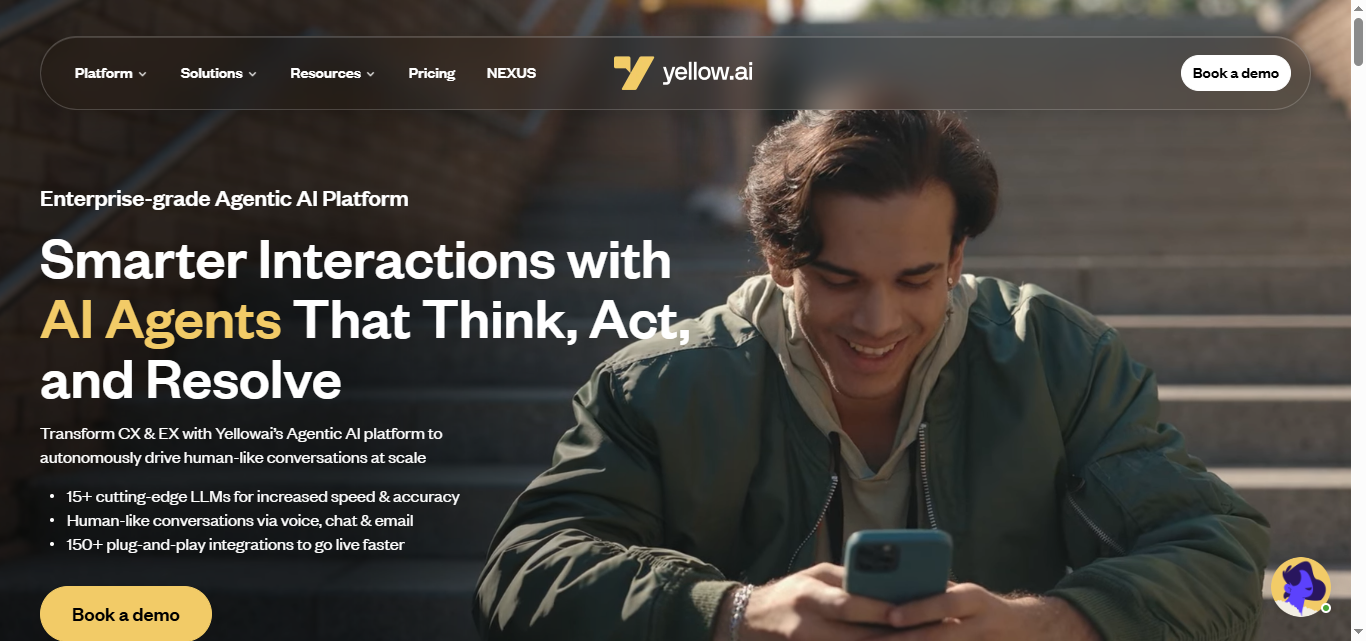
Yellow.ai has the widest channel coverage on this list: 35+ channels across 135+ languages. That's the number that stops people mid-scroll. The nuance is that 35-channel coverage creates its own complexity. You need real investment in onboarding, configuration, and ongoing management to actually realise that capability in production.
Channel Coverage 5/5
Web chat, email, WhatsApp, Facebook Messenger, Instagram, Telegram, LINE, WeChat, Viber, SMS, voice, Google Business Messages, and a range of regional channels not native to most competitors. For enterprises with significant presence in Southeast Asia, the Middle East, or markets where regional messaging platforms dominate... this is simply unmatched. The unified workspace consolidates agent views across all supported surfaces. Two-way communication across all major channels.
Cross-Channel Consistency 4/5
Performance is strong on the core channels (web, WhatsApp, email) and varies more on niche surfaces depending on how well each has been configured for your specific context. Rich media handling... images, voice notes, documents... is solid across supported messaging channels. The honest caveat: out-of-box consistency is lower than on more opinionated tools. More capability, but you need to configure it to get reliability.
Setup Speed and Ease of Use 2.5/5
Yellow.ai has a visual workflow builder that lets business teams design and launch AI agents in plain English, which helps. But this is an enterprise platform and the onboarding expectation reflects that. First deployments typically involve dedicated implementation support, backend integration work, and AI training on your organisational documentation. The learning curve is significant, consistently flagged by G2 and Capterra reviewers.
Human Handoff and Collaboration 3.5/5
Context is preserved across channel switches, and handoffs to human agents include the full cross-channel conversation history. Team collaboration covers conversation assignment, internal notes, routing rules, and SLA management. The inbox is designed for operations teams managing high volume across many channels. The experience is functional... but lacks the polish of Crisp or Kustomer's handoff layer, particularly at the configuration level.
Pricing
Custom enterprise pricing, tiered by conversation volume, channels, and user seats. Not designed for SMB or mid-market budget ranges.
Key features for multichannel AI support
- 35+ native channels including regional platforms across Southeast Asia and the Middle East
- 135+ language support with strong multilingual NLP
- Visual no-code workflow builder for business teams
- 150+ integrations including Salesforce, HubSpot, SAP, and ServiceNow
Overall multichannel AI score: 3.8/5
The right choice for enterprises that genuinely need 35+ channels and multi-region language consistency.
8. Zendesk AI
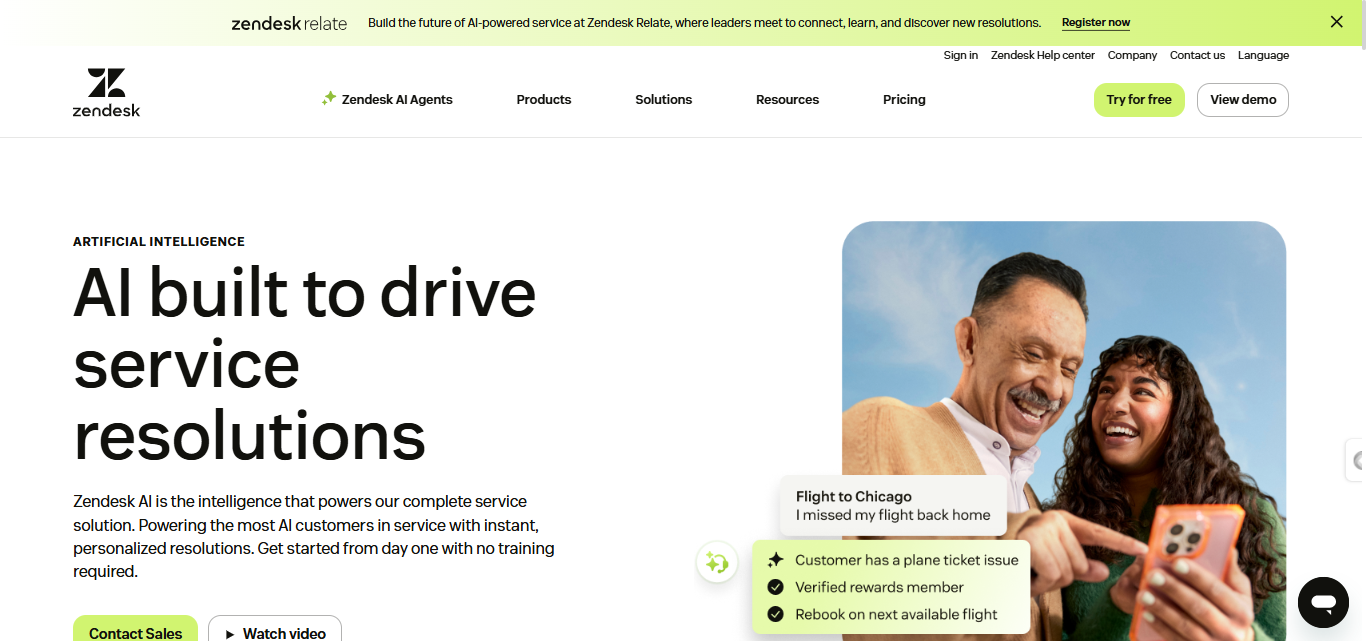
Zendesk is the category elder statesman. A decade of multichannel support infrastructure gives it genuine breadth. The AI layer added in recent years is more capable than its enterprise-heritage reputation sometimes suggests. The important qualifier: the AI you see in a demo is often the Advanced tier. The plan most teams actually buy is not. That gap is larger than it should be.
Channel Coverage 5/5
Email, chat, voice, WhatsApp, Facebook, Instagram, Twitter/X, LINE, WeChat, and SMS all native. Voice AI Agents handle inbound calls end-to-end, including authentication and order lookups. That's a capability few platforms on this list can genuinely match. The unified agent workspace consolidates everything. If raw channel breadth is your primary selection criterion, Zendesk is the reference point in this category. Two-way communication across all major channels.
Cross-Channel Consistency 3.5/5
On the Advanced AI tier, consistency is strong. Here's the issue that comes up constantly in practitioner communities: the knowledge base latency problem. When you update help articles, the AI can take a week or more to incorporate the changes. For teams publishing support content frequently, that creates an AI that is confidently out of date on certain topics. Rich media handling is functional in chat and email. Voice note transcription on messaging channels is not a native feature.
Setup Speed and Ease of Use 2.5/5
Zendesk is powerful and correspondingly complex. The initial setup for a true multichannel deployment, connecting channels, configuring routing rules, training the AI, enabling Intelligent Triage, requires dedicated technical time. This is not a platform you hand to a support manager and expect live before the next office check in.
Human Handoff and Collaboration 4/5
Handoffs preserve conversation context cleanly. The agent receives full history regardless of which channel the customer used. Team collaboration includes internal notes, conversation assignment, tagging, SLA management, and skill-based routing. Collision detection prevents double responses. This is enterprise-grade collaboration tooling, no question.
Pricing
Suite Professional at $115/agent/month. Advanced AI add-on at $50/agent/month. A 10-agent team accessing full AI capability pays approximately $19,800/year before overages. Note: the pricing model penalises automation. Your bill doesn't shrink as the AI deflects more tickets, because you're still paying per agent.
Key features for multichannel AI support
- Widest native channel coverage in the category, including voice, WeChat, and LINE
- Voice AI Agents with end-to-end call handling
- BotQA dashboard for deflection rate, escalation rate, and sentiment monitoring
- Massive app marketplace for extended integrations
- Enterprise-grade SLA management and team collaboration
Overall multichannel AI score: 3.8/5
Extremely capable at full configuration. Channel breadth is unmatched at this tier. But the knowledge base latency issue, steep setup complexity, and a pricing model that doesn't reward deflection are all friction points that teams need to factor in honestly before committing.
9. Freshchat / Freshdesk
Freshchat handles the real-time messaging and AI layer. Freshdesk handles the ticketing and workflow layer. Together they form a coherent multichannel stack that punches above its price point, as long as you don't need the deepest agentic automation in the category. For mid-market teams that need solid coverage without enterprise-level budget justification... this is worth trying.
Channel Coverage 4/5
Website live chat, email, phone, WhatsApp, Facebook Messenger, Instagram, Twitter/X, LINE, and Apple Business Chat all natively supported. Freddy AI, the Freshworks AI layer, operates across channels, though performance is more consistent on chat and email than on social messaging surfaces. Two-way communication across all major channels.
Cross-Channel Consistency 3.5/5
Freddy AI performs reliably on well-documented, structured support scenarios. The consistency dip shows up on more complex or ambiguous queries, particularly on social channels where customer messages tend to be less structured. Rich media handling is functional: images and file attachments process in chat and email. The AI doesn't significantly degrade on any specific channel... but it also doesn't reach the quality peaks of Fin or Hugo on any of them either.
Setup Speed and Ease of Use 4/5
Meaningfully easier to deploy than Zendesk or Ada. Channel connections are guided. The interface is clean. Basic automation is accessible without technical expertise. The workflow builder handles standard routing scenarios without coding. Where the complexity creeps in is on advanced automation: multi-condition routing rules, deep integrations. Teams can typically reach a functional multichannel deployment within a week.
Human Handoff and Collaboration 3.5/5
Freddy AI escalates with full conversation context. Team collaboration covers internal notes, conversation assignment, collision detection, and skill-based routing via Omniroute. SLA management is robust because Freshdesk was built as a ticketing-first platform and that foundational strength shows.
Pricing
Freshchat Growth at $19/agent/month. Freshdesk Growth at $15/agent/month. Full Freddy AI suite requires Enterprise at $79/agent/month for Freshdesk. Budget the combined stack at $40 to $80/agent/month for mid-tier access to AI features.
Key features for multichannel AI support
- Native coverage across email, chat, phone, WhatsApp, social, LINE, and Apple Business Chat
- Omniroute for intelligent ticket assignment by skill and availability
- Scenario automations for standard routing workflows
- Strong out-of-box reporting on team and channel performance
Overall multichannel AI score: 3.7/5
The right fit for growing teams who need broad channel coverage at reasonable cost and can tolerate some manual configuration to dial in AI workflows. Not the right choice if agentic automation depth is a primary requirement: Freddy AI's ceiling becomes visible faster than expected on complex support operations.
10. Lyro by Tidio
Lyro, powered by Claude from Anthropic, stays grounded in what you've told it and won't generate confident wrong answers when it hits the edge of its knowledge. For teams that have dealt with hallucinating chatbots telling customers the wrong return window... that reliability is worth more than a longer feature list. The channel ceiling is real, though. It comes earlier than you'd like.
Channel Coverage 3.5/5
Website live chat, email, WhatsApp, Facebook Messenger, and Instagram. All into Tidio's single unified inbox. No Telegram. No LINE. No voice. No proactive outbound messaging, so Lyro operates reactively rather than initiating contact. For e-commerce and service businesses, these channels cover the majority of inbound customer contact. For teams needing wider channel diversity, the coverage ceiling appears quickly and honestly.
Cross-Channel Consistency 3.5/5
Lyro's consistency comes directly from its knowledge base constraint: it only answers from what you've explicitly told it, across all channels. That means the quality ceiling is set by your knowledge base quality, not the channel. Rich media handling is limited. Lyro processes text reliably, but if your customers regularly send photos of damaged products or screenshots via WhatsApp... this platform will hit a wall fast.
Setup Speed and Ease of Use 4.5/5
Alongside Heyy.io, the fastest platform on this list to deploy. Knowledge base connection, channel setup, and going live can happen in under an hour with no technical background required. The Tidio interface is clean and navigable, conversation views are easy to work with, and the Flows builder for rule-based automation runs parallel to Lyro without requiring deep integration between the two.
Human Handoff and Collaboration 3/5
Escalation from Lyro to a human agent is straightforward and preserves conversation context. Configurable escalation rules let you define what triggers a human handoff rather than leaving it all to the AI. Team collaboration features include conversation assignment and basic internal notes. For small teams, this is functional. For anything more complex... multi-tier routing, approval workflows, large team coordination... the ceiling shows up quickly compared to Zendesk or Kustomer.
Pricing
Plans from $29/month with 50 conversations included. Additional conversations at $0.50 each. At 5,000 conversations per month, usage fees alone reach $2,500 above the base plan. Model your volume before you commit.
Key features for multichannel AI support
- Single inbox across website, email, WhatsApp, Messenger, and Instagram
- Lyro Actions for API-connected task resolution including Shopify, Calendly, and CRMs
- Under-one-hour deployment, no technical knowledge required
Overall multichannel AI score: 3.7/5
Lyro's reliability is worth a lot when you're putting automation in front of real customers. The knowledge base constraint and per-conversation pricing model are the two issues to watch as support volume grows.
Platform Comparison
Views From the Community
These platforms are discussed extensively across G2, Capterra, Reddit, and practitioner Slack communities. The patterns that appear consistently add texture to the benchmark scores.
Unified inbox and channel switching is the most frequent point of differentiation in community discussions. Crisp users repeatedly cite cross-channel context preservation as the capability that moved the needle on agent efficiency. The ability to see a complete conversation history regardless of channel is consistently described as the thing they wouldn't give up.
Intercom Fin's accuracy generates strong community consensus: it's the benchmark for AI response quality. The per-resolution pricing generates equally strong reactions in both directions. Teams with predictable, moderate volume praise the outcome-aligned model. High-volume teams with variable loads describe budgeting as genuinely difficult.
Zendesk's knowledge base latency issue is mentioned with notable frequency across G2 and Reddit practitioner communities. For teams publishing support content frequently, the week-plus delay between article publication and AI incorporation is a real operational problem, not just a minor inconvenience.
Gorgias earns its highest community marks specifically from Shopify merchants. The order-context depth and image-reading AI close support loops that most platforms leave open. Non-e-commerce teams appear in community discussions far less frequently, which is itself a signal.
Heyy.io's community presence is growing fastest among the newer platforms in this comparison, particularly among SMBs and social-aware brands.
Quotes from the community:
"The minute a customer switches from WhatsApp to email, half the platforms on the market act like it's a brand new person. Crisp doesn't. That alone saves us fifteen minutes of context-gathering per escalation." -- G2 reviewer, mid-market SaaS
"Fin had saved us the equivalent of $60k in human salary by end of September 2025. It resolves enough inquiries each month to offset hiring another human agent." -- G2 verified reviewer, on Intercom Fin deflection
"We push out new articles and it takes a week or more before the AI seems to fully incorporate them into answer suggestions." -- G2 reviewer, on Zendesk knowledge base latency
"Lyro won't guess. That sounds boring until you've dealt with a hallucinating chatbot telling your customer the wrong return window. I'll take won't guess over confidently wrong every time." -- Reddit r/ecommerce
Frequently Asked Questions
Can I deploy one AI agent across chat, email, WhatsApp, and SMS without building separate bots?
Yes, with a platform built AI-native from the start instead of one that added channels over time. Crisp's Hugo agent runs as a single configuration across web chat, email, WhatsApp, Instagram, Messenger, Telegram, and SMS — you train it once and it holds the same tone, policies, and automation depth everywhere. Platforms that bolted on channels later usually need separate setup and tuning per channel, which is where consistency breaks down.
Is a multichannel AI support platform GDPR-compliant for WhatsApp, email, and Facebook conversations?
It depends on the vendor's infrastructure, not the channel. WhatsApp, email, and Facebook Messenger can all run through GDPR-compliant setups, but three things decide it: where the vendor stores conversation data, how long they retain it, and whether they'll sign a DPA. Ask directly — most vendor pricing pages don't spell this out, and it varies more between vendors than between channels.
What should I look for in a stable multichannel platform if my current one keeps crashing?
Uptime history and architecture matter more than the feature list. Ask vendors for a public status page, not just a sales claim. Also check whether the platform was built multichannel from day one or stitched together through acquisitions and bolt-on integrations — patchwork architecture is usually where instability shows up first under load.
Sources and Methodology
Analysis draws on direct production experience operating support infrastructure, combined with public platform documentation and aggregated user feedback.
Primary sources include hands-on use of some of the platforms in live support environments and official product documentation for current feature capabilities.
G2 verified reviews, Capterra verified reviews and Reddit discussions in r/SaaS, r/CustomerSuccess, and r/ecommerce as well as Product Hunt and Trustpilot.
Each platform was scored across four dimensions: Channel Coverage (25%), Cross-Channel Consistency (30%), Setup Speed and Ease of Use (20%), and Human Handoff and Collaboration (25%).
Scores are out of 5 per metric. The final composite score is also out of 5.
All pricing reflects publicly available information as of March 2026. Verify directly with each vendor before purchase.
Ready to cut your backlog?
See how Crisp unifies your channels and automates resolution without rebuilding your stack.
Sources
Gartner, Customer service journeys starting on third-party platforms, https://www.gartner.com/en/newsroom/press-releases/2025-07-23-gartner-survey-finds-more-than-half-of-customer-service-journeys-now-start-on-third-party-platforms
The Trust Agency, Omnichannel marketing statistics overview, https://thetrustagency.net/statistic/omnichannel-marketing
Avaya, Customer experience statistics and trends, https://www.avaya.com/en/blogs/customer-experience-statistics-2026/
Gartner, Customer journey and omnichannel strategy insights, https://www.gartner.com/en/marketing/insights/customer-journey
Gartner, Omnichannel CX strategy and execution, https://www.gartner.com/en/documents/6234519
McKinsey & Company, Omnichannel customer journey behavior (multi-channel usage), https://www.mckinsey.com/capabilities/operations/our-insights/redefine-the-omnichannel-approach-focus-on-what-truly-matters
McKinsey & Company, Capturing customer preferences across channels, https://www.mckinsey.com/capabilities/operations/our-insights/how-to-capture-what-the-customer-wants
McKinsey & Company, Omnichannel transformation and execution challenges, https://www.mckinsey.com/capabilities/operations/our-insights/more-than-digital-plus-traditional-a-truly-omnichannel-customer

September 2026 - Product Update
Discover the new Knowledge Base editor, benchmark your AI support performance, track how often Hugo escalates conversations, and more. Discover the latest features and improvements released by the Crisp team in September 2026.


Summer 2026 - Product Update
Meet the refreshed Crisp experience, Understand how Artificial Intelligence handles every conversation, Build reusable teams across your workspace, and more. Discover the latest features and improvements released by the Crisp team in Summer 2026.

Best 9 helpdesk software and ticketing systems for 2026
Need help to choose your next helpdesk with a ticketing tool for 2026? We've gathered a guide that gives you everything you need to convince your C-levels.