Scaling Multilingual Support to New Countries with AI Chatbots in 2026
Supporting customers in 5 languages through human agents costs hundreds of thousands a year. An AI chatbot covers 85+ languages for a fraction of that — with faster responses and consistent quality. Here's the full breakdown.


For the past 20 years, businesses have been on a full-blown global rampage.
Everything has to scale worldwide. Payments? Global… Distribution? Global... Customer acquisition? Definitely global… And to be fair… It’s been working. Really well.
You could ship your SaaS on a random Monday night, and by Friday, you’ve got customers in 20+ countries.
Companies like Stripe and Shopify have made it ridiculously easy to set up shop and sell to customers in over 190+ countries.
But there’s still a missing piece in the equation.
You’ve got customers buying from Berlin, São Paulo, Seoul, Toronto... Money flowing in from every timezone. Meanwhile, support is still answering in one language. Two on a good day.
You see, when a customer from Seoul asks a question in their native language, and they get a reply in a different language, friction sneaks in. Tiny. Subtle. But real. Buying decisions slow down. Brand trust wobbles. Sometimes the purchase just… evaporates.
Now multiply that across thousands of conversations. This is where revenue leaks, retention erodes, and customer satisfaction quietly declines due to, well, a lack of a proper multilingual support system.
This article makes the case that AI chatbots are the very good infrastructure that lets you expand to new markets without rebuilding your team every time.
Why simply hiring more doesn’t scale
Let’s walk through the traditional solution.
You want multilingual support, so you hire a Spanish agent. One French agent. One German agent. On paper, it feels structured, responsible, and scalable. Then traffic expands… and things get interesting.
Then you start seeing users from Brazil. Japan. Taiwan. The Middle East. And your support plan begins to fail stress testing. Because at that point, you really only have two choices: keep hiring for every new language, or default to asking customers to communicate in English. Neither option truly scales.
Hiring indefinitely increases fixed costs. Every new language means another salary, more onboarding, more training, more management oversight, more scheduling complexity. It compounds. Quietly. And quickly. Defaulting to English or any single language does the opposite kind of damage. It doesn’t show up as a line item, but it shows up in friction… slower decisions, weaker trust, lost conversions that never announce themselves.
And to make things even worse, unpredictability is usually a big issue when planning for these things.
Demand for language support is rarely neat or predictable. You don’t get a perfectly consistent stream of Spanish or Portuguese tickets that justifies a full-time hire. You get waves. Spikes. Some weeks, no one. Other weeks, 96!
So you end up overstaffed… or underprepared. Sometimes both at the same time.
You know multilingual support matters. You can see the international revenue slipping away. But in your minds, multilingual equals expensive plus operationally messy.
A few years ago? I would say that's a pretty fair assessment. But today? That assumption is outdated.
How AI chatbots solve the multilingual support problem
Think about what it actually means to add a new country to your support coverage today. You need to source candidates, screen for language proficiency, onboard, train on your product, schedule for timezone coverage, and then manage quality in a language you probably don't speak. That process takes months. And you repeat it every time you expand.
AI chatbots flip that entirely. Adding a new language to your coverage isn't a hiring decision: it's a configuration one.
Let’s run through a possible scenario of how AI chatbots can help resolve problems for a Japanese customer who uses a US-based SaaS product:
- Customer writes: "注文した商品がまだ届いていません。配送状況を教えてください。"
- AI understands the intent — directly in Japanese. They ordered something. It hasn't arrived. They want tracking.
- AI checks your order system, pulls tracking data, and verifies carrier status. All in milliseconds.
- AI responds in natural Japanese: "ご注文いただいた商品は昨日発送され、明日の午後6時までに到着予定です。追跡番号はこちらです..."
Issue resolved in 15 seconds. No human needed. Perfect Japanese that feels native: not translated. The customer gets help faster than your best agent could have provided it.

And this scales in ways humans simply can't match:
- 24/7 availability in every language. Your Japanese customers get help at 3 AM Tokyo time. Your German customers get support on Sunday afternoons.
- Consistent quality everywhere. The same AI that handles English handles Spanish, French, Korean, and Arabic with equal quality. And most importantly, they have access to the same knowledge, and your brand voice stays consistent across every language.
- Zero incremental cost per language. Want to add Portuguese support? Turn it on. No hiring. No contracts. No training cycles. The chatbot handling 5 languages handles 50 with zero marginal cost.
- Instant response times. Customers get answers in seconds, not hours. No waiting for the right language specialist to become available.
- Seamless handoff when it matters. Human support is still very integral in chatbot-powered multilingual support. When issues are too complex for automation, human agents can step in — with full context and messages appearing in the language that they’re faimilar with. Your support team works in their language. Customers stay in theirs.
- One team, any market. You don't need a Portuguese-speaking agent to support Portuguese customers. Your existing team works in their language. The AI handles the customer in theirs. You can enter a new market without adding a single headcount.
This is why chatbots are becoming the default solution for multilingual support. Not because they're trendy. Because they're the only approach that actually scales globally without requiring massive investment or quality compromises.
The economics: why chatbots are the only affordable solution
Let's talk real numbers now. Because at the end of the day, lots of people abandon multilingual support because the unit economics don't make sense.
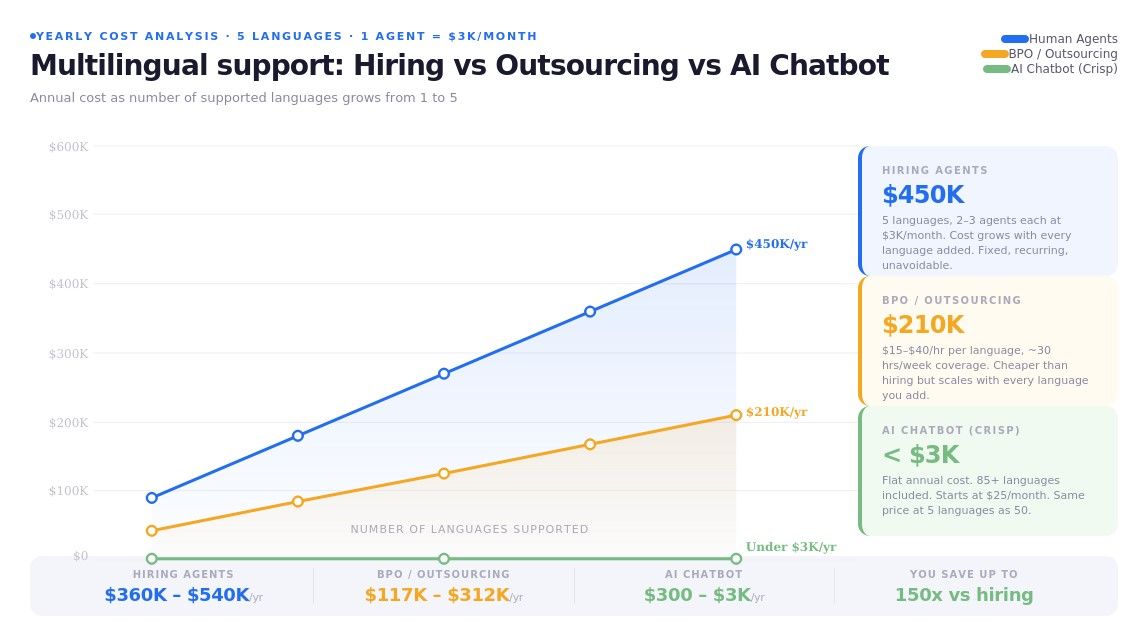
Supporting customers in multiple languages through traditional methods looks something like this:
Hiring multilingual agents
If you’re running a large support ops, you need around 2–3 agents per language for any meaningful 24/7 coverage. At a fully loaded cost of $25,000–$80,000 per agent annually, depending on where you hire from, supporting the major languages runs into hundreds of thousands yearly.
Outsourcing
Sounds cheaper until you do the math. At $15–$40 per hour, per language, with a minimum of 20–40 hours weekly per language to maintain coverage, you're looking at $30,000–$90,000 annually. Plus coordination overhead that quietly eats your team's time.
AI chatbots
Flat monthly fee. You’ll find reliable options that start at $25/month and can reliably take on 85+ languages. This can cut your total yearly cost in multilingual support to as low as $300 to $8000, depending on how big your support operations need to be.
That's why multilingual support through chatbots isn't just better. It's the only economically viable option for companies that aren't enterprise giants with unlimited budgets.
Quality: AI chatbots vs human multilingual support
The cost advantage is obvious. But cost means nothing if the quality falls apart. So, can AI chatbots actually match human agents across multiple languages?
For routine support queries? Yes. Often better.
Modern AI chatbots don't work like a basic translation layer. You know, …just like you’re slapping an English response into Google Translate, translate to Japanese, and hope for the best. Rather, chatbot-powered multilingual support understands context directly in each language and crafts responses accordingly.
Cultural appropriateness. Formal in German. Polite in Japanese. Casual in Brazilian Portuguese. AI chatbot-powered support adjusts formality levels automatically because it understands cultural context, not just literal words.
Technical accuracy. Product terminology, feature names, and technical concepts stay consistent across languages.
Brand voice preservation. Your chatbot's personality translates. Friendly in English stays friendly in Spanish. Professional stays professional across all languages. The tone adjusts for culture while remaining unmistakably yours.
For the 80% that's routine, AI chatbots match or exceed human quality — while responding infinitely faster. You don't have to choose between cheap and good anymore. Multilingual AI chatbots deliver both.
How to implement multilingual AI chatbot support
Now that we've established that AI chatbot-powered multilingual support is the way to go, the scalable, economically sound, customer-first solution your competitors are probably already moving toward, the next question is practical. How do you actually implement it?
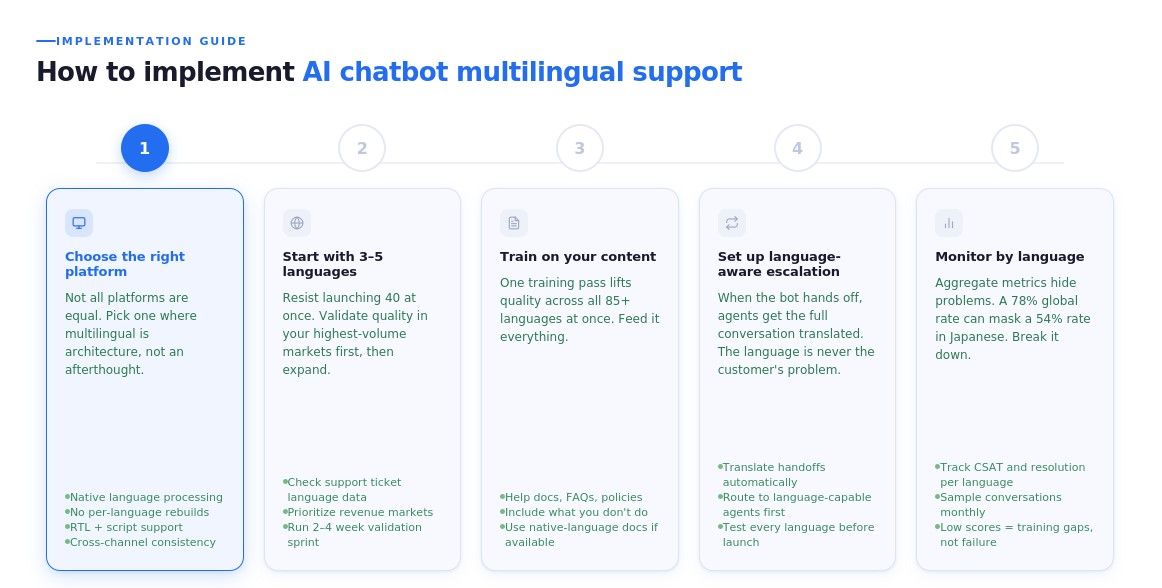
Here’s how:
Step 1: Choose the right platform
There's no shortage of AI chatbot platforms out there. Crisp, Chatbase, Tidio, Heyy, SiteGPT, Intercom, Freshchat — the list is long and growing. Most of them will tell you they support multiple languages. What they mean by that, though, varies enormously. And the difference matters a lot more than most people realize before they're six months into the wrong choice.
Here's the split you need to understand:
Some platforms were built with multilingual support baked into their core architecture from day one. Multilingual support isn't an add-on for them. The AI processes intent natively in each language, constructs responses from that understanding, and handles cultural context automatically.
Others bolted multilingual support on later. They started as single-language tools and added translation as a feature layer when the market demanded it. The result is a system that technically outputs text in other languages …but it just isn’t the same.
Crisp is a strong example of the first category. When you build your chatbot on Crisp, you're building something that speaks 85+ languages as a first-class capability.
When evaluating platforms, here's what to look out for:
- Native language processing – does the AI understand intent in the customer's language directly?
- No per-language rebuilds – you should configure your chatbot once and have it work across all languages automatically.
- Right-to-left and script support – Arabic, Hebrew, Japanese, Chinese, and Korean. If these markets matter to you, confirm they're properly supported, not just listed.
- Channel consistency – multilingual support should work across website chat, WhatsApp, Instagram, and SMS. Not just on one channel while others drop to English.
- Escalation with context – when the bot hands off to a human agent, the full conversation should transfer — translated into the agent's language. If that handoff is clunky, the customer experience breaks at the exact moment it matters most.
Get this decision right, and the rest of the implementation is straightforward. Get it wrong, and you'll spend more time working around your platform than actually serving customers.
Step 2: Start with your top 3–5 languages
AI-powered multilingual support can technically run in dozens of languages from day one. That's exactly the temptation you need to resist — at least initially.
The instinct is to light everything up at once. 40 languages, full deployment, global coverage overnight. But launching into too many languages simultaneously means you can't properly validate quality in any of them. A chatbot that's slightly off in five languages at once is a support problem you won't catch until customers already have.
Start with 3 to 5. Even 2, if that's where your real volume is. Monitor how the conversations are going. Check whether responses are landing correctly. Verify that the chatbot is handling what customers are actually bringing to it, not just the idealized scenarios you trained it on. Get that right first. Then scale.
To find your priority languages, ask three questions:
- Which languages are your customers already writing in? Pull your support ticket data for the last 2–4 months. The answer is already sitting in your inbox.
- Which markets are driving international revenue? High-revenue markets getting English-only support are the biggest opportunity on your list.
- Which ones are underserved right now? Markets where customers are reaching out but getting friction: slow responses, language mismatch, low resolution rates — should be a priority.
That overlap is your launch list. Usually, 3 to 5 languages account for the bulk of your non-English volume. Start there.
Run it for 2 to 4 weeks. Read samples of actual conversations, not just resolution rate dashboards. Make sure the chatbot is handling the real queries, the messy ones, not just the clean-cut FAQs. Once CSAT and resolution rates hit your target in those pilot languages, that's your expansion trigger.
Step 3: Train thoroughly on your content
An AI chatbot is only as good as what it knows. And out of the box, it knows language. What it doesn't know yet is your product, your policies, your edge cases, your brand.
That knowledge gap is the difference between a chatbot that deflects 30% of tickets and one that resolves 80 to 90% of them. The technology is the same. The training is what separates them.
Feed it everything. Your help documentation, your FAQs, your troubleshooting guides, your pricing pages, your return and refund policies, your product changelogs. The more context you give it, the more precisely it can respond — and that precision carries across every language simultaneously. You train once. All 85+ languages get smarter at the same time.
That's the compounding leverage most people miss. You're not building a Spanish knowledge base and a Japanese knowledge base separately. One training pass lifts the quality of the entire multilingual operation in one shot.
A few things worth knowing before you start:
- Start with your highest-traffic content. Whatever answers your most common tickets should go in first.
- Include what your product doesn't do. Negative examples matter. Customers ask about features you don't have, policies you don't offer, and edge cases outside your scope.
- If you have multilingual help docs, use them. Feeding native-language documentation alongside English improves accuracy in those specific markets noticeably.
Step 4: Set up language-aware escalation
Your chatbot will handle most multilingual conversations without human involvement. But escalations happen — and when they do, the language dimension creates a specific failure point most teams don't anticipate until it's too late.
Here's what a broken handoff looks like: a customer writes in Korean. The chatbot handles it well through three exchanges. Then it escalates. Your agent receives a raw Korean transcript, no context, no translation. They either paste it into Google Translate and guess, or they ask the customer to start over — in English. The customer, who was almost resolved, now has to repeat themselves in a language they're not comfortable in. The whole experience breaks at the exact moment it matters most.
A well-configured escalation looks different. The agent receives the full conversation already translated into their working language, with a brief summary of what the customer needs and what the bot already tried. They pick up the conversation without asking the customer to repeat anything. The customer never notices the handoff happened — they just get help.
What to configure before you go live:
- Agents should receive translated conversation history, not raw foreign-language transcripts
- Include a bot-generated summary: what the customer asked, what was tried, what's still unresolved
- Set clear escalation triggers by language — some markets may have higher complexity rates than others and need lower thresholds for handing off to a human
- Confirm that replies from human agents are also translated back to the customer's language in real time — the two-way flow matters
This is one of the most important things to get right before launching in a new market. A bad escalation experience does more damage than no chatbot at all, because the customer feels like they fell through the cracks after being promised automation.
Step 5: Monitor by language performance
Aggregate metrics hide multilingual problems. A global resolution rate of 78% looks acceptable. But if English is at 91% and Japanese is at 54%, something is broken for an entire customer segment, and the average is covering it up.
Language-level monitoring is what catches this. Break every key metric down by language: resolution rate, CSAT, first-contact resolution, response time. Read samples of actual conversations per language monthly. If one language is underperforming, it usually means thin training content for that market, a gap in the escalation flow, or a product update that never made it into that language's documentation.
Why Crisp makes multilingual chatbot support simple
Crisp was built with an international customer base in mind from day one.Not as a feature added when the market demanded it. Multilingual support is woven into the architecture at the foundation level, which means it works the way it should, at the depth it needs to, across every customer interaction.
Most businesses serving global customers are patching the language gap after the fact. Crisp was designed assuming the gap was never acceptable in the first place.
- Real-time translation across dozens of languages. When a customer sends a message in Japanese, Korean, German, or Mandarin, it is understood and handled in real time.
- Intent and context, not just words. Crisp's AI chatbot understands what the customer actually means, including cultural nuance, not just what they literally typed. A frustrated customer in Arabic and a curious one in French get responses that fit their context, not a generic translated reply.
- Fully two-way, across bot and human. If the AI chatbot can resolve it, it does, in the customer's language, automatically. If it needs to escalate, the human agent receives the full conversation context translated into their language in real time. And when the human agent replies, the customer still sees it in their own language. The translation layer works both ways, continuously.
- No lag at the handoff. The moment a human agent takes over, they are not starting from scratch. They have full context, already translated. The conversation continues without interruption.
- Deploy in minutes. No complex setup. No translation workflows to configure. No engineering lift. You configure once and you are serving international customers immediately.
Start delivering multilingual support with AI chatbots
Your customers expect support in their language. Not eventually. Right now. And if you can't deliver it, someone else will.
Right now, no other approach comes close to AI chatbots for multilingual customer support. Hiring caps out at headcount. Outsourcing caps out at budget. Translation tools cap out at quality. AI chatbots fix most of these.
They are uniquely built to deliver multilingual support at scale — in terms of cost efficiency, response quality, language coverage, and round-the-clock availability simultaneously. You can't get that combination anywhere else.
At Crisp, we handle millions of multilingual support conversations monthly across dozens of languages. We've seen companies’ attempts at different approaches to multilingual support. Hiring native speakers. Outsourcing to BPOs. Running everything through translation layers. Building separate support teams per region.
Ready to get started?
See how Crisp's AI chatbot delivers native-quality multilingual support across 85+ languages — without the headcount, the overhead, or the wait.
Sources
- Forbes — The Impact Of Multilingual Customer Support On Customer Satisfaction (2024). (https://www.forbes.com/councils/forbesbusinesscouncil/2024/10/30/the-impact-of-multilingual-customer-support-on-customer-satisfaction/)
- Harvard Business Review — The Value of Keeping the Right Customers / How Customer Service Can Turn Angry Customers into Loyal Ones. (https://hbr.org/2014/10/the-value-of-keeping-the-right-customers)
- Salesforce — State of the Connected Customer Report 2023: Customer Expectations and Language Preferences. (https://www.salesforce.com/resources/research-reports/state-of-the-connected-customer/)Nimdzi Insights — Language Technology Atlas 2024: AI Translation Quality Benchmarks. (https://www.nimdzi.com/language-technology-atlas/)

24/7 Support Benchmarks: What customers expect in 2026
The 9-to-5 support model is dying, and your customers already know it. If your checkout page runs around the clock, they assume your support does too. But knowing you should offer 24/7 support and actually delivering it are two very different things.

Inside Hugo: How Crisp Built an AI Customer Support Agent
Discover how Crisp built Hugo, an AI customer support agent designed to automate support conversations. A behind-the-scenes look at how a 10-year-old SaaS rebuilt parts of its platform to adapt to the AI era.


Automated Customer Service: Examples and Advantages in 2026
Hiring more agents isn't the answer. Discover how AI-powered automation helps support teams handle more conversations, cut costs, and keep customers happy — without growing headcount.